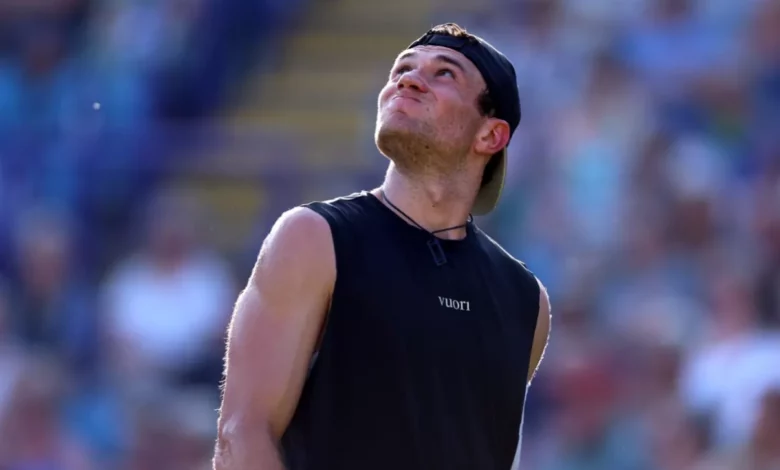
Jack Draper missed a crucial break point early in his Eastbourne International quarter-final against Gabriel Diallo, a moment that underlined the razor-thin margins of grass-court tennis. In a sport where a single point can shift momentum, break points are the most decisive—offering a player the chance to take an opponent’s service game and seize control of a set. For Draper, returning from long-term arm and knee injuries and building match fitness ahead of Wimbledon, converting such opportunities is essential. Yet when a delicate backhand dropshot presented him with a break point at 30-30 in the first game, the British No. 1 could not capitalise, netting the return.
The game had started with Diallo showing aggressive net play, moving forward to put away a winner. Draper responded instantly, drilling a backhand winner into the corner that drew ‘oohs’ from the Devonshire Park crowd. But Diallo soon faltered, netting a backhand to fall 15-30 behind, leaving Draper a double-break opportunity. The Briton could not control his backhand on the run, however, and the score returned to 30-30.
Draper then produced a moment of class—a delicate backhand dropshot executed with perfect timing and placement. The crowd applauded the shot, and it earned him a break point. But he spurned the chance, netting the backhand return. The game went back to deuce.
Draper misfired a forehand on the next point, yet Diallo failed to punish the loose ball. Instead, the Canadian found himself punished by a crisp backhand pass from Draper. Another break point appeared—and this time Draper took it, clinching the opening game.
The match, a quarter-final at the Rothesay International Eastbourne, is being played on outdoor grass at Devonshire Park Lawn Tennis Club. The ATP 250 event serves as one of the final preparation tournaments for Wimbledon, and both players are using it to fine-tune their games. Draper, who reached a career-high ranking of World No. 4 in June 2025, has slipped to No. 160 after a succession of injuries, including knee, hand, arm, thigh, hip and abdominal problems. He missed the Queen’s Club tournament because he was not match-fit, but has been working with Andy Murray as his coach for this grass-court campaign. Murray has praised Draper’s “tennis levels” and said he has “very few holes in his game.”
Draper reached this stage after winning his first two matches in straight sets—beating Marcos Giron 6-4, 7-6 and then fellow Briton Jack Pinnington Jones 7-5, 6-4. He is aiming to progress further than his previous Wimbledon performances, which saw him reach the second round in 2022, 2024 and 2025, and has received a wildcard for this year’s Championships.
Diallo, a 24-year-old from Montreal standing 6’8”, is ranked No. 91 and reached a career-high of No. 33. He won his first ATP Tour title in June 2025 at the ’s-Hertogenbosch tournament, beating Zizou Bergs in the final. His coach, Martin Laurendeau, describes the Canadian as “really dangerous on any surface” because of his power and big game—qualities that suit grass particularly well. Diallo reached the second round at Wimbledon in 2026 after competing in his first main draw the previous year, where he beat Daniel Altmaier before losing to Taylor Fritz. He entered the Eastbourne quarter-final after winning two three-set matches—against Tomas Martin Etcheverry (6-7, 6-3, 6-2) and Terence Atmane (6-7, 6-4, 7-5)—snapping a five-match losing streak.
The importance of break points in tennis cannot be overstated. They represent the most high-leverage moments of a match, where a single shot can decide a game and, often, a set. Against a player like Diallo, who possesses a big serve and powerful groundstrokes, Draper knows that opportunities to break are scarce. His inability to convert the first break point—after a dropshot that deserved to be the highlight of the game—could have proven costly. Instead, he regrouped, forcing another break point with a backhand pass and this time taking it.
The two players had never met in a professional match before, making this a first career encounter. Draper’s early break, secured after that backhand pass, gave him the immediate advantage—a small but significant step in his return to form. For Diallo, the missed chance at 30-30 will be a reminder of how quickly grass-court rallies can shift. Draper’s successful break, from deuce to conversion, showed the composure Murray has helped instil.