Number of climate-related lawsuits against datacentres climbs worldwide, research reveals

Datacentres and artificial intelligence are emerging as prime targets in a wave of environmental lawsuits across the globe, from Santiago to Dublin, according to the latest annual review of climate litigation by the London School of Economics (LSE). The analysis of roughly 3,600 climate-related cases filed since 2015 reveals a growing number of legal challenges that directly contest the energy sources, water consumption and air pollution generated by the facilities that power the digital economy.
Global trends in climate litigation
Climate litigation is surging worldwide. As of June 2025, the LSE’s Grantham Research Institute counted 3,099 cases filed across 55 national jurisdictions and 24 international or regional bodies, with the United States accounting for nearly 65% of the total. Although the rate of new filings slowed in 2024, more than 80% of cases are described as strategic — aimed at influencing policy and corporate behaviour. The target list is also expanding beyond traditional high‑emitting sectors: agriculture, food, retail and professional services are now in the firing line, with datacentres — driven by the explosion of AI — becoming a prominent focus.
Environmental toll of the datacentre boom
Much of the legal action stems from the enormous environmental footprint of datacentres, particularly their energy, water and air‑quality impacts. Global electricity consumption from datacentres stood at roughly 415 terawatt‑hours (TWh) in 2024 — about 1.5% of the world’s total — and is growing at 12% annually. By 2030, that share could reach 3%. AI is projected to account for nearly half of the net increase in datacentre electricity use between 2024 and 2030. AI‑specific servers consumed an estimated 53–76 TWh in 2024, a figure that could climb to 165–326 TWh by 2028. A single query on an advanced generative AI model uses nearly ten times the electricity of a conventional Google search.
Water consumption is equally stark. A medium‑sized datacentre can use up to 110 million gallons of water a year — equivalent to 1,000 households — while larger facilities can draw 5 million gallons a day, comparable to a town of 10,000 to 50,000 people. In the United States alone, datacentres consumed an estimated 17.4 billion gallons of water directly in 2023, with projections of 38 to 73 billion gallons by 2028. AI workloads could account for 200 billion gallons in 2025, rising to 600 billion gallons by 2030. Google has reported that 31% of its freshwater withdrawals in 2023 came from watersheds with medium or high water scarcity. Datacentres also consume water indirectly through electricity generation, especially from fossil‑fuel power plants.
Air pollution is another flashpoint. In Mississippi, the National Association for the Advancement of Colored People (NAACP) has sued Elon Musk’s xAI, alleging the company is violating the Clean Air Act by operating portable methane gas generators without permits. The lawsuit says the turbines emit toxic pollutants including nitrogen oxides and formaldehyde, posing serious public‑health risks to nearby Black and minority communities. Memphis, where the facility is located, is described as an “asthma capital”. The NAACP initially alleged 27 unpermitted turbines but later obtained emails indicating the number rose to 57, with another report stating 59. The US Department of Justice is attempting to block the lawsuit, arguing that xAI’s work is essential to national security and to the economy, including support for “the war against Iran”.
Country‑by‑country legal battles
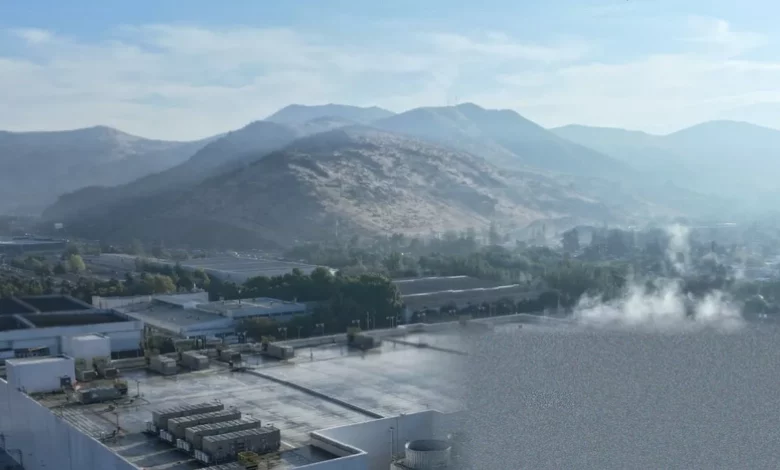
Chile saw one of the earliest datacentre‑related lawsuits in 2020. A group of residents and the local council in Santiago challenged permits granted to Google for a huge datacentre in the Cerrillos area, raising concerns about the impact on the city’s already climate‑stressed water supply. The lawsuit succeeded in halting the project on the grounds that climate impacts had not been properly considered, though it did not stop the wider expansion of datacentres that is draining Chile’s drought‑stricken wetlands.
Ireland is identified by the LSE as a “hotspot” for litigation. The government wants the sector to expand, even though datacentres already consume more than a fifth of the nation’s electricity — 21%, a figure projected to hit 32% by 2026. In December, Ireland’s Commission for the Regulation of Utilities (CRU) ruled that “large energy users” such as datacentres could operate on fossil fuels for the next six years, after which they must run on at least 80% renewables. Friends of the Irish Environment (FIE), Friends of the Earth Ireland and ClientEarth are seeking a judicial review of that decision, arguing it will lock Ireland into high‑emitting, expensive fossil gas and breaches the country’s Climate Action and Low Carbon Development Act 2015. The High Court has granted leave for the challenge, and the State has sought to join as a Notice Party, acknowledging the systemic implications. Separately, FIE has appealed the approval of a multi‑billion‑euro datacentre complex — the Herbata project — arguing it could jeopardise climate targets and undermine EU law. ClientEarth warns the project could set a dangerous precedent for Europe. A report commissioned by Friends of the Earth Ireland and Beyond Fossil Fuels found that the high energy demand of datacentres, coupled with reliance on fossil gas, increased household electricity bills by an estimated €715 million between 2015 and 2023 — an average of €360 per household, described as a “hidden data centre tax”.
In the United States, legal backlash is growing. In California, the city of Pittsburg now requires a datacentre to use renewable energy for power and recycled water for cooling. Litigation is ongoing in Georgia and Pennsylvania against state regulators for approving new fossil‑fuel infrastructure linked to datacentres. The Mississippi case against xAI remains active, with the DOJ intervening on national‑security grounds. Northern Virginia, a major datacentre hub, saw a 63% increase in datacentre water consumption between 2019 and 2023, reaching nearly 2 billion gallons in 2023.
In the United Kingdom, campaigners took legal action against the government’s decision to force through a “hyperscale” datacentre in Buckinghamshire. Tech‑justice non‑profit Foxglove and environmental charity Global Action Plan, represented by law firm Leigh Day, argued the decision ignored the project’s electricity and water demands and failed to consider its climate impacts. The government subsequently admitted to a “serious logical error” in its approval process and conceded the case. The developer, Greystoke, has since agreed that environmental mitigation measures must be made legally binding through a contract with the council, establishing a precedent for enforceable commitments from datacentre developers.
Litigation as a lever for change
The LSE report notes that cases in both the US and the UK demonstrate how litigation “can drive changes in climate‑related decision‑making even in the absence of positive judgments”. The Buckinghamshire case, for example, forced the full scale of environmental impacts to become public. The report’s co‑author, Joana Setzer, an associate professor at the LSE, emphasised that these cases are not necessarily about stopping development. “It is an opportunity to get these massively energy‑intensive developments powered by renewables at the moment in time where that is possible,” she said, pointing to the risk of locking in greater dependence on fossil fuels.