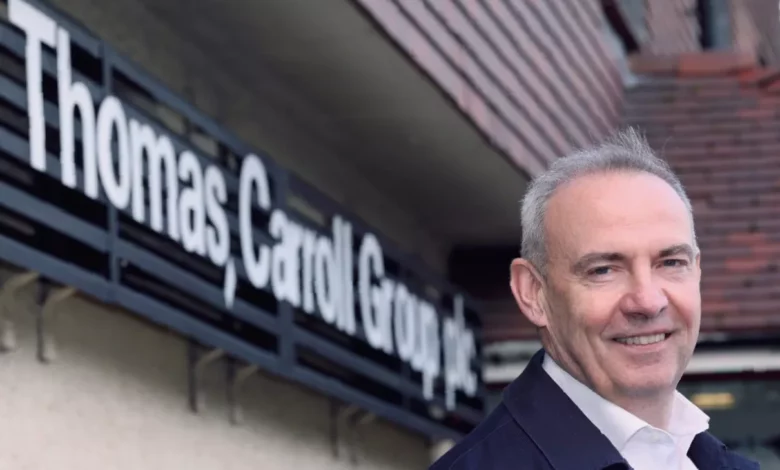
Thomas Carroll Group saw revenues climb 4% to more than £16.2 million in the year to the end of December 2025, the Caerphilly-based independent insurance, risk and insurtech business has reported. The growth, which lifted turnover from £15.6 million in 2024, was described as organic and was accompanied by a rise in headcount from 176 to 186 employees on average over the period.
The rise in revenue, while steady, did not translate into higher profit. Pre-tax profit fell from £1.6 million to £1.3 million as the group absorbed higher costs linked to its continued investment in people, infrastructure and growth initiatives, alongside inflationary cost pressures.
Investment programme weighs on profits
The reduction in profit before tax reflects a deliberate and significant investment programme, the company said, rather than any deterioration in underlying performance. Increased expenditure was driven by recruitment, capability development, office expansion and the scaling of its insurtech arm, TCi Futures, which was launched in 2021 to drive innovation in broker and embedded insurance markets.
The impact of the Employee Ownership Trust (EOT) structure, which the group adopted in December 2023, also provides important context. In 2024, the first full financial year as an EOT, reported profit had surged to £2.14 million from £454,000 in 2023. That leap was largely the result of an exceptional, non-recurring tax credit arising from the transition to employee ownership. Excluding that credit, underlying profit before tax in 2024 rose 76% year-on-year to £1.65 million. The 2025 figure of £1.3 million therefore represents a normalisation after the one-off boost, while still reflecting the costs of the group’s growth strategy.
Chief executive Rhys Thomas explained: “While profit before tax reduced during the year, this reflects a deliberate and significant investment programme that has been fully supported by our employee ownership trust structure. We are attractive to talented people because of the certainty of our future, our independence and our ability to remain in control of our own destiny.”
The group maintained a strong balance sheet, underlining its financial resilience and enabling it to continue self-funding its employee ownership journey, the company said. Thomas added: “These figures demonstrate that investment in people remains central to our strategy. We continue to prioritise capability development, retention and succession planning, recognising that the quality of advice we provide and the experience our clients receive are directly linked to our people.”
Regional expansion and long-term strategy
Alongside its financial results, the group provided details of a push to extend its footprint beyond its Welsh heartland. The most notable move was the opening of a Bristol office in May 2025, based at Aztec West and led by regional director Scott Levett, a Bristol native. The company described the South West of England as an “underserved” market and said capacity at the office was increased during the year to support expansion. The Bristol team includes a number of experienced hires, such as former Young Broker of the Year Callum Higgins, client director Chris Howard, account director George Souroullas and commercial account executive Shaun Briddon, among others.
In London, where Thomas Carroll has had a presence since 2015, further recruitment over the period led to a move into larger premises. The group first operated from a small office in Mayfair, later moved from Tower Hill to Berkeley Square, and now works from Fitzrovia. It has recently launched a dedicated business plan for high-net-worth individuals and created a London and Speciality Division, supported by the headquarters infrastructure near Cardiff.
Thomas Carroll, which was founded by Evan Thomas and Terry Carroll in 1972 and named Insurance Brokers of the Decade at the British Insurance Awards in 2014, also has offices in Swansea, Pembrokeshire, Hereford and Newport. The Hereford office, opened in 2014, has been described as successful.
The group’s independence is a central theme of its strategy, particularly against a backdrop of industry consolidation in which many competitors have been acquired by larger companies or private equity. The transition to employee ownership in 2023, under which 181 employees became co-owners, is intended to reinforce that independence while rewarding staff. Thomas was shortlisted for Employee Owner of the Year at the UK Employee Ownership Awards in November 2025.
The company has also divested its wealth management division, Thomas Carroll Independent Financial Advisers Limited (Thomas Carroll IFA), to Titan Wealth. The division managed more than £160 million in assets under advice for 450 clients. The move allows Thomas Carroll to concentrate on its core strengths in insurance, risk management, health & safety and employee benefits.
In terms of community and employee engagement, the group supports national charities, local food banks and community groups through fundraising and its own charitable trust, which directly assisted six individuals in 2024. Internal initiatives such as the Thomas Carroll Academy for employee development, the ‘TC&Me’ wellbeing platform and activities like the Welsh Three Peaks Challenge aim to foster engagement. A hybrid working policy is also in place.
Chief commercial officer Gareth Cotty has been a key figure in the EOT transition and strategic decisions. The transition was advised by Geldards solicitors, McTaggarts, Kilsby Williams, Azets and MHA. Thomas also noted that operational focus remains on efficiency, governance and regulatory compliance: “Our processes and controls evolve alongside the scale and complexity of the business.”