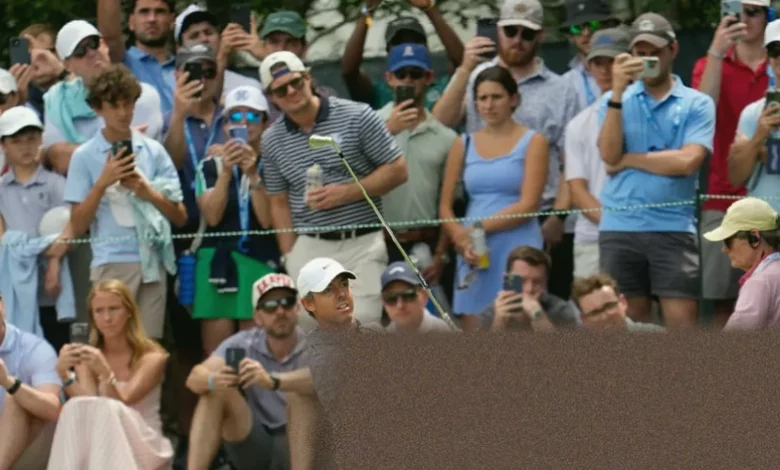
Rory McIlroy’s hopes of a weekend charge at the US Open unravelled on the back nine at Shinnecock Hills, a short missed putt on the 13th hole emblematic of a round that began with promise and ended in frustration. The Northern Irishman, who had reached three under par for the championship after a birdie on the eighth, dropped shots on four of his first seven holes on the inward half, including a par putt from close range that kissed the edge and stayed out at the 366-yard 13th.
McIlroy’s back-nine collapse
McIlroy had started the second round with the composure of a man who believed he could chase down Wyndham Clark’s lead. He found fairways, struck clean irons and holed a dead‑straight 18‑footer on the eighth to reach three under, prompting talk of an afternoon challenge. But the turning point arrived at the 10th, where a 338‑yard drive left him just 79 yards to the flag on a raised green. He thinned the ball, squealed “Oh no!” as it flew through the green, and what should have been a birdie chance became a scramble for par. He missed the par putt from 27 feet and took bogey. The 11th was no kinder: his approach pitched into the swale and left a 22‑footer that turned away from the hole in its final rolls. Another bogey. At the 12th, a short iron scuttled into “cabbagey” grass, and his third shot, struck hot from the thick stuff, left a 20‑foot putt that wobbled and lipped out. “Back when we played with a balata ball,” said commentator Wayne Riley, “Rory’s ball would now look like a Rubik’s cube.” His par putt on the 13th, from tap‑in range, missed. By the time he walked off the green, McIlroy was level par for the week, seven shots behind Clark.
The sequence echoed the difficulty that had already claimed playing partner Tommy Fleetwood. Fleetwood, who had bogeyed the par‑three second after missing the green, saved par from a “jumpy lie” in the fescue on the third and birdied the fifth, but he too struggled on the back nine, finding high grass on the 13th and swearing under his breath. Both men had earlier demonstrated the perils of the 10th green: after overshooting it into a depression that left the putting surface above their heads, McIlroy was bold and ran his putt 27 feet past, while Fleetwood was tentative and barely kept his ball on the green. Both made bogey.
Scheffler’s stubborn resilience
While McIlroy faltered, Scottie Scheffler once again demonstrated why he has not missed a cut since February 2024. The world number one appeared frustrated at almost every turn – television shots caught him grimacing after missed putts and a ruling on the 13th, where he crouched inside a greenside bunker seeking permission to remove a loose stone – and yet he remained at one over par for the week, just four back of second place. A 41‑foot birdie bomb on the 15th hole, his sixth of the day, briefly lifted him to one under for the round, but he could not follow it up, labouring to a par on the long 16th and failing to convert a 14‑footer on the 14th. His streak of resilience, however, kept him in the tournament. “No‑one would pretend he has looked good,” the coverage noted, “but he finds a way of hanging around.”
The brutal character of Shinnecock Hills
The difficulties faced by McIlroy and Scheffler were not isolated. Wyndham Clark’s seven‑under‑par total stood as an outlier, a performance so far ahead of the field that it defied the general experience of the course. The rest of the leaderboard told a story of attrition: only a handful of players broke par, and a forecast cutline of plus four (with a 62 per cent probability, according to Datagolf) underlined how many of the game’s biggest names were heading home. Bryson DeChambeau and Viktor Hovland sat at plus five; Shane Lowry, Jon Rahm and Patrick Cantlay at plus six; the defending champion, J.J. Spaun, at plus eight with 15 holes to play.
The challenge owed much to the character of Shinnecock Hills itself. Drone footage revealed the course’s extraordinary proximity to the sea – Shinnecock Bay, the Atlantic Ocean, Great Peconic Bay and Long Island Sound are all within sight – giving it the atmosphere of “Great Gatsby country”, as the location was described. The coastal setting, however, brought with it variable winds and humidity, conditions that Justin Rose, who shot a second‑round 70 to sit at plus one, said became “tougher when the sun comes out”. Rose, who managed only four and a half hours’ sleep before an early alarm, noted that the US Golf Association needed to “protect two holes out there” and expressed a desire for the course to remain difficult.
The greens, covered in Poa Annua grass, had become knobbly enough to cause multiple short‑missed putts. Max Greyserman three‑putted from inside four feet; McIlroy himself saw his par putt on the ninth slip by from five feet earlier in the round. Commentator Paul McGinley invoked the statistic of “bouncebackability” to describe the ability to recover from such setbacks, but for many players the recovery never came. Harry Higgs, a relatively unknown player with a CV that includes wins on secondary tours and a playoff defeat at the Myrtle Beach Classic, briefly surged into a tie for second after holing a 75‑foot putt from off the green on the par‑three 11th, but even he missed a four‑foot birdie try on the 13th.
The statistical backdrop added weight to the sense that Clark’s lead was formidable yet not unassailable. Twenty‑eight of the last 30 US Open champions were within three shots of the halfway lead, and 27 were within two. The two exceptions were five and six shots back – and one of those, Brooks Koepka at Shinnecock Hills in 2018, recovered from five strokes down. History offered a sliver of hope. But for McIlroy, who had bounced down the fairway on the ninth with a spring in his step, the back nine had become a Rubik’s cube he could not solve. His ball may not have looked like one – the modern ball is far more resilient than the old balata – but the outcome was the same: a scramble for control in a championship that was already slipping away.