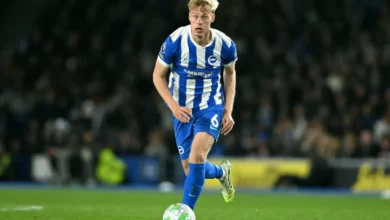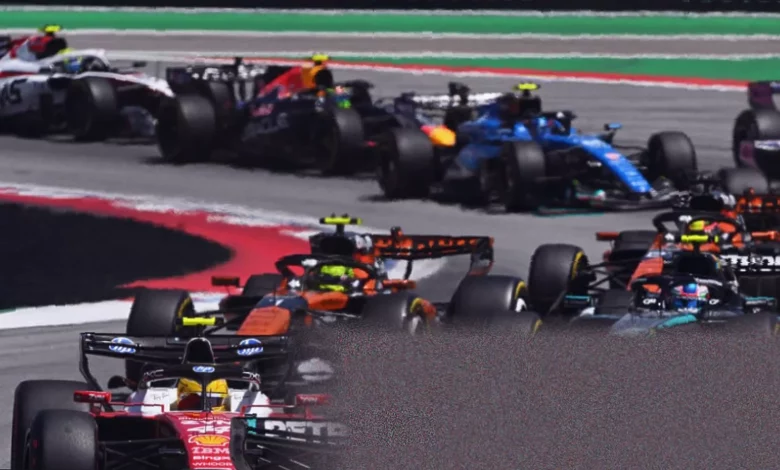
George Russell clung to the lead of the Spanish Grand Prix after repelling a determined attack from his Mercedes teammate Kimi Antonelli, the championship leader who had closed to within half a second before the Briton defended firmly into turn one. Antonelli, who leads the drivers’ standings by a commanding 66 points after five consecutive victories, was then urged by his race engineer to “let’s not take any risks” as the two Mercedes drivers briefly ran amicably out front. The duel set the stage for a high-stakes tactical battle that would ultimately be decided by tyre management and pit strategy on a scorching afternoon at the Circuit de Barcelona-Catalunya.
Battle for the lead
Antonelli had been gaining steadily on Russell in the laps leading up to their confrontation. By lap 30 he was on his final warning for track limits, a sign of the pressure he was applying. On lap 31 the gap was down to less than half a second. A lap later, with Carlos Sainz out of the way in front, Antonelli had a clear run at his teammate. He launched his first attack on the approach to turn one on lap 33, but Russell held firm, forcing Antonelli to back out and prepare another assault. The Italian was told over the radio to avoid taking risks, a reflection of Mercedes’ desire to secure a strong result for both cars.
The harmony was short-lived. On lap 35 the pair continued to circulate amicably, but by lap 36 Mercedes made the decisive call: they brought Russell in first for fresh tyres, leaving Antonelli on track. The move handed the effective lead to Antonelli, but it also set up a strategic game of cat and mouse that would define the remainder of the race. Russell, who had started from pole after declaring himself “back in my groove”, was clearly willing to fight hard for victory in what he described as his first grand prix win since the season opener in Australia.
Pit strategies and tactical gambles
All weekend the conversation had revolved around how to manage the extreme tyre degradation caused by track temperatures that exceeded 50°C during qualifying. Pirelli’s head of motorsport, Dario Marrafuschi, had predicted before the race that a two-stop strategy would be the minimum, with the best option believed to be medium-hard-hard, a first stop between laps 15 and 21 and a second between laps 38 and 44. The tyre supplier had brought softer compounds (C2, C3, C4) than in the previous season, and the rough Barcelona asphalt – second only to Bahrain in macro roughness – was punishing rubber even further.
The opening phase of the race saw Lewis Hamilton and Max Verstappen both start on soft tyres, a bold choice given the degradation. Verstappen’s softs failed to propel him forward from fifth, and by lap five he was not making ground on Lando Norris in fourth. Hamilton, starting second, also struggled to launch an early attack on Russell. The first round of pit stops began on lap 11 when both Verstappen and Hamilton came in – Verstappen taking mediums, Hamilton opting for hards. Ferrari then attempted to disrupt Russell’s rhythm by bringing Charles Leclerc in early, prompting Russell to respond on lap 13, switching his own mediums for hards and momentarily handing the lead to Antonelli.
The strategic chess continued. Ferrari told Hamilton on lap 21 that they were “on plan C”, a clear indication that their original strategy was unravelling. On lap 27 they committed to a three-stop strategy, calling Hamilton in for a second stop and fitting mediums. This followed Leclerc’s earlier decision to stay out an extra lap before pitting on lap 17, after which he emerged with a healthy gap over Oscar Piastri. Red Bull, meanwhile, kept Verstappen on a two-stop approach but recognised that Leclerc remained a threat, telling the Dutchman on lap 23 that the Ferrari driver was “still very much in our race”. Verstappen pitted again on lap 30, dropping him to seventh.
The undercut proved potent. By the time Russell was called in for his second stop on lap 36 – leaving Antonelli out – the gap between the teammates had been fluctuating as each tried to make their tyres last. Mercedes clearly hoped fresher rubber would give Russell the edge in the closing stages. Pirelli had noted that a three-stop strategy might be quicker for someone like Verstappen, but risked overheating soft tyres when overtaking late in the race – a dilemma that now faced several drivers as the sun continued to beat down.
Driver performance and notable battles
While the spotlight was on the Mercedes duo, several other drivers produced notable performances. Lewis Hamilton, second in the championship 66 points adrift of Antonelli, started on the front row but found himself slipping back before recovering. He passed Oscar Piastri on the outside on lap 29, avoiding a loitering Sergio Pérez in the process, and later let Leclerc by into fourth on lap 32 as part of Ferrari’s team orders. Hamilton had also set the fastest lap earlier in the race, underlining his pace despite the strategic confusion.
Charles Leclerc, who had crashed in Q3 and started tenth, made excellent progress. By lap three he was up to seventh after passing Piastri on the outside. He later led briefly during the pit stop sequence before being asked to let Hamilton past. Verstappen, a four-time world champion, endured a frustrating afternoon. His soft-tyre start failed to pay dividends and he spent much of the race stuck behind Norris before dropping further. His Red Bull teammate Isack Hadjar also had a mixed day, tumbling almost ten places on the first lap after a nightmare start before recovering to eighth by the halfway mark.
Further down the field, Fernando Alonso started from the pit lane after Aston Martin made power unit changes to his car, marking what is expected to be his final F1 race in Barcelona. The 44-year-old Spaniard, a two-time world champion with the most race starts in history, had described his car as “the worst car and the worst engine” after qualifying. He managed to pass Valtteri Bottas on lap 12 and later fell to the rear after being overtaken by Ollie Bearman. Alpine’s Pierre Gasly moved past Franco Colapinto on lap 20 under team orders, while Nico Hülkenberg came under investigation for an overtake on Arvid Lindblad that may have involved leaving the track. Both Williams cars were also under investigation for a start-line procedure, and Lance Stroll’s afternoon appeared to be over after he pitted early.
Aron Antonelli’s relentless rise continued to dominate the narrative off track. The 19-year-old Italian has become the youngest driver in history to achieve three consecutive Formula One wins, and with four poles and a 66-point lead, the championship already seems a formality. His teammate Russell, meanwhile, is third in the standings and admitted after qualifying that he had gone “back to basics” after a difficult run that included a penalty in Monaco. As the sun began to lower over the Catalan hills, the outcome of the Spanish Grand Prix remained in the balance – with tyre strategy, track position and raw nerve all poised to decide whether Russell could finally end Antonelli’s winning streak.