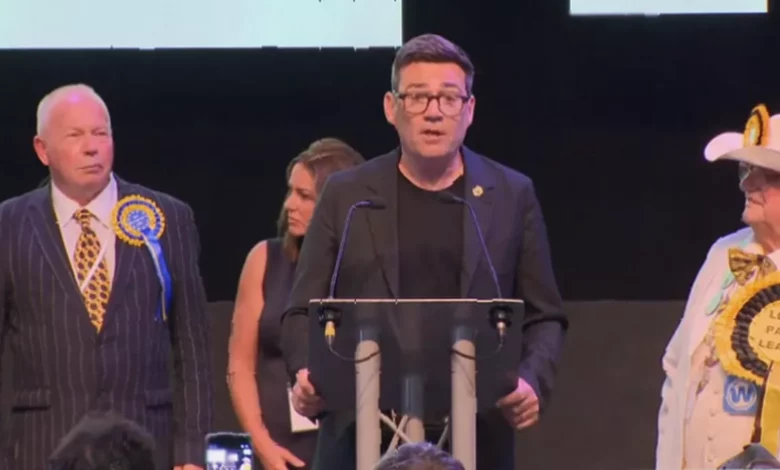
Andy Burnham was this evening declared the new MP for Makerfield, using his victory speech to issue a direct call for political change and national unity. “Everyone knows that politics isn’t working,” he told supporters, arguing that the result could mark a turning point for Britain. “Everyone can feel that the country isn’t where it should be. Tonight could be the turning point.”
The by-election victory hands Burnham a seat in the House of Commons for the first time since 2017, when he stood down as MP for Leigh to become Mayor of Greater Manchester—a role he has held since May 2017, securing re-election in 2021 and 2024. The contest in Makerfield was triggered by the resignation of the previous Labour MP, Josh Simons, who stepped aside to allow Burnham to run, a move widely seen as a strategic step enabling him to re-enter Parliament and potentially challenge for the Labour leadership.
Burnham won a commanding share of the vote. Labour secured 54.8%, with Reform UK trailing on 34.5%. Restore Britain took 6.8%, the Conservatives 2.2%, the Greens 0.7%, and the Liberal Democrats 0.4%. Turnout reached 58.75%, higher than the general election turnout in the constituency. Makerfield has been a Labour stronghold since its creation in 1983, formed from parts of other constituencies including Leigh, which Burnham previously represented. Its name derives from the suffix of towns such as Ashton-in-Makerfield, rather than a single town; the constituency’s electorate stood at approximately 76,517 voters as of 2023.
Burnham’s call for change was framed as a rebuke to the current political order. “People here have voted for change, they have voted for more power for the north and everywhere forgotten by Westminster,” he said. The result intensifies pressure on Labour leader Sir Keir Starmer, with the party described as divided and a number of MPs reportedly eager for a change at the top. Burnham has long been considered a potential successor to Starmer, having contested the Labour leadership in 2010 and 2015—finishing second to Jeremy Corbyn—and consistently registering higher public approval ratings than the current leader in some polls.
A pledge to put ‘place before party’
The most detailed commitment Burnham made in his victory speech was a pledge to “put place before party.” He vowed to represent all constituents regardless of how they voted and to focus on solving problems rather than engaging in political point-scoring. The phrase carries heavy implications for both his approach in Parliament and the direction of his wider political project.
For Burnham, “place” means a shift of power and funding away from Westminster towards cities and regions. His political philosophy—often described as “Manchesterism”—is built around investment in infrastructure, localism, and a less combative political culture. As Mayor of Greater Manchester, his record includes bringing buses under public control and pushing for improvements in public transport, housing and healthcare. He has consistently advocated for greater devolution, arguing that decisions affecting communities should be taken closer to them.

The promise to put place before party also signals a deliberate attempt to break with the adversarial style that has characterised British politics in recent years. Burnham, who identifies as a socialist and is associated with the soft left of the Labour Party, has built his career around a platform of regional rebalancing. He argues that many parts of the country have been neglected by successive governments in London, and that the only way to restore trust in politics is to deliver tangible change on the ground—whether through better transport links, more affordable housing, or improved public services.
If Burnham were to become Labour leader and later Prime Minister, his government would likely prioritise regional growth, increased public investment, and a more active state, potentially funded by higher taxes on wealth and property. His economic approach is seen as being to the left of the current government, with a greater openness to borrowing for capital projects. The Makerfield result, Burnham said, represented “Labour’s final chance to change,” adding: “From here on I will give everything I have got to make it so. To ensure the name Makerfield is forever synonymous with bringing about the change this country needs.”
The by-election also exposed the limits of Reform UK’s advance. The party had targeted Makerfield as one of its key seats, but despite a significant vote share of 34.5%, it failed to unseat Labour. The Conservatives came a distant fourth with just 2.2%, a sign of the party’s continued struggles in former northern strongholds. The higher-than-general-election turnout—58.75%—suggested unusual levels of voter engagement, likely driven by the national significance of the contest.
Burnham’s victory speech thanked election staff, fellow candidates and voters. He repeated the line that “everyone knows that politics isn’t working,” and declared the result could be a turning point. The pledge to put place before party, if honoured, would represent a fundamental reordering of political loyalties—one that could reshape not only the Labour Party but the broader landscape of British politics.