England’s World Cup preparations suffered an extraordinary setback in Kansas City this week when a shipment of match boots belonging to key players including Harry Kane and Jude Bellingham was stolen during transit, leaving the Football Association to scramble for replacements and local police to launch an investigation. The theft is believed to have occurred as the squad’s equipment was being moved from its pre-tournament base in Florida to the training camp at Swope Soccer Village in Missouri. Two suspects have been apprehended, but with only a single football reportedly left from the stolen shipment, manager Thomas Tuchel now faces the unlikely prospect of his side taking on Croatia barefoot if the missing gear cannot be recovered.
Fan fever and the Doomscroll World Cup
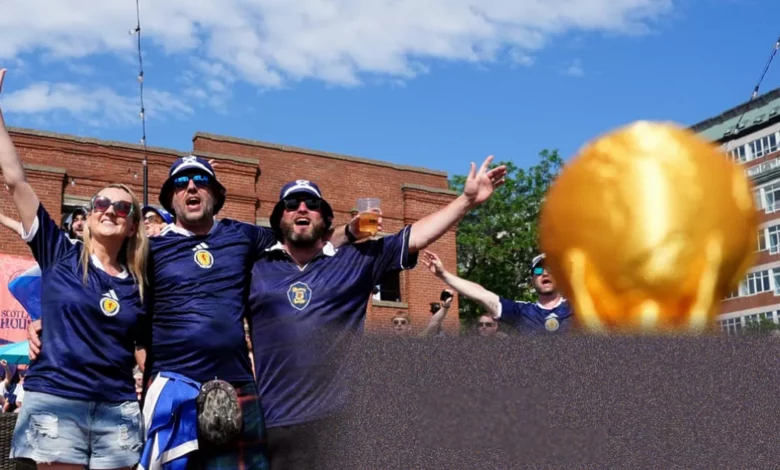
For Scotland fans, the tournament has already delivered a kind of chaos they have waited 28 years to experience. Photographs from Boston show raucous parties at Scotland House, where supporters have embraced the occasion with the kind of enthusiasm that only a first World Cup since 1998 can produce. Bars are serving free Irn-Bru-infused “fiery ginger” beers to patrons with red hair, Scottish whisky firms have collaborated with a Brazilian distiller, and nightclubs have been repurposed as all-night fanzones. “It’s lovely to read and hear about how kids in Scotland are having sleepover parties to stay up for the 2am kick-off,” wrote one fan, Hyndsight2, in a message that recalled the excitement of a first World Cup in 1974. Others, however, are already voicing unease about the tournament itself. The same blog that tracked Scotland’s celebrations also carried a reader’s complaint that the expanded group stages have been “reduced to almost meaningless exhibition games”, with the four‑quarter format, drinks breaks for adverts and a 45‑minute half‑time in the final eroding the sport’s traditional rhythm. “It’s like someone stole our ball and now we won’t ever get it back,” the email added. That sentiment—the sense of a World Cup that is at once exhilarating and grotesque—has been a recurring theme. “It’s the Doomscroll World Cup,” one reporter wrote: bombastic visuals, dramatic comebacks, red cards handed out like sweeties, and a political backdrop so lurid that tuning out seems the only sane option.
Base camp Kansas City
Kansas City, which calls itself the “Soccer Capital of America”, has become the unlikely epicentre of the tournament after stepping in to host matches following Chicago’s withdrawal. The city has invested almost $700 million (£522m) in infrastructure, including new bus services, streetcar extensions and upgraded public safety measures, and expects more than 650,000 visitors and over $650 million in economic activity. Four nations have chosen Kansas City as their base: England, Argentina, the Netherlands and Algeria. England’s team is staying at the Inn at Meadowbrook in Prairie Village, Kansas, a 54‑room hotel described by Tuchel as an “intimate” home away from home. The squad will train at Swope Soccer Village, home of Sporting Kansas City’s second team. Local amenities—including the Market at Meadowbrook cafe and Verbena restaurant—will close during England’s stay, and a no‑fly zone for drones has been established around the hotel, with drone‑jamming technology on standby. “We are delighted to welcome England,” said Pam Kramer, chief executive of KC2026. “The arrival of one of the world’s most followed national teams is a significant moment for our city. England’s decision to base themselves in Kansas City reflects our passionate sports culture, our spirit of hospitality and the world‑class facilities that define our region.” For Scotland, the base is Boston, where the team will face Haiti in their opening Group C match. Haiti, making their first World Cup appearance in 52 years, are considered underdogs but possess dangerous attacking players such as Duckens Nazon and Sunderland’s Wilson Isidor. Scotland, who warmed up with friendly wins over Curaçao and Bolivia scoring eight goals, are favourites—though as one analyst noted, “it’s always hard to judge a team by warm‑up matches.”
Players of note: names, stories and injury setbacks
The tournament has thrown up a gallery of memorable names. Iain Pearson, a commentator, pointed to South Africa’s “poetic names that roll nicely off the tongue”, singling out Mbekezeli Mbokazi for alliteration and Kamogelo Sebelebele for what he called “one of the world’s great surnames”. Duckens Nazon, the Haiti forward who has played for Kerala Blasters, Oldham and CSKA Sofia, has been nominated as the player with the best name and CV at the World Cup. England‑born Folarin Balogun opened his account with two goals for the United States in their 4‑1 victory over Paraguay—a performance that prompted the observation that English‑trained strikers are already making an impact. Balogun, raised in London and developed at Arsenal, now plays his club football for Monaco. Brazil, meanwhile, will be without Real Madrid winger Rodrygo, who sustained a torn anterior cruciate ligament and meniscus in March. He has written about the “immense sadness” of missing the tournament, but plans to travel to the US to support the Seleção. “I have pride in Brazil and belief that the team can do something special,” he said.
The politics of the beautiful game
No World Cup in recent memory has arrived wrapped in so much geopolitical tension, and the 2026 edition has made little effort to disguise it. From the opening ceremony—a Hollywood‑style spectacle at SoFi Stadium featuring Katy Perry, Future, Anitta, LISA, Rema and Tyla, with parallel ceremonies in Mexico City and Toronto—to the relentless cycle of controversy, the tournament feels as much a stage for power struggles as for football. The treatment of Somali referee Omar Abdulkadir Artan has become a cause célèbre. Artan, named Africa’s best male referee in 2025, was denied entry to the United States after an 11‑hour interrogation in Miami, reportedly over suspected ties to a Somali militant group. FIFA confirmed he would be unable to officiate, stating that host governments ultimately determine visa and entry decisions. Artan received a hero’s welcome upon returning to Somalia. Iran’s participation has been equally fraught. The team threatened to boycott the tournament amid ongoing conflict with the United States and Israel; many of their backroom staff were denied visas, and the squad moved its base camp from Arizona to Mexico over security concerns. Kylian Mbappé has emerged as the latest in a distinguished line of French players to take on the far right. Zinedine Zidane famously called on voters to reject Jean‑Marie Le Pen in the 2002 presidential election, describing his party as one “which does not correspond to France’s values”. Lilian Thuram was even more vocal, repeatedly attacking Le Pen over his attacks on the national team’s diverse origins. Mbappé’s stance echoes that legacy. Off the pitch, FIFA’s dynamic pricing strategy for tickets has drawn widespread criticism, with some match prices reaching levels that effectively exclude ordinary fans, prompting investigations into alleged misleading sales. Concerns have also been raised about limited public transit access to some US venues, extreme heat and its environmental impact, and labour and security rights in host cities. “After Russia and Qatar, and with Saudi Arabia 2034 to come, it may be that this is now the rule, not the exception,” one observer noted. For many, the question is not whether the World Cup can remain apolitical—it never could—but how much politics a fan can stomach before the Beautiful Game becomes the Doomscroll Game.
Rule changes: from hair‑pulling to mistaken identity
The tournament has already seen the first application of the International Football Association Board’s “mistaken identity” rule change, a VAR protocol that allows cards issued to the wrong player to be corrected. It was used in USA’s opener against Paraguay, when US defender Tim Ream—at 38, the oldest US men’s player ever to appear at a World Cup—was initially shown a yellow card before VAR intervened to book Paraguay’s Miguel Almirón for simulation. The Premier League, meanwhile, has issued a significant clarification on hair‑pulling. The league said in a statement that a red card will apply only where hair‑pulling is carried out with “excessive force and/or brutality”; deliberate but less forceful incidents will be punished with a yellow. The change follows a spate of red cards last season—Manchester United’s Lisandro Martínez, Everton’s Michael Keane and Sunderland’s Dan Ballard were all sent off for pulling an opponent’s hair, decisions that many felt were harsh. “Always found the immediate dismissal for a hair pull odd,” one blog comment noted. “It is difficult to prove intent on some of them, often looking like an accident when challenging for a ball.” The Premier League also said referees will be more closely scrutinising holding offences and will place greater emphasis on protecting goalkeepers, penalising players who initiate contact without a genuine attempt to play the ball if it affects the keeper’s ability to challenge. As one reader put it, “it’s like someone stole our ball and now we won’t ever get it back”—but the rulebook, at least, is being rewritten.