eyeo, a Dutch imaging startup, has raised €40 million in Series A funding to commercialise a nanophotonic colour-splitting technology that it says can recover the 70% of light every conventional image sensor currently throws away. The round, led by Innovation Industries, brings the company’s total funding to €55 million and will pay for its first full in-house chip design team as it moves towards launch.
How nanophotonic chips split light instead of filtering it
Traditional image sensors depend on colour filters that have not changed in 50 years. Each pixel is covered with a filter that allows only red, green or blue wavelengths to reach it while blocking everything else. The result is that around 70% of the available light never reaches the chip — a fundamental limit that every smartphone, autonomous vehicle, XR headset and industrial camera currently accepts.
eyeo’s approach is fundamentally different: its nanophotonic colour-splitting platform (known as NCOS®) physically separates light by wavelength rather than filtering it. A photonic structure on the chip captures incoming photons and guides them through a waveguide, where the wavelengths are separated and each colour is directed to the correct pixel. This method, the company says, delivers three times the light sensitivity of standard sensors, enables pixels smaller than 0.5 microns, and provides true colour accuracy without the extra processing needed by software-based solutions.
The technology is the result of seven years of development at imec, the Belgian semiconductor research institute, and is protected by 26 patents. Crucially, it is designed to work with existing CMOS sensor platforms, meaning manufacturers do not have to redesign their products to use it — the nanophotonic layer can be integrated into the same fabrication processes already validated at a commercial foundry.
Jeroen Hoet, eyeo’s chief executive, said the idea took shape when he met the technology’s inventor at imec. He spent a year at the institute as an entrepreneur-in-residence, building the founding team and testing early customer interest before formally launching the spin-out with co-founders Gerd Van den Branden, Alden Carracillo and Jan Genoe.
Funding and the problem it solves
The €40 million Series A was led by Innovation Industries, a deep-tech venture capital fund that has raised substantial backing from Dutch pension funds. Existing investors imec.xpand, Invest-NL Deep Tech Fund, QBIC fund, High-Tech Gründerfonds (HTGF) and Brabant Development Agency also participated. The round also benefits from support under the European Union’s InvestEU programme. eyeo had previously raised €15 million in seed funding in May 2025.
“Every modern device that sees the world — from smartphones to autonomous systems — is held back by the same 50-year-old constraint. eyeo removes it at the source,” Hoet told Tech Funding News. He contrasted eyeo’s hardware approach with software-based alternatives, which he said increase power consumption, reduce quality and face resistance from the market because they require changes to the image processing pipeline. “We are the only ones who, in hardware directly inside the chip, have completely removed the colour filters,” he said.
Nard Sinteni, partner at Innovation Industries, said: “eyeo is delivering the kind of foundational breakthrough that redefines an entire category. This is a powerful example of deep-tech innovation driving real structural progress in semiconductors, with implications that extend across the broader technology ecosystem.”
Market and future plans
The global imaging sensor market is valued at around $20.66 billion in 2024 and projected to reach $29.62 billion by 2029, according to recent market estimates. Some forecasts put the figure as high as $45.54 billion by 2031. Approximately seven billion image sensors are shipped every year for smartphones, autonomous vehicles, XR headsets, industrial machines and smart city infrastructure.
eyeo’s technology takes aim at a market still dominated by traditional colour filter designs from established makers such as Sony, Samsung and OmniVision. The startup identifies competitors including Admiral, AdSorcery, Invisit and Alarum Technologies, while noting that alternative approaches such as AI-enhanced processing from companies like Glass Imaging, or Foveon X3 sensors, address the same problem from different angles.
Hoet said eyeo is already working with “top customers” in smart city, industrial, XR and mobile markets, although it is not yet naming them. The company plans to release an evaluation kit to select customers after summer 2025 and aims to launch its first commercial product by late 2025 or early 2026.
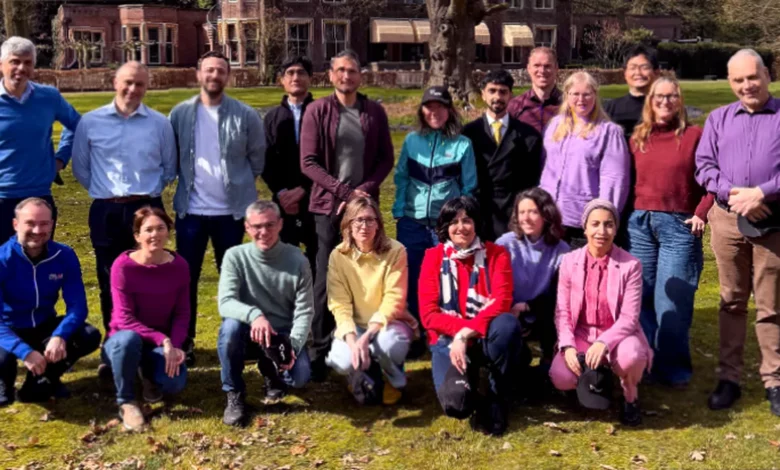
The Series A funds will be used to expand eyeo’s integrated circuit and system architecture team at its sensor design centre in Antwerp, develop next-generation 3D-stacked CMOS image sensors, and build commercial partnerships with original equipment manufacturers worldwide. Since its launch 18 months ago, eyeo has grown from four to 19 employees and expects to triple its workforce over the next two years. Hoet noted that the team is roughly half male and half female, drawn from about ten different nationalities. “The best people mean a combination of expertise and different perspectives — gender, backgrounds, ethnicities. That’s when you come to the best possible solutions,” he said.
eyeo chose to base its headquarters in Eindhoven in the Netherlands’ Brainport region, a hub for photonics and semiconductor expertise that is also home to industry giants such as ASML, NXP and ASM. The Dutch deep-tech ecosystem, the company said, offers a collaborative “quadruple helix” of knowledge institutions, industry, government and society that supports long-cycle hardware innovation.