Google Search now requires explicit user consent before it can function, a shift that places data privacy decisions directly into the hands of the individual. The change means that anyone using the site’s search feature must first click ‘Allow and Continue’ to load Google Custom Search, which may deploy cookies or similar technologies. Without that consent, the search box remains inactive, illustrating the growing regulatory and consumer pressure on technology companies to make data collection transparent and optional.
How consent works and why it matters
Consent in this context is not a blanket permission but a granular choice tied to a specific service. The user is asked to authorise the loading of Google Custom Search, and the technology may then use cookies or analogous tracking tools. This opt-in mechanism aligns with broader data protection principles that require a clear, affirmative act before personal information can be processed. The significance of the change lies in its visibility: rather than assuming consent through continued use of the website, the user must actively grant it. The same principle of informed choice is increasingly being applied in other sectors. The Competition and Markets Authority (CMA), for example, has pushed for greater transparency in the fuel retail market, where drivers currently face wide local price variations and potential savings of up to £9 on a tank if they “shop around.” Just as Google is now requiring a deliberate click to enable search, the government’s forthcoming Fuel Finder scheme will give motorists the ability to compare real-time fuel prices via apps and websites, a move that depends on retailers providing accurate data and consumers actively choosing to use the tool.
The search feature and its wider context
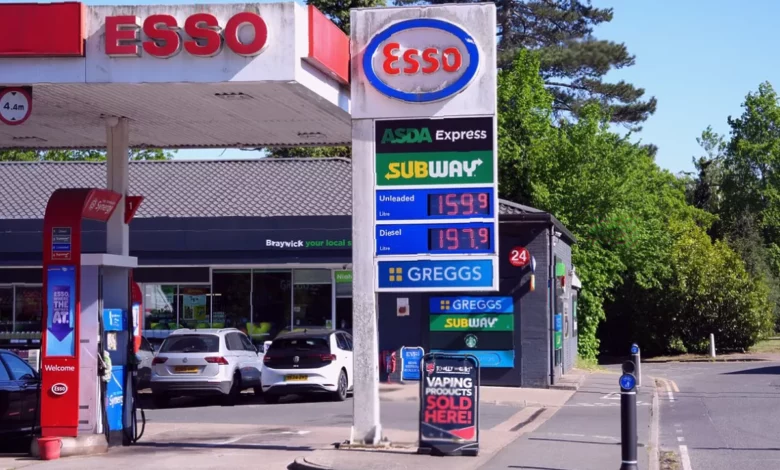
The search feature itself, once consent is given, operates as a customised gateway to web results. The requirement to enable it through a consent step is a practical response to evolving legal standards and user expectations around tracking. Yet the most striking parallel between this digital consent environment and the real-world economy can be seen in the current fuel price crisis, where the primary driver of rising costs is not retail behaviour but the elevated price of crude oil. Geopolitical events in the Middle East, particularly Iran’s actions regarding the Strait of Hormuz, have sent Brent crude surging past $100 a barrel and at times above $120. Supply chain concerns and geopolitical risk premiums have driven wholesale costs sharply higher, and the effect has been direct: average petrol prices rose by 16% between February 28 and April 2026, reaching 153.7p per litre, while diesel jumped 29% to 184.2p per litre. That increase in fuel costs was the greatest contributor to the UK’s Consumer Prices Index (CPI) inflation rising to 3.3% in March 2026, feeding directly into the cost of living and higher operational costs for businesses reliant on transport or energy-intensive production.
The CMA’s monitoring reports have found that, on average, retailer fuel margins have remained “broadly unchanged” since the start of the Middle East conflict in late February 2026, similar to the average seen throughout 2025. However, the watchdog has observed increased margins for a “minority of retailers” in March 2026 and is investigating those instances. Despite the recent stability, fuel margins remain at “historically high levels,” raising concerns about a “lack of effective competitive pressure” in the fuel retail market, a problem the CMA first flagged in its 2023 road fuel market study. The government’s Fuel Finder scheme, to be enforced by the CMA, is designed to address this by encouraging competition through price transparency. Drivers will be able to use apps and websites that display live pump prices, enabling them to make an informed choice about where to fill up. The scheme mirrors the consent model in that it hands the consumer the tool to decide, provided the underlying data is shared.
Privacy and the trade-off between data and transparency
The privacy implications of the Google Search consent requirement are clearly spelled out in the website’s privacy policy, which the user is invited to consult before making their decision. The use of cookies or similar technologies by Google Custom Search means that data about search queries and user behaviour could be collected, stored, and potentially shared. For the individual, the choice is whether the convenience of an instant search is worth the privacy cost. This trade-off is not dissimilar to the one facing motorists in the fuel market, where the promise of lower prices via the Fuel Finder scheme depends on the collection and sharing of location and pricing data. The CMA will enforce retailer compliance, but the scheme’s success rests on public willingness to use the apps and share the information that makes the system work.
Beyond the digital consent issue, the broader fuel price story is shaped by several structural factors. Fuel duty currently stands at 52.95 pence per litre for petrol and diesel, a rate frozen since 2011-12, with a temporary 5p cut introduced in 2022-23 extended until the end of August 2026. The government has cancelled the planned inflation-linked increase for 2026-27 and will gradually return rates to early 2022 levels by March 2027. These measures are expected to save the average motorist over £90. VAT at 20% is applied to both the pre-tax price and the fuel duty, meaning that taxes constitute a significant portion of the pump price. Wholesale fuel costs, which are influenced by crude oil prices and refining costs, typically take 10 to 14 days to feed through to the pump, a lag that has contributed to the “rocket and feather” effect. The RAC has noted that pump prices have fallen more slowly than wholesale prices in recent weeks, even after a temporary ceasefire in the Middle East led to a retreat in wholesale costs from their peaks.
The government has also extended a rural fuel duty relief scheme that provides a 5p-a-litre reduction for registered retailers in certain remote communities. On the broader energy front, Ofgem’s energy price cap for April-June 2026 is set at £1,641 per year for a typical household, a decrease of 6.6% from the previous quarter, partly because the government is funding environmental and social schemes through general taxation from April 2026, saving customers an average of £150. Meanwhile, the government is implementing measures to reduce the influence of volatile global gas prices on electricity prices, including increasing the “electricity generator levy” and encouraging long-term fixed-price contracts for renewables.
The interaction between digital consent and economic transparency is not coincidental. Both the Google Search change and the Fuel Finder scheme represent a shift toward empowering the individual to control their experience, whether by granting or withholding permission to be tracked or by comparing prices to secure a better deal. The CMA’s role in enforcing compliance with the Fuel Finder scheme underlines the institutional weight behind such consumer rights. The cost of ignoring these shifts is visible in the price data: for diesel, the average pump price in April 2026 stood at 184.2p per litre, a 29% increase since late February, while supermarket prices remain lower than other retailers, with a gap that has widened in recent weeks. The choice, whether in a search box or at a petrol station, increasingly belongs to the user.