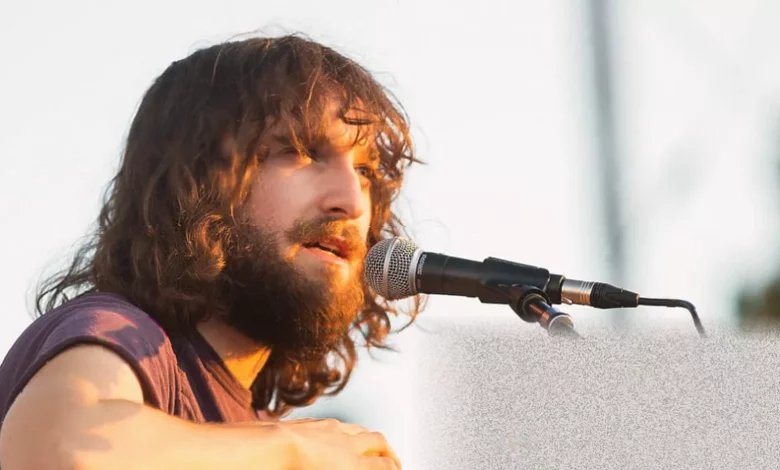
On a Halloween night in 2022, singer-songwriter Angelo De Augustine was at home in Los Angeles when his body suddenly gave way. Overcome by strange and alarming sensations, he collapsed. “I lost control of my body,” the 33-year-old recalls. Had he been alone, the story might have ended there, but family members rushed him to hospital where he would spend days undergoing a battery of inconclusive tests.
Conscious yet critically impaired, he describes a terrifying limbo. “I couldn’t hear, I couldn’t see well and I couldn’t really move,” he says. Despite exhaustive exploration, doctors could offer no concrete diagnosis. Their parting advice, as De Augustine remembers it, was stark: “Come back if you go completely deaf or blind.” Sent home reeling and semi-incapacitated, he was consumed by one thought: to finish the album he had been working on for the past year. “Nobody was helping and I didn’t think I would survive the illness,” he admits. “I wanted to get it finished and then thought I was probably gonna die.”
The Long Road Back
That album, Toil and Trouble, was released in 2023, a feat De Augustine now says he pushed through “way too much” to complete. What followed was a gruelling, three-year process of physical and mental recovery where he had to relearn how to walk, talk, hear, play, and sing. The experience was, he suggests, likely rooted in a overwhelmed nervous system. “Sometimes when somebody is under a great deal of chronic fear and stress for a very long time they can go past the allostatic load: the nervous system’s ability to self-regulate,” he explains. “The brain tries to protect itself, so it sends all these strange symptoms to your body. I felt like my whole body was shutting down.”
His rehabilitation was a painstaking recalibration. He returned to live with his mother, the professional vocalist Wendy Fraser—known for her work on the Dirty Dancing soundtrack—because he couldn’t perform basic tasks like making dinner. Progress was erratic: “Stop. Start. Get a little better, get a little worse.” A breakthrough came with joining a local spa. “I realised that when I was in water, the symptoms went away,” he says, “which was the start of realising just how stressed I’d been.”
He also committed to a daily programme of physical and mental exercises, prompting a “slow but upward trend.” The regimen, he says, taught him to “retrain the parts of my brain where wires had become crossed.” For a long time, even playing guitar felt wrong, but gradually the connection returned. This hard-won healing forms the core of his forthcoming album, Angel in Plainclothes, set for release on 24 April 2026.
A Collaborative Rebirth
Where De Augustine had typically crafted his albums alone—playing and engineering everything himself—his compromised health forced a new, collaborative approach. For Angel in Plainclothes, he brought in string arranger Oliver Hill, harpist Leng Bian, and pianist Thomas Bartlett (AKA Doveman), who also produced De Augustine’s 2019 album Tomb. His mother contributed percussion. LA musician and producer Jonathan Wilson provided drums and his Topanga Canyon studio for the track “The Cure,” a song drawing parallels between illness and addiction, and has since become a friend.
The album’s ethereal sound is further textured by an array of antique instruments: a bowed psaltery and aquarion, a Marxophone, a bass recorder, a train whistle, a 1960s German guitaret, a miniature accordion, and a 1990s synthesiser version of a Japanese koto harp. De Augustine, an enthusiast for unusual sounds, speaks with palpable excitement about recent finds, like a civil war-era pump organ that fits in a suitcase.
Thematically, the record is filled with reflections on life’s transience and second chances. The opening elegy “Empty Shell” poses the question: “Where do you run when your life’s on the line?” The lead single “Mirror Mirror” is described as a psychedelic country track employing sound layering and tape machine varispeed, a departure from his simpler past work. In it, he looks at his reflection but doesn’t see himself, a metaphor for feeling like a ghost. Another track, “Spirit of the Unknown,” wistfully recalls simple joys like “apples on the tree.”
Finding a New Self
De Augustine’s musical journey began after an early aspiration to be a professional footballer was ended by injury. His self-released debut, Spirals of Silence, arrived in 2014, followed by Swim Inside the Moon on Sufjan Stevens’ label Asthmatic Kitty in 2017. The collaborative album A Beginner’s Mind with Stevens in 2021 brought critical acclaim, and the song “Time” from Tomb later found mass exposure in Zach Braff’s 2023 film A Good Person, soaring to over 31 million streams—a success he was too ill to capitalise on at the time.
Now, slowly rebuilding his career, he has tentatively returned to performing, playing his first full-band show in five years in late 2025. He is scheduled to embark on his first US tour in seven years in May 2026, with dates in California, Oregon, and Washington. He describes his current state as a cross between “something like my old self” and a fundamentally changed person. “I’m just really trying to find myself again,” he says. “For so long, my only focus was trying to be a great songwriter and perhaps I paid the price for that. Now I’d rather not have tried so hard. I just want to live a good life.”