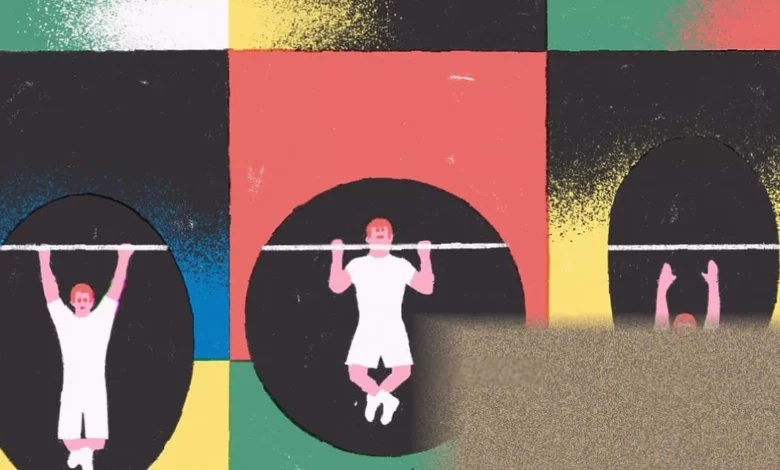
Pull-ups are a challenging yet rewarding fitness goal. From the US presidential fitness test — which required public middle and high school students to perform them between 1966 and 2013 and which Donald Trump has considered reinstating — to the UK Royal Marines, who demand a minimum of three to four pull-ups from prospective recruits, the exercise has long served as a benchmark of upper-body strength. There are no definitive figures on how many adults can actually perform one properly, but two things are widely agreed: they are extremely difficult and, when executed cleanly, they look impressive.
What is a pull-up?
A pull-up begins with a dead hang: arms fully extended, feet off the ground, gripping an overhead bar. From that position, the individual pulls their body upward until their chin clears the bar, then lowers themselves back down with control. “Done well, it’s a controlled, deliberate movement,” says Emily Schofield, a certified personal trainer at Ultimate Performance. “There’s no kicking, jerking or relying on momentum.” She adds that many newcomers instinctively try to use their arms too much, but the prime mover should be the latissimus dorsi — the large, fan-shaped muscles that run from the lower back to below the shoulder blades. The trapezius, which stretches from the neck to the mid-back, also plays a key role, along with the shoulders, forearms, biceps, triceps and abdominal muscles.
Benefits of pull-ups
Pull-ups build upper-body strength, particularly in the back, says Mathew Forzaglia, a certified personal trainer and founder of Forzag Fitness. The Cleveland Clinic lists the latissimus dorsi and trapezius as the muscles most engaged by the exercise. Forzaglia also notes that pull-ups develop core stability — preventing the body from swaying during consecutive reps — and improve grip strength. Beyond the obvious gym appeal, Schofield says pull-ups enhance functional strength by forcing the body to work as a single unit, improving coordination, neuromuscular control and posture, as well as boosting performance on other lifts and creating a more balanced physique.
Age and gender should not be considered barriers, Schofield stresses. “Many women instantly dismiss the idea they’ll ever be strong enough to perform a pull-up,” she says, but she points to one client in her 70s who can complete a full set of eight pull-ups “with greater strength and control than people half her age.” However, she warns that those with shoulder injuries, elbow pain or any upper-body joint issue should prioritise rehab and strengthening work before attempting the exercise.
How to achieve a pull-up
Jumping straight onto the bar is one of the most common mistakes, Schofield says. Most people need to build a base of strength first by targeting the muscles required. Recommended exercises include lat pulldowns, bent-over dumbbell rows, single-arm dumbbell rows, wide upright rows and shoulder shrugs. Forzaglia also recommends inverted rows using TRX straps or a barbell set up in a squat rack, which “helps build the foundational pulling strength needed to progress.”
Even if a full pull-up is out of reach, time spent on the bar is valuable. Schofield suggests attempting partial reps, holding the top position, or controlling the lowering phase — all of which teach the body how to coordinate the movement. Progress can be slow, regardless of gender. Countless programmes claim to teach a pull-up in 30 days, but achieving one depends on baseline fitness, bodyweight and physical build. While the exercises listed above are relatively safe, Schofield advises working with a certified personal trainer for personalised guidance and encouragement. “Because pull-ups are difficult, people tend to avoid them when they struggle,” she says. “But that’s exactly when they should practice them the most. The key is to practice, practice, practice.”