Conceptions among women over 40 in England and Wales have reached a record high, according to the latest figures from the Office for National Statistics (ONS). In 2023, there were 36,085 conceptions in this age group, equivalent to a rate of 17.6 per 1,000 women — surpassing the previous record of 17.3 per 1,000 set in 2021. The ONS said rates among the over-40s have increased by almost a third since 2010, when the figure stood at 13.4 per 1,000.
Of those 36,085 conceptions, 22,365 led to maternities — which covers the birth of live-born and stillborn children — while 13,725 ended in abortion. The proportion of conceptions ending in abortion among women aged over 40 has risen sharply over the past decade, from 28.3% in 2013 to 38.0% in 2023.
Across all age groups, total conceptions in England and Wales in 2023 stood at 871,050, a rate of 72.7 per 1,000 women — the highest since 2018 and the third consecutive annual increase. Women aged 30 to 34 had the highest number of conceptions for the seventh year running (260,810) and the highest conception rate at 118.9 per 1,000 women. This age group also recorded the lowest percentage of conceptions ending in abortion, at 22.4% (58,335).
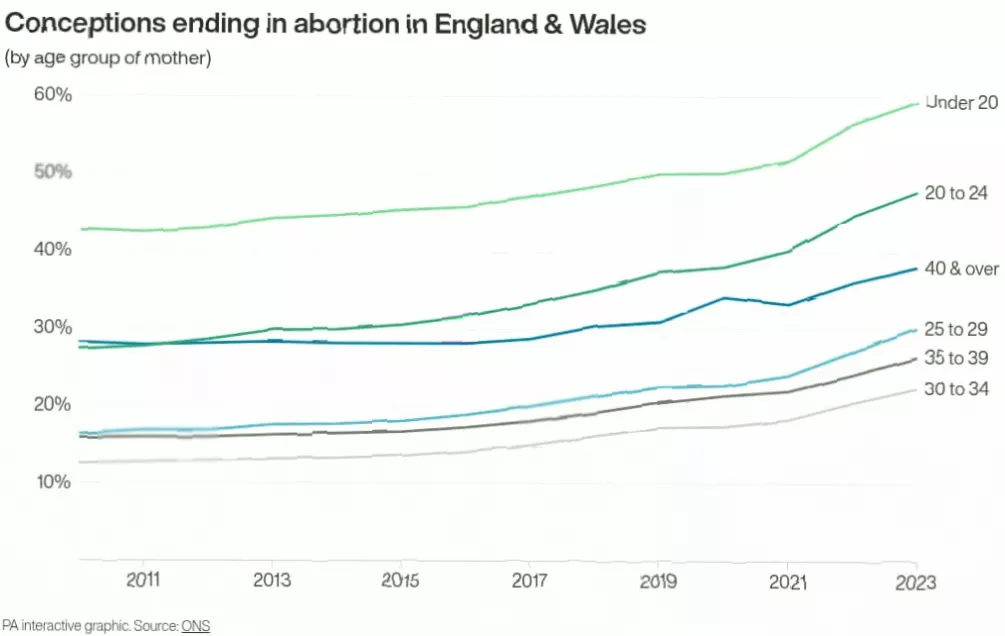
Teenage conception rates for under-20s remained below pre-pandemic levels in 2023, at 28.0 per 1,000 women. However, the ONS data showed a slight increase in conceptions among those aged under 18 since 2021, reversing a previous 14-year downward trend. The number of conceptions leading to maternities for women aged under 20 was the lowest on record at 19,820, down from 20,655 in 2022. Under-16s had the highest percentage of conceptions ending in abortion at 66.3%, followed by 16-17 year olds at 60.4%. The overall fertility rate in England and Wales has reached a historic low, with fewer births and older parents.
Record proportion of conceptions ending in abortion
Nearly one in three conceptions in 2023 — 32.1% — led to an abortion, a record high and up from roughly one in four in 2020 (25.3%). The number of conceptions resulting in abortion reached 279,970, a 13.0% increase from 2022 and a 35.2% rise since 2019. By contrast, the number of conceptions leading to maternities has continued a downward trajectory since 2012, declining by an average of 1.5% per year.

The ONS data, published on Friday, complements separate figures from the Department of Health released in January, which recorded 277,970 abortions in England and Wales in 2023. The difference arises because the ONS bases its figures on the estimated date of conception, while the Department of Health uses the date the abortion took place. The age-standardised abortion rate for residents in England and Wales was 23.0 per 1,000 women in 2023 — the highest since the Abortion Act of 1967. Medical abortions now account for 87% of all abortions, a significant increase from 49% in 2013.
Charities and health leaders responding to the Department of Health data in January attributed the record number of abortions to economic pressures and the rising cost of living, as well as poor access to sexual health services. Many women are reportedly choosing to delay or have smaller families due to financial strain. Temporary measures introduced during the Covid-19 pandemic, which approved the use of both pills for early medical abortion at home without the need to attend a hospital or clinic, were made permanent in England and Wales in 2022, increasing accessibility. The overall number of abortions in England and Wales has shown a consistent upward trend since 1969.
Geographical variation across England and Wales is marked. Liverpool recorded the highest percentage of conceptions ending in abortion in 2023 at 43.3%, up from 40.3% the previous year. Knowsley in Merseyside followed at 40.4% (up from 37.9%), Lambeth in London at 40.3% (up from 38.5%), Brighton & Hove in East Sussex at 40.1% (down from 40.3%), and Salford in Greater Manchester at 40.1% (up from 36.5%). At the other end of the scale, Forest of Dean in Gloucestershire had the lowest percentage at 19.9% (down from 24.2%), followed by East Cambridgeshire at 20.0% (up from 18.5%), South Cambridgeshire at 20.0% (down from 20.1%), and Stroud in Gloucestershire at 21.2% (down from 21.3%).
The largest year-on-year increase in the proportion of conceptions leading to abortion was in Bolsover in Derbyshire, up by 8.5 percentage points from 20.3% in 2022 to 28.8%. The biggest fall was in Ceredigion in west Wales, down by 4.9 percentage points from 32.4% to 27.5%. At the regional level, the West Midlands had the highest conception rate at 80.9 per 1,000 women in 2023, while the South West had the lowest at 64.8 per 1,000 women. The conception rate for women aged 15 to 44 has decreased by 12.4% from 2011 to 2021.