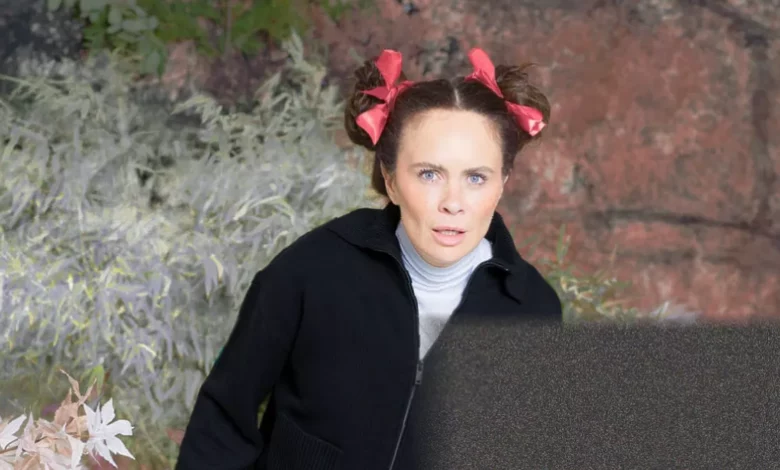
Joanne McNally was three years old, standing on a rockery in a Dublin schoolyard, telling a circle of little girls that her birth parents had been killed in an airplane crash and that she was the sole survivor. None of it was true. But that childhood fantasy, she now says, was her first one-woman show – and she liked the feeling of having an audience.
Childhood and the origins of a performer
Born in County Roscommon in 1983 and raised in Killiney, County Dublin, McNally was adopted by the McNally family. Her adoptive mother, Pat, explained the adoption as a story of being “too loveable”, with everyone wanting to keep them. Despite a loving upbringing, McNally has spoken of an “identity crisis” as a child. She reconnected with her biological father, Kevin, who lives in Australia, in 2018, and has also met her biological half-brothers, with whom she shares a striking resemblance.
From an early age she was loud, flirtatious and loved telling stories. “I remember standing on the rockery in the yard in school, as if risen, with a horseshoe of little girls round me, telling everyone my origin story,” she says. “All of which was untrue. But it was my first little one-woman show and I liked the feeling of having an audience.”
Yet alongside that early need to perform was a growing unease about her body. “As far back as I can remember, I always thought I was fat,” she recalls. When the other children played mummies and daddies, she was always cast as the daddy. In school musicals, she played the boys’ roles. “It didn’t help that I had a fringe that looked like it had been sewn on from a horse’s arse.”
She did not see herself as an attractive teenager. “I felt like more of a personality hire and, because of that, I wanted to be more desirable. For a young girl, there’s a quickfire way you can do that, and that’s to shed weight.”
Bulimia and breakdown
Once she hit her twenties, McNally threw herself into the party scene. She worked in public relations for a youth agency and studied English and Sociology at University College Dublin, but the job left her stressed and unfulfilled. “Me and my friends were big drinkers and loved going clubbing and doing three-day benders. I don’t regret a minute of it as I made some of my best friends in Dublin. We were living the brand – partying all the time, wearing bicycle locks as necklaces, backward baseball caps and huge tortoiseshell glasses. But in the background to all the fun, my bulimia was spiralling out of control.”
In her late twenties, she moved to work for a mental health charity, hoping a change of environment would help. Instead, the solitude made things worse. “I thought if I could just get out of the PR job, my headspace might change. I went from super-busy and sociable to one email a day, and it sent me absolutely nuts. In that solitude, I let the eating disorder take over.” The bulimia became so severe that she slept in the charity’s office, unable to return to her housemates. Her mother refused to allow her back home until she sought treatment.
In her early thirties, McNally reached a breaking point. “I decided I would totally succumb to the mental breakdown so that no one would expect anything from me. I quit my job and moved into my mum’s attic, cocooned at the top of the house and living like a mental patient.” The physical toll of bulimia has been long-lasting. “I wouldn’t wish it on anyone – bulimia is really bad for you, and I still get teeth pulled out and filled in because being sick messes you up.”
Yet the breakdown, she says, “was the making of me. I had a big fork in the road. I had no mortgage, no kids. While I wasn’t in a position to be earning, I had the financial freedom to explore what I should be doing with my life.” She traces the root of her eating disorder to a deeper dissatisfaction. “Aside from wanting to be desired, the other reason I became bulimic was that I was deeply unsatisfied. I tried to get a sense of validation or achievement from being thin, as there was this other part of me I wasn’t expressing.”
The turning point came when a friend, director Una McKevitt, asked her to perform in a documentary-style play called Singlehood, about single people’s experiences with dating. “This sounds wanky, but once I stood on stage, it felt as if I was home.” Around the same time, she began an anonymous blog called Eat the Pastry, about bulimia, which led to a newspaper column. “Suddenly I was in a play and making a teeny bit of money writing. I had a real reason to get better.”
Comedy career
Initially McNally thought she would go into theatre, but she crossed paths with comedian PJ Gallagher, who was certain she should try stand-up. “I was ambitious and driven but I lacked confidence – and still do. Had he not been so encouraging, there’s no way I would have stepped on stage at a comedy club.” She supported Gallagher on his “Concussion” tour in 2015 and subsequently signed with the Irish comedy agency Lisa Richards.
Her breakthrough came with her one-woman show Bite Me in 2016 – a dark comedy based on her experiences with eating disorders that earned multiple award nominations and transferred to London’s Vault Festival. Her subsequent tour, Prosecco Express, was a major success, including a 78-night run at Dublin’s Vicar Street and performances at the London Palladium. The show explored themes of being a single, child-free woman in her late thirties.
During lockdown, she launched the podcast My Therapist Ghosted Me with Vogue Williams. The title originated from McNally’s own therapist allegedly ceasing contact with her. “We had this trapped audience, everyone was inside and on their phones and needed company,” she says. The podcast quickly became a phenomenon, reaching millions of listeners monthly and winning Best Podcast at the Global Awards 2022 and Podcast Champion at the 2023 British Podcast Awards. McNally’s company, Prosecco Pig Ltd, which produces the podcast, posted a post-tax profit of €674,823 in 2025.
“It wasn’t until the restrictions had lifted and I was doing a gig in a club in Greenwich, south London, that I realised that it wasn’t just my bubble listening to it. Four girls had come down to see me and asked for a photo afterwards. It wasn’t like I was Paul McCartney at the height of the Beatles, but it was the first sign that something was happening.”
Her current stand-up show, Pinotphile, is touring Ireland and the UK until December, with dates extending into 2026. She is set to be the first Irish female comedian to host a solo show at Dublin’s 3Arena in 2026. She also hosts the BBC Sounds series Joanne McNally Investigates, which has covered topics including “Who Replaced Avril Lavigne?” and “Did the Furbys Spy on Us?” and is a team captain on the TLC comedy panel show Unacceptable alongside Richard Ayoade, hosted by Ed Gamble. She has appeared on Taskmaster, finishing second in series 17, and The Big Fat Quiz of Everything, and is set to appear in the second series of The Celebrity Traitors in autumn 2026.
Her audience, she says, is overwhelmingly female and fiercely devoted. “The version of me on stage with a mic is feral – and so are the audience. The crowds at my gigs are boozy, because I am a boozer, but in spite of how mad the energy is, everyone is respectful. I have had a couple of stage-stormers, however, and there have been kerfuffles – mainly handbags falling off balconies by accident, and the crowd telling whoever dropped it to shut up while they’re trying to retrieve it. In general, they are funny and sweet. I get a lot of single people, which I love, and there’s a woman in Kilkenny who comes to my Christmas show every year, takes a photo of us together, and the following year presents me with a snowglobe containing the picture.”
Reflecting on her career, McNally notes that comedy attracts a certain type of character. “I’ve met a lot of adopted comics over the years. I always thought there was no connection between the two things, but there is probably something in the huge effort to prove yourself and your worth, and being put up for adoption. Really, though, doesn’t everyone want to be accepted by the tribe?” When she met her birth father in her late twenties, she was preparing to discover she was part of a showbiz dynasty. “Of course, I’m not. My birth father was, like, ‘I think you’re just your own thing.'”
If you told the insecure 18-year-old she would be doing comedy for a living, McNally says her jaw would be on the floor. “But the little girl version of me in the photo would not be surprised. She was obsessed with Annie the orphan and knew her destiny was treading the boards – being loud, telling stories on stage, where I belong.”