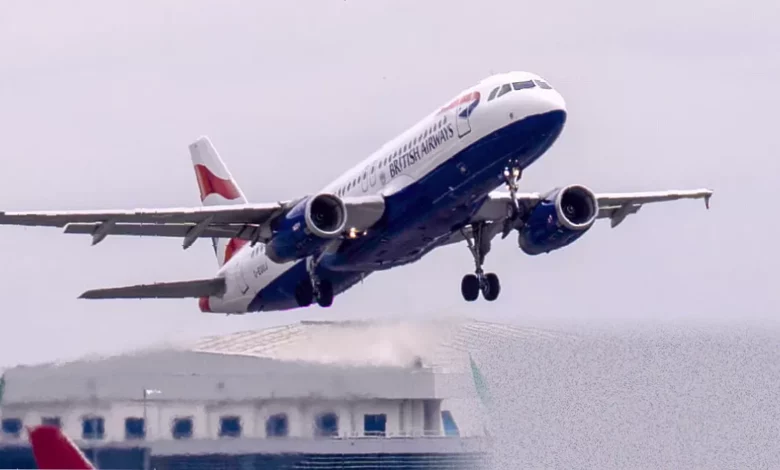
Hundreds of flights faced severe delays due to thunderstorms that swept across southern England on Saturday, leaving passengers stranded on grounded aircraft for hours as air traffic control restrictions rippled through Heathrow, Gatwick and other airports.
More than 600 flights in and out of the two London hubs were delayed, according to flight tracking data. FlightAware recorded at least 367 delayed flights at Heathrow and 352 at Gatwick, with some reports putting the total number of affected services at nearly 800. Delays stretched to six hours or more, and dozens of flights were cancelled altogether. One Gatwick–Antalya service scheduled to land in Turkey at 11:50am was not due to arrive until 6pm.
The disruption followed back-to-back days of temperatures exceeding 30°C across the UK and much of Europe during a record-breaking heatwave. Thunderstorms and heavy downpours lit up the skies of London overnight, prompting the Met Office to issue yellow thunderstorm warnings for large parts of southern England and an amber extreme heat warning for eastern and southeastern England that remained in place until Sunday morning. The storms reduced the volume of airspace controllers could safely use, forcing aircraft to be spaced further apart. Nats, the UK’s air traffic control service, said it had imposed temporary restrictions because of “forecasted severe weather across the south-east of England” and warned that disruption was “expected to continue through the rest of the day” and into Sunday.
Passengers described scenes of frustration and discomfort. One traveller said they had been stuck on a grounded British Airways plane at Heathrow from 7am until noon. Another reported that their daughter had been sitting on an easyJet aircraft at Gatwick for four hours. At Venice airport, 29-year-old Adam Joseph told the BBC he had been stranded without air conditioning after his Gatwick-bound flight was delayed for at least four hours. “We could’ve stayed at the hotel for another three to four hours,” he said. “I’ve had to give up my chair to a family with a pregnant mother. People are very angry … we have had no communication from [British Airways] whatsoever.” Joseph also said he had been told that because the delay was caused by an air traffic control restriction, he would not be entitled to compensation.
Airline responses and the compensation gap
Both British Airways and easyJet acknowledged the disruption but pointed to the weather and resulting air traffic restrictions as the root cause. British Airways said in a statement: “Like other airlines, we’ve had to make some adjustments to our schedule today due to air traffic control restrictions caused by adverse weather conditions affecting parts of UK airspace. While the vast majority of our customers will be unaffected, we apologise for the inconvenience caused and our teams are working hard to help those impacted get their journeys back on track.” The airline’s policy states that it will not permit aircraft to remain on the tarmac for more than four hours without the opportunity to disembark, unless there are safety or security reasons.
EasyJet said it had “pre-emptively cancel[led] some flights to and from Gatwick in advance” of the storms. A spokesperson added: “We are doing all possible to minimise the impact of the weather disruption for our customers and are notifying passengers in advance with their options to rebook or receive a refund as well as hotel accommodation and meals where required.” Under easyJet’s policy, passengers may be entitled to compensation if a flight arrives more than three hours late, unless the delay is due to “extraordinary circumstances” such as bad weather.
The distinction matters because it directly affects what passengers can claim. Under UK regulations (known as UK261), airlines are obliged to provide care — including food, drink and, where an overnight stay is needed, accommodation — during any delay. If a flight arrives at its destination more than three hours late, passengers may be entitled to compensation of up to £520, but only if the delay was within the airline’s control. Severe weather is classified as an “extraordinary circumstance” that exempts airlines from paying compensation. The same principle applies when air traffic control restrictions are imposed for safety reasons because of thunderstorms: the ultimate cause is the weather, not the airline. This means that, as Joseph was told, passengers whose delays stem from such restrictions are unlikely to receive cash payouts. However, if a flight is delayed by five hours or more, passengers have the right to choose not to travel and receive a refund for the unused portion of their ticket.
The wider impact extended beyond the main London airports. Delays were reported at Leeds Bradford, where three departures were held up, and at Edinburgh, which saw four arrivals and 15 departures delayed on Saturday. London City Airport also experienced disruption; a spokesperson said flights were gradually returning to normal after “this morning’s weather-related air traffic restrictions”. Eurocontrol, the European air traffic management agency, identified Heathrow and Gatwick as the only UK airports facing “heavy” delays linked to the thunderstorms, with the most significant congestion affecting airspace between southeast England and northwestern Europe.
The heatwave that preceded the storms has raised broader health concerns. The London Ambulance Service recorded its highest ever number of life-threatening emergencies in a single day during the hot spell, and more than 10,000 people died as a result of summer heatwaves in the UK between 2020 and 2024, according to official figures. Scientists have linked the severity and frequency of such extreme heat to climate change. The Met Office’s dual warnings — yellow for thunderstorms and amber for extreme heat — underlined the volatile conditions that swept across the region over the weekend.