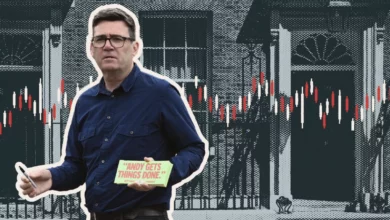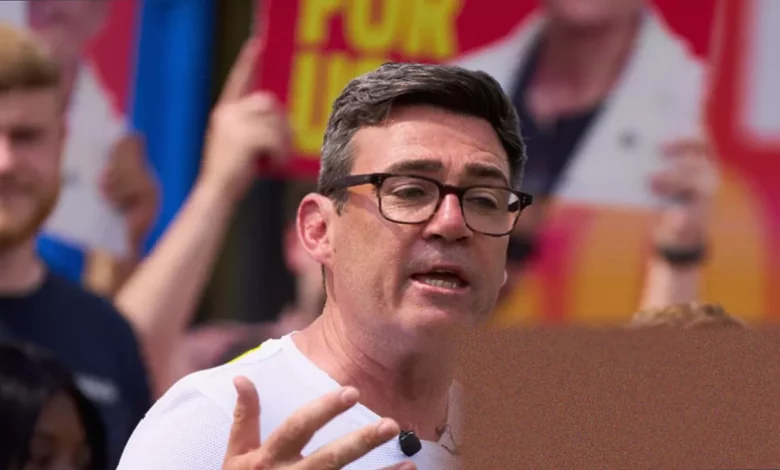
Andy Burnham is the most popular politician in the country — for now. But at Westminster, where everyone wants a piece of the prime minister presumptive, that popularity has become a logistical nightmare for the small team around him. Labour MPs, trade unions, Whitehall civil servants, political advisers and thinktanks are all jostling for his ear, and the gap between demand and supply is cavernous. “There are so many different demands all at once. But the supply of face time with Andy is significantly smaller than the demand. It’s been like laying down a new train track simultaneously with driving the train at 200mph,” one close ally said.
Burnham arrived back at Westminster on Monday in a black cab from Euston station, flanked by just two aides. He was given offices on the top floor of the Portcullis House complex, overlooking Big Ben, on the same corridor as his close allies Louise Haigh and Anneliese Midgley. In the middle of a heatwave, the two packed rooms have been stifling. His inner circle — barely half a dozen people, with others dipping in — is camped out in one of them, overseeing parallel operations: the leadership campaign, transition planning, policy and communications. The pressure on them has been intense. Late one night, one member went to bed with 450 unread WhatsApp messages.
The tiny cohort is being drowned in paperwork. Team Burnham admit they have been overwhelmed by a “mountain” of policy papers. “Everybody wants to share their ideas. It’s great, but impossible,” one said. They have received about 100 submissions since the byelection that paved his way to No 10 — a decisive victory in Makerfield on June 18, where Burnham won a majority of more than 9,000 votes after the sitting MP Josh Simons resigned to let him stand. In the thinktank world, policy specialists say they are worried about a “bandwidth problem” because there is so much material and not enough people to sift the ideas. “We have offered help but they don’t seem to be ready for that yet,” said one thinktank boss. Miatta Fahnbulleh, a former thinktank chief who quit as a minister over Keir Starmer’s leadership, and Josh Simons have been drawing up policy for the prime minister presumptive, before a likely coronation in just three weeks’ time.
The media demands are no less relentless. Burnham’s team have been “trying to hold the line”, they said, though at times they have struggled as “allies” freelance with their views — sometimes contradictory, sometimes just plain wrong. The sheer volume of interest has created what one MP called a “massive bunfight for influence”. Among Labour MPs there is excitement about Burnham’s charm offensive, but also anxiety among those who have not yet managed to secure a meeting. Sally Jameson has been ushering small groups of MPs into the second office to meet Burnham, but the queue is long. Every day brings a new rumour about jobs, some of it put about by the individual themselves or their allies. The jostling for positions in a new Burnham administration has been, as one of his inner circle put it, “excruciating”.
That jostling is sharpened by the political tensions Burnham must navigate. The appointment of James Purnell — a former Labour cabinet minister and ex-chair of Labour Friends of Israel — as his chief of staff has caused consternation on the left. Purnell’s past roles include leading Flint Global, a lobbying firm whose clients include arms companies, tech giants and private water firms. The right, by contrast, has taken succour. “Everyone projected on to Andy what they wanted, and only some people will get it,” one MP said. There are also reports of “daggers drawn” within some of the outer circles of Burnham’s operation, with those who thought they were part of the core team feeling pushed out by Haigh and Simons, who are in the ascendancy. One MP has been almost in tears over it.
His choice of chancellor, more than any other appointment, will show his instincts. Will he smash through Treasury orthodoxy with a left-leaning figure like Ed Miliband, or a more centrist one? Speculation is rife: Miliband, Wes Streeting and Shabana Mahmood are all reportedly being considered. Streeting, who initially looked like a potential leadership rival, has thrown his full support behind Burnham in return for a senior cabinet role. Burnham has already spoken to some of the current cabinet — including Yvette Cooper and Rachel Reeves — but sources say those conversations were about the handover, not jobs. While Miliband is advising on the economy, the Guardian understands Burnham has not yet sat down with home secretary Shabana Mahmood, although he has met John Healey, who quit over military funding. Others are still awaiting a call.
To build credibility with financial markets, Burnham has appointed prominent economists as advisers: Andy Haldane, former Bank of England chief economist; Richard Hughes, ex-chair of the Office for Budget Responsibility; and Jim O’Neill, crossbench peer and former Treasury minister. He has privately reassured colleagues that he supports Rachel Reeves’ fiscal rules, signalling continuity in budget policy, but he has also indicated a willingness for greater public spending and borrowing, potentially funded by higher taxes on wealth and property. He has committed to not raising income tax, VAT or national insurance. His economic agenda — to be detailed in a major speech in Manchester on Monday — will focus on boosting growth by giving regional mayors more control over social housing, welfare and post-16 education. It is an approach he calls “Manchesterism”, a critique of London-centric governance that he laid out in his book “Head North” with Steve Rotheram.
Burnham himself has so far kept a cool head, despite the absurd pressure. When he arrived in Westminster Hall on Monday to see hundreds of cheering Labour MPs assembled for a photograph with him, he could not hide his blushes. “Blimey,” he said. Since then he has kept a lower profile, focusing on private meetings with Labour MPs — many from the 2024 intake whom he is meeting for the first time — in his office, the tea rooms and voting lobbies of the Commons, as he signs up the 81 nominations required to run for the leadership. A friend cited the byelection as evidence of his focus: “He could have been distracted by all the national noise, but he prioritised speaking to undecided voters. He wasn’t easily swayed from that, despite all the competing demands.”
But his close allies acknowledge that with so many MPs wanting to pitch for jobs or ideas, expectations are hard to manage. “He’s just one person and everybody projects their hopes on to him. It’s hard to live up to,” one admitted. “Andy is the personification of this moment of possibility,” another said. The pressure will only intensify when he gets to No 10, although by then he will have an army of civil servants behind him. Until that moment — probably July 20, the first working day after the earliest point he could become leader of the party (July 17) — his team will get by on caffeine and goodwill. “We all have the same dry sense of humour which gets us through. We’re northern realists about everything. We’re taking it all in our stride,” one of them said.
They are also looking to Burnham himself to see them through. “He knows what he wants to do and why he’s doing it, that really helps guide you. If you’re clear about that, then it helps you prioritise and cut out the noise.”