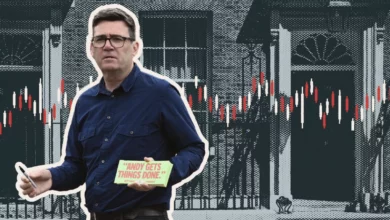
Andy Burnham has celebrated the life and work of the poet Tony Harrison at a gathering in Salts Mill, Shipley, using the occasion to underline how literature can alter the course of a person’s life. The event, attended by actors, directors, writers and family members, featured speeches from several politicians, including Richard Burgon, the Labour MP for Leeds East, who in 2020 tabled an early day motion in Parliament recognising that Harrison had “always written, and spoken, for the people”. Yet it was Burnham’s tribute that offered the sharpest illustration of poetry’s transformative power.
Burnham first encountered Harrison’s work as a sixth-former, after an English teacher introduced him to V, the long poem that would later become infamous. Written in 1985 and set in Holbeck Cemetery in Beeston, Leeds, V recounts the poet’s confrontation with a skinhead who has sprayed graffiti on headstones — a young man with whom Harrison discovers he shares much in common. The poem’s notoriety erupted in 1987 when Richard Eyre dramatised it for Channel 4. The Conservative MP Gerald Howarth attempted to have the broadcast banned, and the Daily Mail branded it a “torrent of filth” because of its use of four-letter words. Despite the controversy, the critic Bernard Levin called it “one of the most powerful, profound and haunting long poems of modern times”. The BBC later broadcast the full poem on Radio 4 in 2013.
For the teenage Burnham, the existence of V was proof that a working-class background — which he and Harrison shared — need not silence or disadvantage a person. The poem carries an epigraph from Arthur Scargill, the former leader of the National Union of Mineworkers: “My father still reads the dictionary every day. He says your life depends on your power to master words.” Burnham quoted those words to his own father, who was sceptical about his son studying English at university. “What use would a degree like that be?” his father wondered. The quote did the trick. Burnham went on to study at Fitzwilliam College, Cambridge.
Politicians who hold English literature degrees are rare. Among those who won seats in the 2019 general election, they account for just 4%. Steve Witherden, a Labour MP in Wales, did not learn to read until he was 11, making his study of English at Lampeter all the more significant; others argue that an English degree fosters broad-mindedness and empathy. Burnham himself is robust on the point. Knowledge of Chaucer — another favourite — Shakespeare, Orwell and Harrison has done him no harm on people’s doorsteps, he believes. In 2015 he confessed to wondering whether he might write poems himself one day, “when politics has run its course for me”. If he does produce something more literary than a political manifesto, he would join a distinguished line of MPs and prime ministers who have turned author: Benjamin Disraeli (“When I want to read a novel, I write one”), who wrote Vivian Grey, Coningsby and Sybil; Winston Churchill, awarded the Nobel Prize in Literature in 1953 for his historical and biographical writing; Alan Johnson, author of memoirs such as This Boy and the Louise Mangan detective novels; Rory Stewart, whose books include The Places in Between and Politics On the Edge; and, less celebrated for literary merit, the fiction of Jeffrey Archer, Edwina Currie and Ann Widdecombe.
How a poem shaped a political outlook
Burnham’s career demonstrates that a humanities degree need not be a disqualification from political life. Yet the number of young people studying English, history or languages at university has declined catastrophically in recent years, with many institutions shedding staff and closing degree courses. Against that backdrop, Burnham’s attachment to Harrison’s V carries particular weight. The poem draws its title from the word “versus”, representing the conflicts that divide society: “communism v. fascism”, “Left v. Right” and countless others. It was inspired by Harrison’s discovery that his parents’ grave had been vandalised with graffiti, including the word “UNITED” daubed on the headstone. The skinhead who sprayed it is a Leeds United supporter, but Harrison takes heart all the same: he knows “what the UNITED that the skin sprayed has to mean” and imagines an end to “all the versuses of life” — the class, economic and ethnic differences that split the nation, “the unending violence of US and THEM”. The poem was written during the 1984-85 miners’ strike, a period of acute division, and its epigraph from Arthur Scargill — emphasising the power of mastering words — resonates directly with Burnham’s own story.
Two weeks before the Salts Mill event, Josh Simons stood down as the Labour MP for Makerfield, allowing Andy Burnham to contest the seat in a by-election. Simons, elected in July 2024, had served as Parliamentary Under-Secretary of State in the Department for Science, Innovation and Technology from January to March 2026, and as Parliamentary Secretary in the Cabinet Office from September 2025 to February 2026. He previously directed Labour Together, a think-tank, holds a PhD from Harvard University and authored Algorithms for the People: Democracy in the Age of AI. The by-election now gives Burnham a chance to enter the House of Commons at a moment when the versuses Harrison identified 41 years ago have grown only more entrenched. The poem itself acknowledged the bleak prospects for ending them, but Burnham, armed with what poetry has taught him, may have a chance.