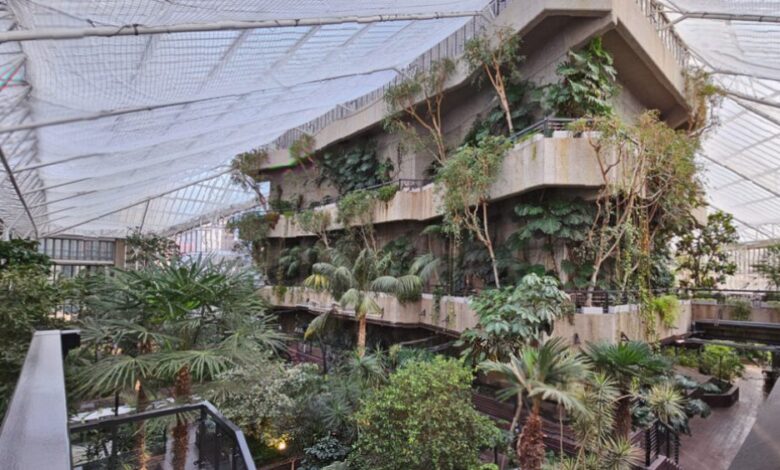
In the heart of London’s brutalist Barbican Centre, a vast tropical conservatory offers a free, year-round escape, merging lush greenery with raw concrete in a striking example of “eco-brutalism.” This heated glasshouse, the second-largest in London after the Princess of Wales Conservatory at Kew Gardens, invites visitors to explore a dystopian paradise where nature has reclaimed the city.
Originally built between 1965 and 1976 on a site devastated during World War II, the Barbican Conservatory was designed by architects Chamberlin, Powell and Bon to conceal the massive fly tower of the Barbican Theatre below—a concrete structure used for lowering scenery. Today, it wraps around this tower, with the building’s distinctive concrete still evident, enhancing the effect of an urban landscape abandoned to over 1,500 species of plants and trees.
The collection includes rare and endangered specimens from tropical, sub-tropical, and temperate regions, featuring palm trees, banana plants, tree ferns, coffee plants, ginger plants, cacti, and succulents. Amidst the foliage, colourful koi carp inhabit the ponds, alongside terrapins with an unusual history: research indicates they were relocated to the Barbican after becoming an invasive species on Hampstead Heath, following a surge in pet ownership after the 1990s Teenage Mutant Ninja Turtles film.
Entry to the conservatory is free but requires booking a timed slot in advance, with tickets released roughly monthly by the Barbican Centre. Current availability includes Friday 6th March from 6.30pm to 9.30pm, Sunday 8th March from 12.00pm to 5.00pm, Friday 20th March from 6.30pm to 9.30pm, Saturday 21st March from 12.00pm to 5.00pm, and Sunday 22nd March from 12.00pm to 4.00pm. Visitors typically spend 45 minutes to 1.5 hours exploring, with seating throughout and a small bar and cafe serving drinks, snacks, and afternoon tea on select occasions. The space is accessible, accommodating prams and pushchairs, and the nearest tube station is Barbican.
The conservatory is set for a significant transformation as part of a broader £451 million renewal of the Barbican Centre, with the first phase costing £231 million and significantly funded by the City of London Corporation. Led by landscape design practice Harris Bugg Studio and architects Allies and Morrison, the project aims to improve accessibility with new staircases and lifts, replace glazing, re-waterproof floors, and upgrade building systems. Construction is expected to begin around 2027, potentially leading to a full site closure from June 2028 to June 2029, after which the conservatory is slated to become a free daily public garden.
Opened by Queen Elizabeth II in 1982, the Barbican Centre is a vast cultural hub housing art galleries, theatres, cinemas, and a concert hall. Despite being described both as the “ugliest building in London” and a “site of special architectural interest,” its conservatory has hosted art exhibitions, including a site-specific commission by Ranjani Shettar, and features a unique typeface in its signage. For those seeking a winter retreat or a glimpse into this blend of nature and architecture, free tickets are available through the Barbican’s website, with a newsletter to alert visitors to new date releases.