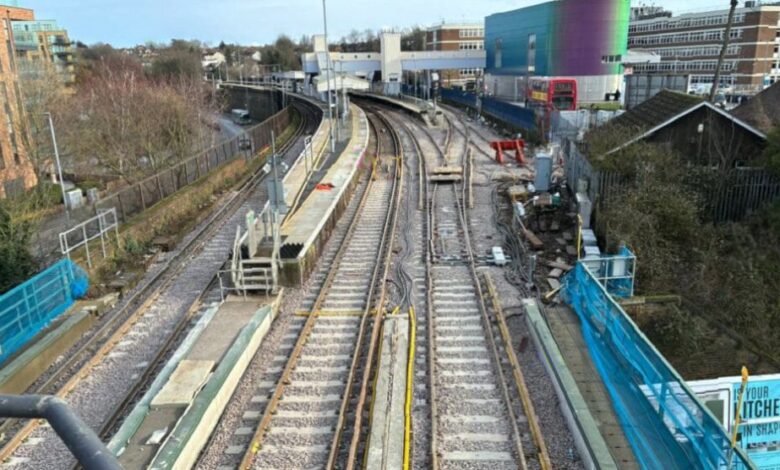
Train services have resumed through Dartford Junction following a strategically timed nine-day closure for a £10 million upgrade aimed at securing the long-term reliability of Kent’s busiest and most critical rail interchange. The work was deliberately consolidated into a single block over the February half-term to avoid approximately 30 separate weekend closures, minimising disruption for passengers.
The core engineering project, led by South Eastern Railway, involved replacing 10 sets of switches and crossings and laying around 400 yards of new track between Slade Green and Dartford, with conductor rails also installed to power trains. This investment targets a junction that handles some 650 trains daily, forming a pivotal link for services between Kent and London.
David Davidson, Chief Operating Officer for South Eastern Railway, underscored the upgrade’s importance. “This work strengthens the long-term resilience and efficiency of one of the busiest points on our network,” he said. Davidson, whose career includes senior operational roles at Network Rail’s Kent, Western, and Anglia routes, noted that scheduling during the school holiday was key to limiting customer impact.
Comprehensive Station Enhancements
Alongside the junction work, a wide-ranging package of station improvements was delivered. At Dartford station – the busiest in Kent with annual passenger usage recorded at 4.62 million in 2018/19 – teams completed repainting, reduced platform stepping distances, carried out lift maintenance, and installed tactile paving for improved accessibility. All stations closed for the duration received a repaint.
Further enhancements saw damaged fencing replaced at Stone Crossing, the accessible toilet refurbished at Greenhithe, a deep clean undertaken at Swanscombe, and new LED lighting with additional customer information screens installed at Northfleet.
Service Alterations and Passenger Impact
The main closure period, from Saturday 14 to Sunday 22 February 2026 following preparation work on 7 and 8 February, necessitated significant service changes. Southeastern and Thameslink services were suspended between Slade Green, Barnehurst, Crayford, and Gravesend via Dartford, with no Thameslink trains running between Plumstead and Gravesend. Accessible, high-frequency replacement bus services operated on all affected routes during this nine-day block.
While those specific routes were halted, other services continued: Southeastern Metro routes into London via the Sidcup, Bexleyheath, and Woolwich lines generally ran with amended timetables, high-speed services to and from St Pancras via Gravesend operated normally, and an hourly Thameslink shuttle service ran between Gravesend and Rainham. Passengers were advised to plan ahead, allow considerable extra time, and check travel information due to anticipated queues for replacement buses during peak hours.
This £10 million project is a key component of a wider £300 million investment programme by South Eastern Railway across its network. The typical off-peak service from Dartford includes multiple trains per hour to London terminals such as Charing Cross, Victoria, and Cannon Street, as well as to Gravesend and Rainham, with a journey time to the capital of approximately 41 minutes.
Further follow-up work is scheduled for Sunday 1 March and Sunday 5 April 2026, when standard replacement bus services will be in operation. The decision to undertake this major upgrade in one intensive period was taken to deliver lasting improvements while reducing the cumulative disruption of repeated weekend engineering works.