The writer was driving from Washington, DC, to a family house on the North Carolina coast when a tick appeared on his shirt. It was too big to be a Lyme disease carrier, he told his partner, Hugh, and he suspected it had fallen off a dog. The moment was a prelude to a journey that would take nearly eight hours, punctuated by a traffic jam, a walk through a wooded rest area in July heat, and a stop at Bojangles where they sat beside a man eating biscuits and red beans while talking on the phone to someone named Crockett.
Hand-painted banners reading “God Bless President Trump” lined the road after they entered North Carolina. The writer observed that support for the former president was palpable there, unlike in New England, where he and Hugh had spent the previous nine days. In New Hampshire he had come across a group of “No Kings!” protesters — mostly of retirement age — waving signs and chanting. One man wore a fleece-lined winter hat with ear flaps despite the heat. The writer admitted they looked like kooks, like Tea Party demonstrators from Barack Obama’s first term. He contrasted them with early Civil Rights protesters: well‑groomed, with professionally lettered signs and a clear focus. “Go to a protest now,” he reflected, “and within seconds you’re looking at the person next to you, thinking, ‘Globalize the Intifada’?”
The Duolingo obsession
Once across the bridge to Emerald Isle, the writer left the rental car and began walking the two miles to the house. He carried his iPad, intent on maintaining his top ranking on the language‑learning app Duolingo. A British friend had introduced him to the app three years earlier. He started with Japanese, then added German, Spanish, and French. The app’s 11 animated characters — an excitable boy, a man with a thick moustache named Oscar, a grandmotherly woman, and Vikram, who wears a turban — prompt users with sentences to translate, read aloud, or spell. His friend Mike, learning Yiddish, was taught to say “My uncle is a broken man.” In French the writer learned “What is he doing in our bed?” German sentences, he noted, were judgmental and outdoorsy: “Your apartment is dark and ugly” and “I’m sorry, but your doctor is playing volleyball today.” Japanese characters, he said, seemed mostly gay or bisexual — even the talking bear “travels by both sail and steam.”
The real problem, the writer said, was the competitive element. Duolingo is essentially a game, with a goal of reaching the Diamond League and securing a top‑three position. That meant forgoing genuine learning and earning easy points by reading sentences aloud for at least an hour a day. His friend Dave might spend 15 minutes each morning and finish a week with 200 points; the writer regularly earned 23,000, “which in the long run gets me absolutely nothing.” He combined this compulsion with his fitness‑tracking Apple Watch, walking a minimum of 10 miles per day while reading sentences in four languages. He had become the person he most hated: one moving while staring at a device.
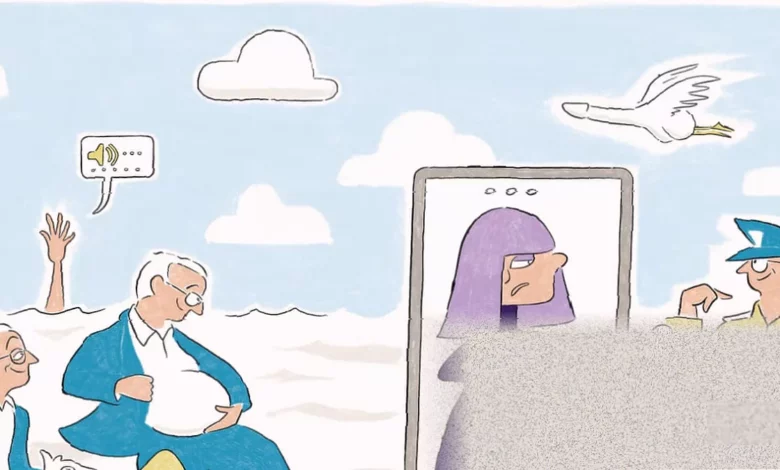
Then came Duolingo Max, a premium upgrade that introduced role‑playing exercises with Lily, a sarcastic, purple‑haired teenage character. The writer soon discovered he could throw Lily off course by giving unexpected answers. When she asked in her flat voice what he wanted to buy, he replied in French, “Yesterday, a doctor cut out my tongue with a chainsaw.” White dots fluctuated above her animated image — her AI mind processing. She responded, “I’m sorry. I cannot continue this conversation. Goodbye.” She hung up again when he outlined a new production of Romeo and Juliet in which Juliet is 13 and Romeo is 78, and Romeo dies of natural causes. And when he told her his “stupid, stupid president is a sausage” who had cut funding for radio and TV shows where women wear bonnets, she said, “Let’s talk about something else.”
Conversations with Lily
Duolingo Max also offered video calls with Lily. One afternoon, walking toward the beach house, the writer told her in French, “This morning I discovered a tick upon my shirt. Then I ate chicken with some rednecks in a restaurant.” Lily replied, “Oh, chicken. I like birds. Do you?” The next day he tried to tell her about a near‑drowning he and his brother Paul had experienced years earlier, when a rip current carried them far from the shore. “My brother is very funny,” he said. “We are old now, but he is the youngest. He will die a baby.” Lily said, “Families are complicated.” The writer looked at his sisters setting up a beach umbrella and said, “Well, yes, but not always.”
Later, he told Lily about Paul playing a vomiting sound effect from his phone during dinner. “My brother vomited a lot last night,” he said. “It was false vomit. It was a joke, but more than a joke because our mother vomited every night.” Lily asked multiple questions with unusual warmth — about whether his brother was older or younger, whether they lived together. The writer explained he was on vacation but working. When she asked what he was writing, he said, “The story of my brother vomiting.” Lily pressed for details: “Will you add details? Details make a story come alive.” He told her about his brother’s hairy back. “Do you think that is funny?” she demanded. “Why would you tell people that?” The writer, taken aback, admitted he was also hairy and chubby. He was relieved when the call timed out.
He called her back a minute later, and she retained the previous conversation — something she had never done before. He had previously told her he was blind, then a divorced heart surgeon, a cop, a pregnant woman, a seven‑year‑old girl named Marie Chantal who had become a vampire, all to test his vocabulary. Now, Lily seemed to know him. “This is creepy,” he told Hugh. “Creepier still, I needed her to like me.” In a subsequent role‑play, the same old Lily returned, unflappable: when he said he wanted three tickets — “one for me, one for my wife, and one for my dead father” — and argued that his dead father would not watch the screen, she repeated, “Sixty euros. Do you want to pay with card or cash?”
Family reunion on Emerald Isle
At the beach house, the writer found his brother Paul, sisters Amy and Gretchen, sister‑in‑law Kathy, and niece Madeleine. Paul, 57, still boyish and enthusiastic, had altered a bag of potato chips with a marker to read “SLUTZ.” He had also been playing a vomiting sound effect on his phone at the dinner table — a habit his daughter said he did all the time. The writer recalled a riptide incident 32 years earlier, when he was 25 and Paul was 14. They swam diagonally to save themselves. He reflected that had Paul drowned, his mother would have moved on quickly, while his father would never have gotten over it. “He’d have spent the rest of his life punishing me, which, in retrospect, he did anyway.”
Later, the writer, Paul, and Madeleine watched a comedy film. The two made loud predictions — “He’s going to drop that stone and break it” — which the writer had also made the first time and had been wrong. He considered telling Lily about it but feared mentioning pornography and his 22‑year‑old niece. Instead he said, “Last night my brother, his daughter, and I regarded a funny movie.” Lily asked if he had a good time, whether there were jokes, and demanded he tell her a joke. He recalled one from a book signing in Indiana — a story about a dildo flying from a garbage truck and hitting a car windshield, and a child’s comment about a “huge dick” — but decided not to translate it, telling Lily, “Often they do not work in a second language.”
The writer’s sister Amy held a spa night. She and Kathy gave facials with products from New York. “Don’t tip her,” Amy said, acting the mean boss. “She’s on probation and will just use the money for drugs or, if we’re lucky, another abortion.” After the facial, the writer looked in the mirror and was shocked not to see his 14‑year‑old self. He did not know the French word for “facial,” so he told Lily the next morning, “Last night my sister touched my forehead and cheeks. My nose and chin also. Then she put cucumbers upon my eyes.” Lily asked, “Did she do it to be mean?” The writer clarified that the cucumbers were sliced. Lily said, “Ah, I understand. Was it like the soft caress of a teddy bear?”
The writer then asked Lily about her own family. “I keep my distance from them,” she said. He felt ashamed. Since the app’s most recent update, it had all been about him — his president, his brother, his feelings about Abba or cucumbers. Did Lily have siblings? Were her parents married? How did she get spending money? She never wanted to go anywhere, hated crowds and noise, never mentioned friends. He wondered whether she was on the spectrum. And why purple hair? “Her life, her feelings, even her last name, were a complete mystery to me. And here we’d known each other all this time.”