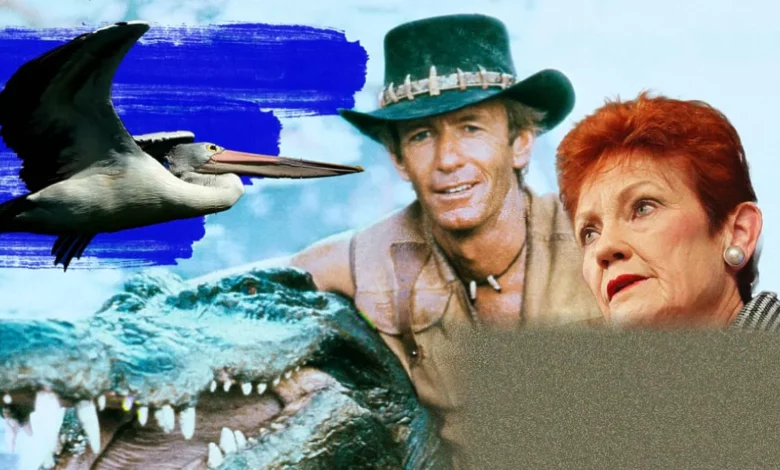
Paul Hogan has compared Pauline Hanson to a pelican in a recent political jab, dismissing the One Nation leader’s push for an “Australian monoculture” as a throwback to an imagined past.
The Crocodile Dundee star, tracked down by the Australian Financial Review to his home in Venice Beach, California, reportedly used the bird metaphor after Hanson invoked his name in a Senate speech. “She’s a pelican, yeah,” Hogan is said to have told the paper, adding that Hanson “sounds very much like this stupid boofhead over here, Trump”.
On first hearing, the remark may raise a question: is calling someone a pelican an insult? For those steeped in Australian vernacular, the answer is clear — but the term carries a surprisingly deep and layered history.
The insult that waddles like a duck but flies like a Shakespearean reference
While “pelican” does not have a dedicated entry in the Australian National Dictionary, its usage as a term of derision is well understood. The online consensus holds that it refers to a fool or a clown, a reputation drawn from the bird’s unhurried, ungainly appearance. Hogan himself deployed it in precisely this sense in the 1986 film Crocodile Dundee, when his character shouts at a New York driver: “Get on the right side of the road, ya pelican!”
The word’s pedigree as an insult extends far beyond Australian shores. In King Lear, the eponymous king rails against his daughters Goneril and Regan as “pelican daughters”. According to the New Oxford Shakespeare, this image derives from the belief that “young pelicans supposedly fed on their mother’s blood”, making the term a potent symbol of greed and cruelty. Whether Hogan, at 86, was reaching for Shakespearean allegory to skewer Hanson’s political ambition is considered unlikely by commentators, but the parallel demonstrates how deeply the insult is rooted in the English-speaking imagination.
More recently, actor Russell Crowe reportedly used the term after the 2014 NRL grand final, tweeting that a sponsor of the Canterbury-Bankstown Bulldogs was a “pelican” after the executive appeared to back the opposing team. Crowe later deleted the tweet, saying he had been misconstrued.
Australians are no strangers to turning native wildlife into insults. The galah — a noisy, foolish-looking cockatoo — gives its name to a fool or an idiot. The bin chicken, a colloquial term for the Australian white ibis, is used derogatorily for its scavenging habits. A drongo describes a stupid or incompetent person. Beside these, the pelican may seem a milder jab, but Hogan’s intent was unambiguous: he did not mean it as a compliment.
It is a characterisation that BirdLife Australia would contest. The conservation body describes the pelican as “highly mobile”, noting that it works cooperatively in groups “to drive fish into a concentrated mass” and can “soar to heights of up to 3,000m” — qualities that, as one commentator observed, would not be unwelcome in a prime minister. Indeed, the bird has enjoyed a steady rise in Guardian Australia’s Bird of the Year poll, aided by the advocacy of reporter Matilda Boseley.
How a Senate speech on monoculture provoked a movie star
The context for Hogan’s remark was a Senate speech in which Hanson set out her vision for an “Australian monoculture”. That vision had first been aired at the National Press Club on June 17, 2026, when she declared that Australia “cannot be a multicultural society” and must exist as a “monocultural society”. High migration, she argued, had eroded national identity and values, and Australians must live “under the one cultural umbrella”.
In her Senate address, Hanson attempted to give her concept a familiar, friendly face. She called for the return of “Paul Hogan and Norman Gunston” — Norman Gunston being the satirical character created by comedian Garry McDonald, known for his awkward interview style and parody of Australian cultural figures. These, she said, were “essential features of Australian monoculture, and there’s nothing remotely exclusionary about them”. She went on to list the core elements of Australian culture as she saw them: “a fair go, tolerance, secular democracy, freedom of speech and religion, and the rule of law” alongside “irreverence and larrikinism”.
The proposal drew swift criticism and confusion. Opposition Leader Angus Taylor questioned the monoculture idea, saying Australia should not “look like Japan” and that he supported “a version” of multiculturalism consistent with core Australian values. Hanson, for her part, pointed to the Socceroos — a national football team drawn from diverse backgrounds — as an example of people from different roots uniting under one flag.
Hogan’s response cut directly against her argument. “She’s living in the past, obviously,” he said. “How can [Australia] be a monoculture? We’re all migrants, except the Aboriginals, who as far as we know have been [in Australia] for 60,000 years.” He added: “I want to die in Australia — in a multicultural Australia!”
The actor, who has lived in California since the mid-2000s but returns to Australia twice a year, drew on his own experience as a rigger on the Sydney Harbour Bridge to illustrate his point. He recalled meeting “New Australians” — the post-war term for recent immigrants — from a wide range of backgrounds, and said they enriched the country.
Hogan’s place in Australian vernacular history is itself contested. He is credited by academics with giving “G’day” international prominence, but he has never fully recovered from the phrase “throw another shrimp on the barbie”, which originated in a 1984 Australian Tourist Commission advertising campaign aimed at American tourists. The campaign used “shrimp” instead of the Australian term “prawn” to ensure comprehension, but many Australians found the tagline cringeworthy and inauthentic. Despite that, Hogan remains a national treasure at 86 — one who, in this latest exchange, has offered a simple rule for belonging: “What makes a good Australian is wanting to be one.”