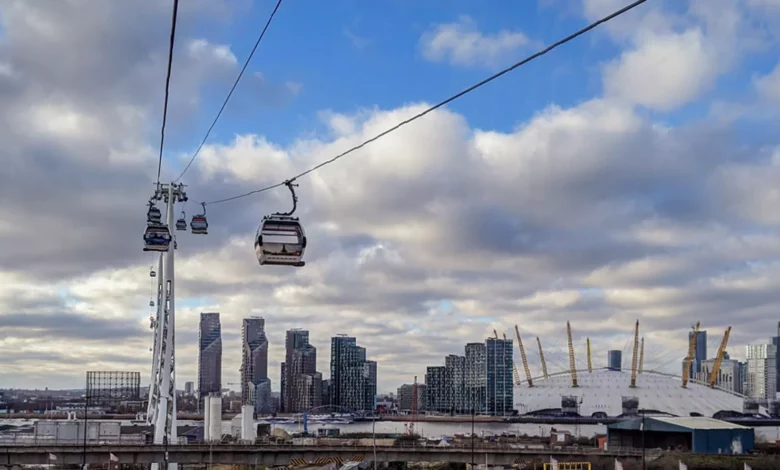
The aerial gondola that has been known as the IFS Cloud Cable Car is now officially the London Cable Car, after its latest sponsor ended its contract. Transport for London (TfL) confirmed the rebranding, which appeared on its website yesterday when all IFS branding was removed from the cable car’s pages. The IFS name will remain on Tube map diagrams until those maps are next updated.
Name change and end of IFS sponsorship
IFS Cloud took over sponsorship of the cable car in 2022, initially for a two-year term with an option to extend for up to eight years. The technology firm renewed the contract that same year but decided to end it on 18 March 2026. The cable car, which opened on 28 June 2012 as the Emirates Air Line, had previously operated under a 10-year sponsorship deal with the airline worth £36 million — £3.6 million annually. That deal expired on 28 June 2022, leading to an unbranded period until IFS stepped in in September 2022, rebranding the service as the IFS Cloud Cable Car. The IFS sponsorship was reportedly worth around £2.1 million over four years, significantly less than the Emirates arrangement. The Emirates Aviation Experience, an adjacent visitor attraction, closed on 5 June 2022.
Although the cable car is colloquially known as the “dangleway” by some Londoners, TfL has now settled on the London Cable Car as its official name. The Greater London Authority’s pages on the City Hall website, however, were still displaying the old Emirates branding at the time of the announcement.
A new strategy: short-term partnerships and leisure focus
TfL has confirmed that it does not expect to seek a replacement long-term sponsor. Instead, the organisation is shifting its approach to focus on short-term creative partnerships and a substantial leisure‑led overhaul of the cable car’s customer experience. Danny Price, TfL’s Director of Sponsored Services and Regulatory Compliance, said: “Since opening in 2012, London’s Cable Car has become one of the capital’s most popular visitor attractions, welcoming around 1.5 million customers each year. As both the Cable Car and the sponsorship market have evolved, so has our approach. Rather than entering into a new contract with a named sponsor, we will now focus on a number of short-term creative partnerships that help us celebrate the seasons, major events and cultural moments in the capital.”
Price added: “This commercial decision is aligned with increased demand from brands to run shorter, more flexible, experience-based activations, and operating without a named sponsor will mean that the London Cable Car is a more attractive proposition for these partnership activities. We have a number of exciting plans in development for the London Cable Car, which will help ensure it remains one of the best things to do in London.”
The new strategy builds on work that began earlier this year, when TfL started looking for a partner to refresh the cable car as a predominantly leisure‑focused destination. Planned improvements include upgrades to the overall customer journey and a potential transformation of the South Terminal into a more immersive, experience‑led environment. TfL is also seeking a delivery partner for what it calls “London Cable Car Customer Enhancements,” with the aim of extending visitor duration and increasing revenue. This could involve updates to the ticketing system to allow pre‑booking of timeslots, as well as the development of events and commercial partnerships.
The shift away from a named sponsor marks a contrast with the cable car’s history. City Hall initially projected around two million passengers per year, but actual ridership has consistently fallen short: the cable car carried approximately 1.5 million passengers in the year to July 2022, and around 1.45 million in 2023. Its capacity is 4,080 passengers per hour and can carry up to 500,000 people per week in summer. Since opening, it has seen more than 14.8 million journeys by October 2022. The cable car has also gained traction on social media platforms such as TikTok and Instagram, with viral videos contributing to periodic ridership boosts. Despite its popularity as a visitor attraction, it has faced criticism over its construction cost — about £60 million, making it the most expensive cable car system ever built when it was completed in 2011 — and its annual operating costs of roughly £6 million. Some critics have described it as a “white elephant” and questioned its usefulness for commuters.
Operational continuity
Despite the rebranding and strategic pivot, day-to-day operations are unaffected. FirstGroup continues to operate the cable car, having taken over on 28 June 2024 under a five-year contract with an option to extend for a further three years. The full eight-year deal could be worth up to £60 million. Prior to FirstGroup, the construction and initial operation were handled by Doppelmayr and Mace respectively. FirstGroup has also committed to a local community programme that includes new apprenticeships, educational outreach, and work placements for local school students.