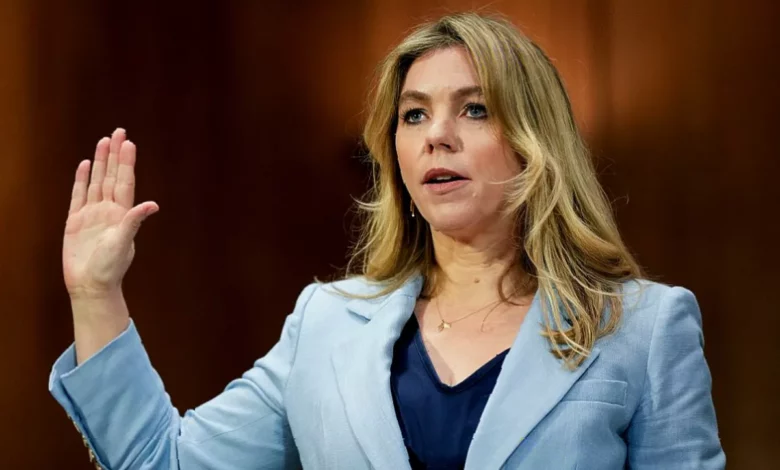
Meta silenced a former director at the Hay Festival over her book. Sarah Wynn-Williams, who served as a senior director at the company from 2011 until her dismissal in 2017, sat mute on stage during a panel discussion of her whistleblowing memoir Careless People after a gagging order imposed by the social media giant left her facing financial ruin if she spoke. The company, which owns Facebook, Instagram and WhatsApp and has frequently invoked freedom of expression to justify extreme content on its platforms, last year secured an emergency arbitration ruling in the United States to stop Wynn-Williams promoting the book on the grounds that she had “potentially violated her severance contract”. Meta’s legal action relies on a non‑disparagement clause in her severance agreement that, according to The Times, could prevent her from saying anything negative about the company “potentially for ever”.
The gagging order and Meta’s legal campaign
Meta’s emergency ruling was obtained in the US and threatens penalties of up to $50,000 for each breach of the agreement. The company subsequently asserted that Wynn‑Williams’s planned appearance at the Hay Festival alongside investigative journalist Carole Cadwalladr and former White House technology adviser Tim Wu — both critics of Meta — also breached the legal ruling. Her lawyers advised her to sit in silence on the stage, a scene that Wu described as an act of “medieval” despotism. “This amounts to targeting people for the ‘crime’ of free association and the public discussion of ideas at a literary festival taking place in Hay‑on‑Wye, not Beijing,” Wu observed. PEN America called Meta’s legal campaign a “blatant attempt to censor free speech” and “egregious hypocrisy”, given the company’s recent public stance on prioritising speech and dropping fact‑checking. Meta disputes the book’s claims, calling them “false and defamatory” and “a mix of out‑of‑date and previously reported claims about the company and false accusations about our executives”. The company insists it is simply enforcing the terms of the arbitration award that Wynn‑Williams agreed to. The National Labor Relations Board in the US issued a ruling in 2023 that it is generally illegal for companies to offer severance agreements that prohibit workers from making potentially disparaging statements, though that ruling is now suspended under the Trump administration’s NLRB. Separately, the UK’s Employment Rights Act 2025 is set to invalidate similar contractual provisions related to harassment or discrimination.
The book’s allegations
It is easy to see why Meta is so “rattled” by the book, which The New York Times described as “a darkly funny and genuinely shocking” account of one of the world’s most powerful companies. The memoir, titled after F. Scott Fitzgerald’s description of Tom and Daisy Buchanan in The Great Gatsby — a couple who “smashed up things and creatures and then retreated back into their money or their vast carelessness” — contains an extraordinary array of allegations. These range from sexual harassment, including an allegation against Meta’s chief global affairs officer Joel Kaplan, to the “deliberate manipulation of vulnerable teenagers”. Wynn‑Williams also alleges that Meta embedded staff in Donald Trump’s 2016 presidential campaign, worked “hand in glove” with China’s autocratic regime by developing censorship tools compatible with the Great Firewall, and was complicit, in her view, in the 2017 Rohingya genocide in Myanmar. The book further claims that Mark Zuckerberg personally sought to censor content on behalf of the Chinese government. The Spectator called the book “petty, malicious and tremendous fun”, while the Financial Times said it paints “an often horrifying picture of a supranational colossus untroubled by local laws or ethical codes”. Meta’s legal action and Wynn‑Williams’s very public silencing have inadvertently driven a surge in sales — what is known as the Streisand effect. According to The Bookseller, sales rose by 305% week‑on‑week after the Hay Festival incident, and the book reached number one on The New York Times best‑seller list. Wynn‑Williams received an advance of more than $500,000 for the memoir. She testified before the US Senate Judiciary Committee in April 2025, and The Times observed after her Hay Festival appearance that “everyone who cares about free speech” or “the deeds of the powerful and unaccountable” should buy the book.
Wynn‑Williams’s background
New Zealand‑born Sarah Wynn‑Williams, now in her mid‑40s, had what the Financial Times described as “a front row seat in Meta’s growing‑up stage”. After growing up in Christchurch — where she survived a shark attack as a teenager — she graduated in law from the University of Canterbury and also holds a Master of Laws from Victoria University. She briefly practised law before joining New Zealand’s diplomatic service, which posted her to its embassy in Washington, DC, and later worked with Oxfam International. She joined Facebook in 2011, excited about the platform’s potential. “After years of looking for things that would change the world, I thought I’d found the biggest one going,” she recounted. She worked in Sheryl Sandberg’s public policy department from 2011 until 2017. In 2017, she was fired. Meta called it “poor performance and toxic behaviour”. Wynn‑Williams maintains she was fired after she filed a claim of sexual harassment. She is married to a journalist and has three children.