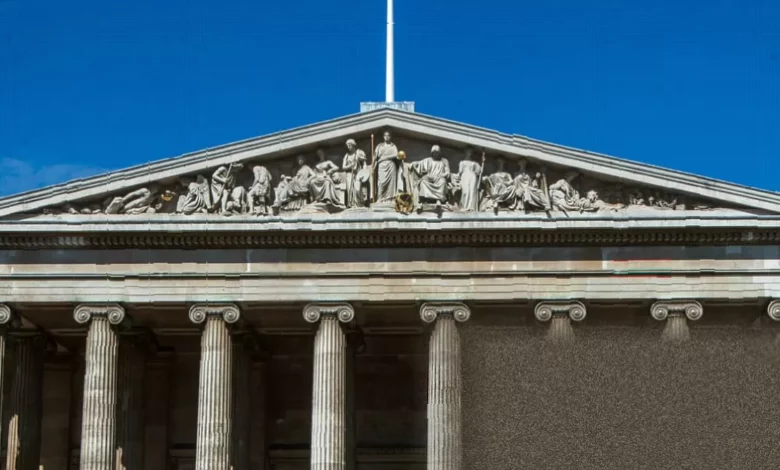
The Palestinian ambassador to the UK, Husam Zomlot, has called for Foreign Office intervention after the British Museum removed references to Palestine from its exhibits, describing the action as a historical “erasure” at a time when Palestinians in Gaza face what a UN independent commission has deemed genocide.
Zomlot wrote to the museum’s director, Nicholas Cullinan, on 9 April demanding the restoration of the name “Palestine” on a panel that had listed present-day countries within the ancient Levant, where it was replaced with “Gaza and the West Bank”. He also sought the reinstatement of “Palestine” and “Palestinian” on explanatory panels in the ancient Levant and Egyptian rooms. The ambassador had been invited to meet Cullinan and curators on 24 March but said he was given no undertaking the changes would be reversed. He declined a subsequent tour of the museum, writing that without corrective action or a clear commitment to address the issues, further engagement “could be interpreted as an endorsement of the current presentation”. He added he would welcome a tour once the necessary corrections are made.
The UK officially recognised the state of Palestine in September 2025, a step Zomlot argues should compel the museum to align its displays with government policy. He has appealed directly to the Foreign, Commonwealth and Development Office, saying: “I sent a letter to the minister in charge in the Foreign Office, and we are waiting for [a response].”
Changes to the exhibits and the museum’s rationale
The alterations became widely known after the Telegraph reported on 14 February that they followed concerns raised by the pressure group UK Lawyers for Israel (UKLFI). UKLFI had written to Cullinan arguing that “several maps and descriptions retroactively apply the term ‘Palestine’ to periods in which no such entity existed and risk obscuring the history of Israel and the Jewish people”. The group said applying a single name across millennia “erases historical changes and creates a false impression of continuity”, suggesting instead that regions be labelled by period-specific names such as Canaan, the Kingdoms of Israel and Judah, or Judea.
However, the changes predated the UKLFI letter. Cullinan reportedly saw the letter only after the Telegraph story was published. The British Museum has not explained its own reasoning, but UKLFI quoted the museum as telling them: “Audience testing has shown that the historic use of the term Palestine … is in some circumstances no longer meaningful.” The museum itself issued a statement saying: “We have not removed the term ‘Palestine’ from displays and continue to refer to it across a series of galleries, both contemporary and historic, and on our website.” Photographic evidence appears to contradict this; the name does remain on some exhibits, such as maps of the ancient Middle East in the Egypt room.
Specific changes include replacing “Palestinian” with “Canaanite” on a panel about the Hyksos rulers of Egypt from the 18th to the 16th centuries BC, and removing references to Palestine and the Philistines from a text about the Phoenicians, who are now described as “locally known as ‘Canaanites’”. The museum has also stated it uses UN terminology for modern boundaries—Gaza, West Bank, Israel, Jordan—and refers to “Palestinian” as a cultural or ethnographic identifier where appropriate.
Historical and political context of the name ‘Palestine’
Scholars of the ancient world have broadly questioned the need for the change. The origin of the name “Palestine” is believed to derive from the Egyptian and Hebrew word peleshet, referring to the Philistines, an Aegean people who settled on the Mediterranean coast in the 12th century BCE. The term first appears in Greek literature in the 5th century BCE in the writings of Herodotus. Later, the Romans renamed the province of Judea “Syria Palaestina” in 135 CE after the Bar Kokhba revolt, a punitive measure intended to sever the link between Jews and the land. Historically, the term was used to describe a broad region between Syria and Egypt, without precise geographic definition, and lacked political significance for centuries—it was not an administrative unit within the Ottoman Empire.
Marchella Ward, a lecturer in classical studies at the Open University, said: “The decision to remove Palestine has nothing to do with historical accuracy. It’s no less accurate than any other term. In fact, given that it’s used so frequently in historical sources rather than in biblical sources, one might say it’s more accurate than other terms.” She noted that ancient peoples did not think in terms of nationalities, and the names outsiders used often bore no relation to what people called themselves.
Josephine Quinn, professor of ancient history at Cambridge University, argued it is “futile and distorting to portray names used thousands of years ago in the Middle East as relevant to what should happen now”. She added: “The worrying thing for me is the idea that it matters, that ancient categories have any direct relevance to politics today, or that they can justify or excuse genocide in the contemporary world.”
The changes come amid an ongoing conflict in Gaza. Zomlot noted that in September 2024, Israel bombed the most important storage depot of ancient artefacts in Gaza City, pulverising three decades of archaeological work. A UN Independent International Commission of Inquiry report released on 16 September 2025 concluded that Israel has committed genocide against Palestinians in the Gaza Strip, finding that Israeli authorities and forces committed four of the five genocidal acts defined by the 1948 Genocide Convention.
Government stance and wider reactions
The British Museum is publicly funded but run by an independent board of trustees chaired by former Conservative chancellor George Osborne. A British government spokesperson said: “Museums and galleries in the UK operate independently of the government, which means that decisions relating to the management of their collections are a matter for their trustees.” Zomlot hopes, nonetheless, that the government will use its influence to persuade the museum to align with the UK’s recognition of Palestine.
The Palestinian Embassy has expressed serious concern that attempts to cast the name “Palestine” as controversial risk normalising the denial of Palestinian existence, especially when Palestinians in Gaza face genocide and those in the West Bank face ethnic cleansing. A petition calling on the British Museum to reverse its decision has garnered thousands of signatures. The museum has also faced criticism over its sponsorship by BP and its alleged complicity in the conflict, with protests held outside the building. In May 2025, the museum hosted an event marking the anniversary of Israel’s founding, organised by the Israeli embassy in London.