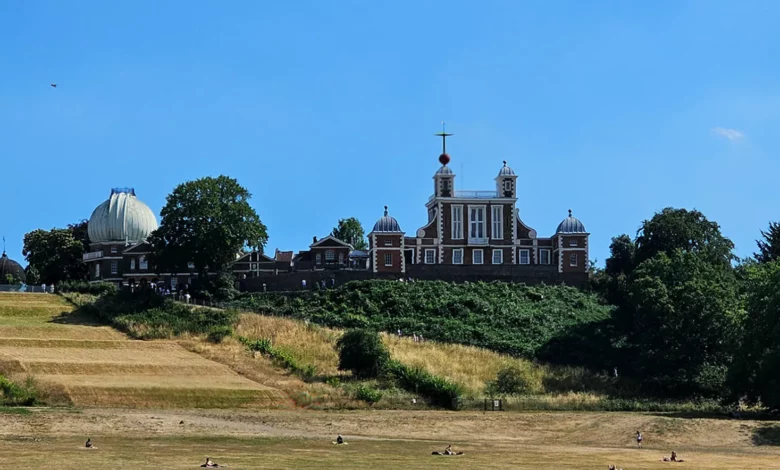
The Royal Observatory in Greenwich is offering heavily discounted entry every Tuesday throughout June 2026, with tickets available for a flat rate of £10 per person — a significant saving on the usual prices of £24 for adults and £12 for children.
The discount applies to all visitors, adults and children alike, for any Tuesday in the month. Tickets must be booked in advance, with the observatory advising early booking to secure a place.
Perched on the hill above Greenwich Park, the Royal Observatory is one of London’s most important scientific landmarks. Established in 1675 by King Charles II, it was Britain’s first purpose-built scientific institution. Its founding mission was to solve the “longitude problem” that had plagued seafarers for centuries, by creating accurate star maps and charts that would allow ships to determine their position at sea. Over the following centuries, the observatory became a global centre for practical astronomy, producing star catalogues, precise timekeeping systems and The Nautical Almanac, a publication vital to maritime navigation.
The Prime Meridian and Greenwich Mean Time
The observatory is best known as the home of the Prime Meridian — the line of zero longitude that divides the eastern and western hemispheres — and as the birthplace of Greenwich Mean Time (GMT). In 1884, an international conference adopted the meridian as the global standard for longitude, a decision that remains in place today. Visitors can stand astride the line, with one foot in each hemisphere, a photographic moment that has become a rite of passage for many. The observatory’s work on timekeeping also produced GMT, which served as the world’s time reference until it was superseded by Coordinated Universal Time (UTC), though GMT is still widely used in the UK and during British Summer Time.
The original building, completed in 1676, is known as Flamsteed House, named after John Flamsteed, the first Astronomer Royal. Inside, the observatory houses a collection of historic telescopes and astronomical instruments, including the Great Equatorial Telescope — the largest historic telescope in the UK — which offered new views of the universe more than a century ago.
Guided tours and additional visitor information
For visitors wanting a deeper insight into the observatory’s history, guided tours are available for an additional £5 per person. The tours run daily at 11am, 3pm and 5.30pm. When booking a visitor ticket, simply scroll down the booking page and add a guided tour to the basket. The observatory is open daily except 24, 25 and 26 December. During summer — June to September — opening hours are 10am to 7pm (with a slight reduction in September), and the rest of the year 10am to 5pm. Refreshments can be purchased from stalls outside the main entrance or at the Parkside Café located down the hill at the National Maritime Museum.
Accessibility is a key consideration. The Astronomy Centre galleries are fully accessible via lift, but older parts of the observatory — including Flamsteed House and the Great Equatorial Telescope — may have restricted access due to their historic nature. Some guided tours also have limited accessibility. Visitors needing extra help can request assistance, and guide or assistance dogs are welcome. The observatory is located at the top of a hill in Greenwich Park, with accessible routes available, though some are steep. Public transport options include trains to Greenwich or Maze Hill stations, the DLR to Cutty Sark, and various bus routes; riverboat services also run to Greenwich.
Ongoing redevelopment: the First Light project
The Royal Observatory is currently undergoing a major redevelopment programme called “First Light”, which began in autumn 2025 and is expected to be completed by spring 2028. Funded in part by a £9.7 million grant from the National Lottery Heritage Fund, as part of a total project cost of £77 million, the project aims to conserve the historic listed buildings, improve visitor experience, enhance accessibility and create a more sustainable operation. Plans include a new entrance pavilion, improved landscaping, renovated galleries, new event spaces and — for the first time — making areas such as the Great Equatorial Telescope accessible to visitors. Some phased closures are in place during construction: the Peter Harrison Planetarium closed in September 2025, but the Prime Meridian line and Flamsteed House remain open throughout. The observatory is also undertaking decarbonisation works, including the installation of air source heat pumps, to reduce its environmental impact.
Educational and family activities
The observatory is described as a “starry-eyed adventure” for families, with interactive exhibits, planetarium shows and the chance to stand on the Prime Meridian. An onsite schools programme offers astronomer-led workshops and planetarium shows for various key stages, restarting in January 2026. Adult astronomy courses are also available for those wanting to study the universe in greater depth.
The Royal Observatory is part of Royal Museums Greenwich, which also includes the National Maritime Museum, the Queen’s House and the Cutty Sark, all located nearby. The observatory marked its 350th anniversary in 2025. For visitors on a low income, a special £3 ticket is available for those receiving certain government benefits.