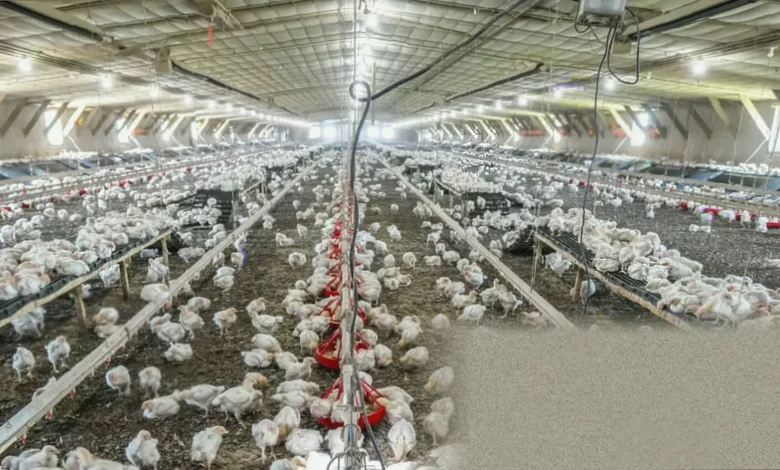
The global meat supply has quadrupled over the past sixty years, with the average person now eating twice as much pork and roughly six times as much chicken as their grandparents’ generation, according to data from the United Nations Food and Agriculture Organization (FAO). The supply of poultry rose from below 3kg per person in 1961 to 17kg in 2022, while pork supply doubled to 15kg per person over the same period. Beef, the most emissions-intensive meat, held steady at 9kg per person. Overall, average global meat supply climbed from 25kg per person in 1961 to 47kg per person in 2022.
The shift toward poultry is even more stark when measured in animals: in 1961, roughly two chickens were slaughtered per person each year worldwide; by 2025 that figure is projected to reach nine per person. Chicken is now the dominant meat in mature markets such as the United States, surpassing the combined intake of beef and pork, and the global poultry market is expected to reach 173 million tonnes by 2034, driven principally by rising demand in Asia, notably China, India, Indonesia, Pakistan and Vietnam. Pork consumption, which represents about 34% of global meat intake, increased by 77% between 1990 and 2022 to reach 113 million tonnes, although it now faces competition from poultry and plant-based proteins in middle- to upper-income markets such as China, Mexico and Brazil. Developed countries are projected to cut per capita pork consumption by 2% by 2033, even as countries like Vietnam, the Philippines and Thailand increase their intake. Global beef consumption, meanwhile, is projected to reach 59.5 million metric tonnes in 2026, a slight year-on-year decline driven largely by reduced consumption in China. Over the past 46 years, however, global beef consumption has risen by an average of 0.8% annually, and China and Hong Kong together became the world’s largest beef importers in 2017.
Environmental cost of rising meat demand
Agriculture is the second most polluting sector of the global economy, and the FAO’s review of the science on meat supply and demand forecasts that its planet-heating emissions will rise by 7.6% over the next decade, with livestock responsible for an estimated 80% of that increase. Animal agriculture already accounts for 12–20% of global greenhouse gas emissions, according to the FAO data, and is a leading cause of biodiversity loss. Methane and nitrous oxide from livestock are particularly potent. Beef production is the most emissions-intensive meat, emitting over 300kg of CO₂-equivalent per kilo of protein produced, compared with below 50kg for chicken. Cattle (raised for both beef and milk) contribute around 62% of total livestock emissions, followed by pigs at 14% and chickens at 9%.
The environmental footprint extends beyond emissions. Agriculture alone threatens 86% of species at risk of extinction, and over two-thirds of all agricultural land is used to grow feed for livestock, while only 8% is used for food for direct human consumption. In Brazil, four-fifths of the Amazon rainforest has been deforested for livestock farming. The FAO report also found that about 14% of meat and milk is lost during production or wasted after reaching supermarket shelves and restaurants.
FAO’s framing draws criticism from researchers
The Intergovernmental Panel on Climate Change (IPCC) has identified a shift from meat-heavy to plant-rich diets as one of the most effective demand-side actions for cutting greenhouse gas emissions. Yet the FAO report, commissioned as a comprehensive assessment of livestock’s contribution to food security, sustainable food systems, nutrition and healthy diets, stops short of recommending that wealthy nations eat less meat, even as it acknowledges that high-income countries are “driving excessive consumption” of animal products.
“This report documents the problem clearly but stops well short of that conclusion,” said Cleo Verkuijl, a senior scientist at the Stockholm Environment Institute, who was not involved in the report. She argued that the fundamental issue is the mandate: “The report sets out to help policymakers identify entry points where interventions support the positive contributions of animal-source foods to healthy diets. That may be the right framing for food-insecure populations, but it’s the wrong premise for wealthy nations, where the health and environmental case points toward reduction.”
Matthew Hayek, a food systems researcher at New York University, said the report “largely sidesteps” the implications of high meat consumption in rich countries and the climate benefits of reducing it. “Instead, the authors present environmental issues merely as consumer perceptions or future research needs,” he said. “Their framing obscures the vast literature and strong evidence base showing that high levels of meat consumption have negative environmental impacts and are linked to a range of adverse health outcomes.” Hayek has previously criticised earlier FAO reports that cited his research, alleging “egregious errors” that downplayed the climate benefits of reducing meat, and a lack of engagement with scientific criticisms that one researcher described as “like hitting a brick wall.”
Daniela Battaglia, a livestock development officer at the FAO and co-author of the report, said the organisation’s work was evidence-based and that different scientists might hold different opinions. Its message to policymakers, she said, was to reduce specific problems associated with meat production, such as antimicrobial resistance and greenhouse gas emissions, rather than to reduce livestock numbers. “We have the technologies, we have the innovation, we have the knowledge to significantly reduce emissions,” Battaglia said. “It’s also a matter of trade-offs. Animal-source food are still important as a source of nutrients … you have to make a balance towards trying to reduce the negative impact and maximise the positive one.”
The FAO said the report would be followed by another later this year that will examine environmental sustainability in greater detail. The regional disparities in meat consumption remain stark: in low- and middle-income countries, where food insecurity is most prevalent, animal foods are many times more expensive relative to incomes than in wealthy nations, where doctors and climate scientists advise eating less meat. “While high-income countries still have quite high and stable consumption, low-income countries are still constrained by the affordability of [animal products],” Battaglia said.