A tropical bird, the western reef heron, has been sighted in the United Kingdom for the first time, drawing hundreds of birdwatchers to north Wales and prompting experts to link the arrival to a northward shift in species ranges driven by climate change.
The heron was first spotted in Foryd Bay in Gwynedd over the weekend of June 7–8 before moving to nearby Caernarfon harbour, where it fed among the boats with the medieval castle as a backdrop. Simon Hugheston-Roberts, who made the initial sighting while out on a walk, told the BBC he recognised the bird from his experience birdwatching in Africa and the Middle East. “I was lucky to see a small dark heron flying over me on the shore,” he said. Ian Lycett, who travelled from London to see it, described the experience as “a long drive … but well worth the effort” and called the close-range views in the harbour “fantastic”.
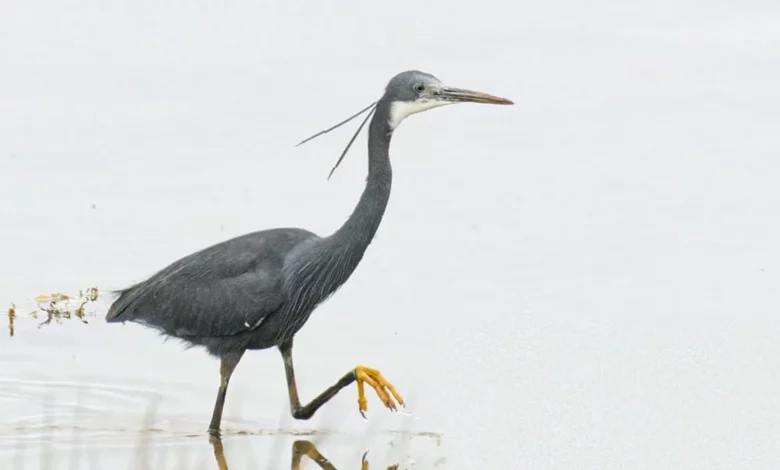
The western reef heron (Egretta gularis) is similar in size and structure to the common little egret but is distinguished by its blue-grey plumage — a dark morph with a distinctive white throat. According to the British Trust for Ornithology (BTO), it has a larger, yellower bill and extended yellow on its thicker legs. “They’re very striking,” said Nick Moran, training manager at the BTO. “Unlike anything else we have here in the UK.” Evidence from the research briefing suggests the same bird may have been present in Pembrokeshire nearly a month earlier, on 13 May, on Sandy Haven beach. Experts believe the individual is an adult and likely arrived from Europe rather than directly from Africa, possibly having hatched there, and may have been blown off course by recent strong southerly winds.
Climate change driving northward shift
Ornithologists say the heron’s appearance is part of a broader trend in which formerly tropical and southern European species are moving poleward as the climate warms. “The fact that they are getting here in the first place, and then surviving, is likely to be because of increasingly mild winters,” Nick Moran said. “It’s much easier to survive in the winter now than it was 50 years ago because we don’t see shallow water bodies freezing over with any regularity. These herons and egrets typically feed in relatively shallow water.”
Alexander Lees, reader in biodiversity at Manchester Metropolitan University and chair of the British Ornithologists’ Union records committee, described the western reef heron as the latest of “what were formerly largely tropical species whose distributions are shifting north with climate change”. He pointed to the first breeding record of zitting cisticola — a Mediterranean warbler — in Suffolk in the summer of 2025. “The reason that species didn’t historically breed here is because it’s very sensitive to harsh winters. It couldn’t survive because if we had a prolonged cold spell, they all die. But we no longer get those prolonged cold spells.”
The research briefing notes that climate change is driving a consistent poleward shift in the distribution of bird species, exceeding 11 kilometres per decade. The timing of breeding and migration has also become earlier, averaging one to three days per decade. This can create phenological mismatches, where birds arrive at breeding or feeding grounds too early or late to coincide with peak resource availability, reducing their reproductive success. While some resident and short-distance migrants may benefit from warmer temperatures, long-distance migrants, habitat specialists and cold-associated species are often negatively affected. The overall wild bird population in Britain has declined significantly since 1970.
A pattern of arrivals
The western reef heron is not the only tropical visitor to have been recorded in recent days. A squacco heron — another rare species typically found in southern Europe and north Africa — has been drawing birdwatchers to Lincolnshire this week. According to the BTO, the bird is seen in the UK only a few times a year; recent sightings include locations near Crowland and Deeping High Bank.
Other notable tropical sightings in the UK over the last few years include the black-winged kite, which first visited in 2023 and has been seen in Norfolk; the brown booby, first recorded in Kent in 2019 and subsequently spotted in Cornwall; and the white-rumped swift, which first colonised Spain from north Africa in the 1960s and was recorded in Britain for the first time in 2018, in Yorkshire. In 2022, the RSPB described sightings of European bee-eaters as an “unmissable sign” that the nature and climate emergency had reached Britain. More recently, reports have emerged of European bee-eaters, golden orioles and European serins following a May heatwave.
Western reef herons have increasingly been recorded in southern Europe, including Spain and France, and had been expected to appear in the UK, Alexander Lees noted. Nick Moran cautioned against expecting a sudden influx of the species, but said more sightings were likely. “I don’t expect we’ll have dozens of records by this time next year, but I strongly suspect we’ll get more.”