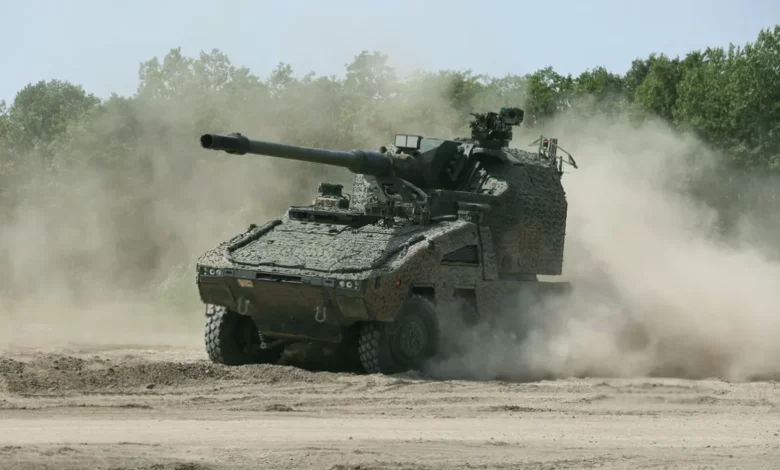
Britain’s army will soon operate remote-controlled artillery under a £1bn programme to acquire 72 RCH-155 howitzers, the Ministry of Defence has confirmed. The deal marks the largest single investment in the army’s indirect fire capability in decades and is intended to close a critical gap opened when the UK donated its own AS90 guns to Ukraine.
Next-generation capability
Each Remote-Controlled Howitzer 155mm (RCH-155) is capable of firing eight rounds per minute at targets up to 70km (43.5 miles) away. The weapon is mounted on a Boxer chassis that can travel at up to 100km/h (62mph) and redeploy rapidly, making it harder for adversaries to counter-battery fire, the MoD said. The system is operated by just two soldiers from a protected crew compartment, with firing controlled at the push of a button.
The contract for the howitzers has been awarded by the Organisation for Joint Armament Cooperation (OCCAR) on behalf of the British Army to ARTEC GmbH, a joint venture between European defence firms KNDS and Rheinmetall. First deliveries are expected in 2028, with a minimum deployable capability due within the decade.
Deputy Chief of the General Staff, Lt Gen Simon Hamilton, said the RCH-155 would be the “first significant milestone in replenishing” Britain’s artillery arsenal. “Britain answered the call for aid by providing artillery systems to Ukraine at the outbreak of the war,” he said. “We knew the risk – the gap in our warfighting capability – that this would present.” The Archer mobile howitzer system will serve as an interim solution until the new guns become operational.
Manufacturing and job creation on British soil
The guns will be manufactured in the UK, with Rheinmetall’s Telford facility producing the barrel, breech, recoil system and trunnions. The MoD says British steel from Sheffield Forgemasters will be used, supporting the government’s Steel Strategy launched in March 2026. Sheffield Forgemasters – acquired by the MoD in 2021 – is working to reinstate the manufacture of gun barrels, a capability that has been absent for approximately 20 years, to supply Rheinmetall. The MoD has invested over £420 million in the company to bolster sovereign steelmaking, and a £210 million machine shop construction is under way.
The Boxer drive module – comprising the chassis, engine and drive train – will be built at KNDS UK’s state-of-the-art facility in Stockport, which has been a significant employer in the region since 1915 and sources over 60% local content for the Boxer programme. Rheinmetall’s Telford site is supported by a £53 million contract for long-lead items and a £30 million contract for the establishment of a dedicated “Gun Hall”.
The MoD estimates the programme will support at least 500 jobs across the UK: 100 new skilled roles at Telford, 100 at Stockport, and a further 300 in the wider supply chain. Defence Secretary John Healey MP said: “This major investment is defence delivering for the battlefield and for Britain’s economy. By securing next-generation artillery with Germany, not only are we rearming to strengthen Nato against growing Russian aggression, but also creating highly skilled jobs here in Britain. This is what we mean when we say defence is an engine for growth – investment in our security that powers new jobs across the country.”
Strategic context and Nato strength
The programme falls under the Trinity House Agreement, a UK-German collaboration signed in October 2024 to strengthen European defence and security ties, deepen interoperability between allied forces, and increase industrial capacity in armoured vehicles and artillery. Key “lighthouse projects” under the agreement include developing deep precision strike capabilities and enhancing air defence systems.
Healey said the investment would help strengthen Nato against the growing threat of Russian aggression. The UK government has committed to raising defence spending to 2.6% of GDP from 2027, after Nato allies set a target of 5% of GDP by 2035. The government has stated it is making the largest sustained increase in defence spending since the Cold War, with an additional £5 billion this financial year and £270 billion across this Parliament.
Nevertheless, concerns persist about the adequacy of the spending trajectory. Former defence chief Lord Stirrup warned in February that the UK risked being seen as a “paper tiger” and needed to “put our money where our mouth is”. He has called for a “decade of sustained investment” to rebuild defence capabilities and said the UK is “badly exposed” after depleting stores through aid to Ukraine. An open letter from three former defence secretaries, retired senior military chiefs and ex-MI6 head Sir Richard Dearlove published earlier this year said Britain’s actions were falling “dangerously short” of meeting treaty obligations. “We are deluding ourselves if we believe Russia and our other adversaries are unaware of this,” the letter stated. “Commit now to a bold, credible and measurable path to spending 5% of GDP on core defence.”
Former Nato chief Lord George Robertson has criticised the government’s defence spending as “corrosive complacency”, warning that Britain is “underprepared” and its national security is “in peril” due to an “ever-expanding welfare budget”. Reports have indicated a potential £28 billion shortfall in the MoD’s budget.
The RCH-155 procurement is notably expensive compared with other howitzer deals: Egypt procured 200 K9A1s for approximately £1.26 billion, while Finland’s contract for 112 K9s was valued at around £473 million. However, the MoD argues the investment is essential for both battlefield capability and the UK’s industrial base. Recent legislation introduced in May 2026 could give the government powers to nationalise British Steel if deemed necessary for public interest, national security and economic stability, underscoring the strategic importance of domestic supply chains.