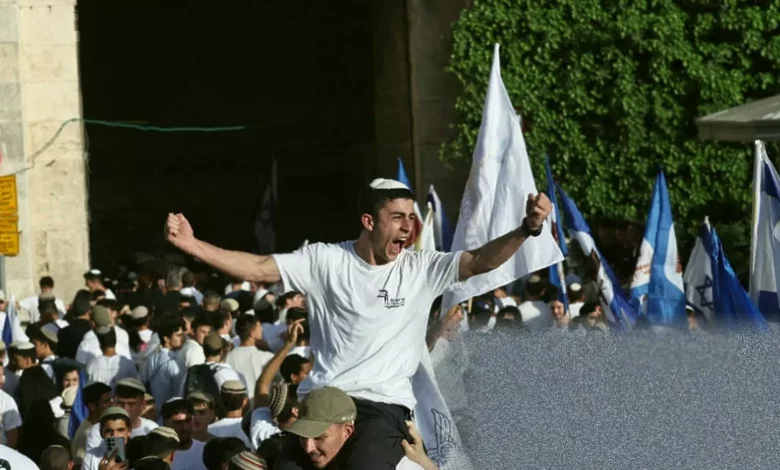
Nationalist marchers chanted “Death to the Arabs” in Jerusalem during the annual state-sponsored parade that marks the city’s capture and annexation, as thousands of demonstrators flooded the Old City with slogans that included “May your villages burn” and “Gaza is a graveyard”.
Other chants heard among the crowds on Thursday, May 14, 2026, included “Muhammad is dead” and “Arab sons of whores”, while in previous years marchers had shouted “burn Shu’afat”, a reference to a Palestinian neighbourhood in East Jerusalem. The annual assertion of Jewish control over the eastern half of the city has grown more extreme in recent years, with the event now drawing participants bused in from across Israel and from settlements in the occupied West Bank in an operation funded by the Jerusalem municipality, government ministries, the Prime Minister’s office and the Kehillot Foundation – an organisation linked to the Garin Torani movement, which aims to move religious Jewish families into mixed neighbourhoods.
Most Palestinian shop owners in the Muslim quarter had shuttered their businesses and left before the march began, and Israeli authorities ordered all shops in the Old City to close by noon. A 19-year-old marcher, Ariel Amichai from Modi’in, said he believed Jerusalem Day was the only day Jews could enter the Muslim quarter through the Damascus Gate – a claim that is incorrect, as both Israelis and Palestinians use the gate daily. Asked what message the parade was meant to send to Palestinians, he replied: “That they must leave. This is our country. And they can’t just be here and try to stab us or kill us.”
As the march passed through the Old City, members of radical Jewish groups who had entered the Muslim quarter scuffled with Palestinian residents who had remained, with both sides throwing chairs at each other before police separated them. The national security minister, Itamar Ben-Gvir, later made his way to the al-Aqsa mosque compound – known to Jews as the Temple Mount – where he danced with supporters singing “the Temple Mount is in our hands” and unfurled an Israeli flag. Writing on Telegram on Thursday evening, Ben-Gvir said: “59 years after the liberation of Jerusalem, I raised the Israeli flag on the Temple Mount and we can proudly say: We have returned governance to the Temple Mount.” The finance minister, Bezalel Smotrich, also took part in the march.
Holy site at the heart of the conflict
The al-Aqsa mosque compound is Islam’s third-holiest site and Judaism’s holiest place, making it one of the most contested religious spaces in the world. Since Israel captured East Jerusalem from Jordan in June 1967, an informal arrangement known as the “status quo” has governed the site: Muslims are permitted to pray there, while non-Muslims may visit but are forbidden from praying. Jordan, through the Jerusalem Waqf department, has long overseen the holy sites under that agreement. Ben-Gvir, who has repeatedly visited the compound since taking office, has led a campaign to erode the 59-year-old status quo, arguing for increased Jewish access and prayer rights. His actions and statements are widely seen as a direct challenge to the arrangement that has, for decades, prevented outright religious confrontation at the site.
Counter-protesters and the call for Kiddush Hashem
Once most Palestinian residents had left the Old City, much of the tension shifted to confrontations between government-backed marchers and members of the progressive grassroots movement Standing Together, which had come to protect Palestinian residents from political violence. The organisation, which mobilises Jewish and Palestinian citizens of Israel in pursuit of peace, equality and social justice, deployed a record 400 volunteers in hi-vis purple vests, according to organiser Suf Patishi. “We wanted to really cover each and every corner of the city to make sure that we prevent attacks against Palestinians,” Patishi said. “Yes, it is dangerous to us, but nothing like the danger to the Palestinians that are living here.”
Among the protective cordon of counter-protesters were a few religious Jews. One ultra-orthodox man with a long grey beard and a gold coat, who gave his name only as David, said he had travelled from northern Israel. “I’ve become appalled by the violent behaviour of people in my community,” David said. “I’m a man of faith, religious, and they’re doing this in our name, and I felt I should do something to contrast that. This is a desecration of God’s name, so the only way to remedy that is to do the opposite, a Kiddush Hashem, a sanctification of God’s name.”
The term Kiddush Hashem refers to conduct that reflects positively on the Jewish people and God, often through acts of righteousness, integrity and compassion, standing in direct opposition to the Chillul Hashem – the desecration of God’s name – that David said the nationalist marchers represented. The parade, formally commemorating the “reunification” of East and West Jerusalem after the 1967 Six-Day War, has a history of controversy and violence. In 2021 it contributed to the start of a broader Israel-Palestine crisis; in 2022 marchers beat and pepper-sprayed Palestinian residents, wounding at least 79 people; and in 2015 the Israeli High Court of Justice rejected a petition to prevent the parade from marching through the Muslim Quarter but warned police to arrest participants shouting racist slogans. Jerusalem Day was officially established as a national holiday in Israeli law in 1998.