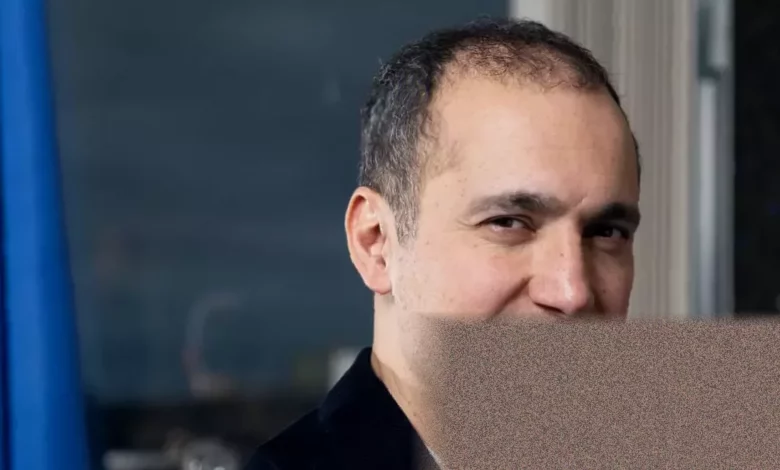
The 2026 Stockholm Water Prize, the world’s most prestigious award for contributions to water resources, has been awarded to Professor Kaveh Madani, a scientist whose groundbreaking work has been conducted under extraordinary personal and political pressure. The Iranian-born academic, currently the Director of the United Nations University Institute for Water, Environment and Health (UNU-INWEH), is recognised for transforming how water crises are understood and managed.
At 44, Madani becomes the youngest laureate in the prize’s history, the first UN official and the first former politician to receive the honour, often dubbed the “Nobel Prize of Water.” He will receive the award from His Majesty King Carl XVI Gustaf of Sweden during World Water Week in Stockholm this August.
A Scholar in Exile
Speaking from exile, Madani said the accolade left him feeling “encouraged and humbled,” but the moment was bittersweet. “The sad part is that I don’t know if my compatriots [in Iran] will be celebrating it with me,” he said. “I don’t even know if they will hear about this because they’re disconnected at the moment.”
Madani’s current role leading a UN thinktank caps a distinguished academic career that has included posts at Imperial College London, Yale University, and the University of Central Florida. He is also a Research Professor at the City University of New York’s CUNY-CREST Institute. His research portfolio includes over 300 publications and previous honours including awards from the American Geophysical Union and the European Geosciences Union.
From Childhood Trauma to “Water Bankruptcy”
His relationship with systemic disruption began early. At six years old, an Iraqi missile struck near his Tehran home while he was watching television. “I remember the presenter saying, ‘Dear children …’ and then there was an explosion. Everything went dark,” he recalled, describing a scene of devastation that has remained a recurring nightmare.
He left Iran on a passport that “severely limits your options,” finding refuge in Sweden where an immigration officer’s decision to grant him a visa, as he puts it, “shaped my whole life.” He earned a Master’s in Water Resources from Lund University in Sweden, followed by a PhD in Civil and Environmental Engineering from the University of California, Davis, after a B.Sc. in Civil Engineering from the University of Tabriz.
It was early in his career that he began applying game theory and decision analysis to water management, challenging conventional models that assumed cooperation. This work led him to a critical conclusion: many severe water shortages were primarily a result of mismanagement, not just climate change. He coined the concept of “water bankruptcy” to describe a permanent state where long-term use exceeds renewable supply, causing irreversible damage. “The world has moved beyond a ‘water crisis’,” he argues, “and entered an era of global water bankruptcy.”
A Dangerous Foray into Politics
In 2017, in an extraordinary move, the Iranian government invited the diaspora scientist home, offering him a cabinet-level position as Deputy Head of the Department of Environment. He also served as Vice President of the UN Environment Assembly Bureau. Madani accepted, with one condition: “I didn’t want to end up in jail.”
His hope for change was immediately tested. Upon arrival in Tehran, he was arrested at passport control by the Revolutionary Guards—a parallel power structure to the elected government—and interrogated. “No one, not even the government, could locate me,” he said.
Despite the “bumpy start,” he pushed for internal reforms, appointing women to senior positions and taking his warnings about water mismanagement directly to the cabinet. However, hardliners swiftly reframed his work as sabotage. He was accused of being a spy for Western intelligence agencies, labelled an “infiltrator,” a “water terrorist,” and even a “bioterrorist.” Some alleged he aimed to destroy Iranian agriculture and weaken the country by promoting reliance on genetically modified food.
“You read it and you laugh. But after repeated interrogations you realise they are serious,” Madani said. He credits his training in game theory with helping him survive the interrogations, by understanding the logic of his accusers.
The pressure intensified in 2018 amid a wider crackdown on environmental experts. Several conservationists were jailed. One, the Iranian-Canadian professor Kavous Seyed-Emami, died in custody under disputed circumstances. After multiple arrests and interrogations, Madani resigned and fled the country in April 2018, going into hiding before resurfacing in the United States.
A Global Perspective on a Shared Crisis
Madani is quick to stress that the perilous state of water security is not unique to Iran. He points to “day zero” crises in Cape Town, Chennai, and São Paulo, and the vanishing waters of the Aral Sea, the Dead Sea, and the Great Salt Lake in the US. “It’s everywhere,” he said.
He is equally clear that political change alone is not a panacea. “There is this belief that Iran would become Switzerland overnight if the Islamic Republic disappeared, but if day zero arrives and the reservoirs are empty, it doesn’t matter who is in power,” he noted.
The current conflict in the Middle East, he argues, has buried vital environmental conversations. “More than 3 million people have been displaced. If there is no peace, no one gives a damn about the environment.” The damage will be lasting, with strikes on oil facilities leading to chemicals falling as acid rain, contaminating soil and water for years.
Now serving as an international civil servant, he must navigate diplomatic protocols, even when events in his homeland weigh heavily. “I feel like I’m working with a map of the world in which Iran would be dark because anything I say about it is politicised,” he explained.
In his prize acceptance statement, he distilled a core message: water does not wait for politics. “Water bankruptcy is a common threat that transcends every military line,” he wrote. “We must recognise our shared vulnerability if we are ever to find our shared peace.”