The UK may see a handful of hantavirus cases linked to an outbreak on a cruise ship, but an expert leading research into the virus has stressed it is “very, very unlikely” the situation will develop into anything resembling the Covid-19 pandemic.
Expert: Hantavirus ‘very, very unlikely’ to cause pandemic
Professor Emma Thomson, who heads the MRC Centre for Virus Research at Glasgow University, said any potential cases in the UK could be managed “very easily with the existing facilities we have”. Her centre is one of only two in the country currently researching hantavirus.
“It is very, very unlikely that something like this will turn into something akin to the Covid-19 pandemic,” she told BBC Radio Scotland’s Breakfast programme.
Professor Thomson said it “wouldn’t be very surprising if we found one or two positive tests in the UK, one or two positive people”, adding that this would be “in keeping with other countries and what they have seen”.

Outbreak on the MV Hondius
The concern follows an outbreak of the Andes strain of hantavirus on the MV Hondius, a Dutch-flagged cruise ship that departed from Ushuaia, Argentina, on a 45-day voyage planned to visit Antarctica and South Atlantic islands. The ship encountered difficulties docking in Cape Verde and eventually disembarked passengers in Tenerife, Canary Islands, Spain, where repatriation efforts began.
As of 15 May 2026, at least 11 cases have been reported among passengers, including eight confirmed, two probable and one inconclusive. Three people have died, including the first passenger to fall ill, who became sick on day five of the voyage and died on day ten — the first known hantavirus death on a cruise ship. The incubation period for Andes virus can be up to six weeks, meaning further cases could still emerge.
Investigations suggest the initial infection may have occurred ashore in Argentina or Chile before passengers boarded the ship. The virus can spread through contact with infected rodents — via urine, saliva or faeces — or, more rarely, through close contact with an infected person.

The Andes strain is the only form of hantavirus known to be transmissible between humans, but Professor Thomson stressed it is “not nearly as transmissible” as viruses such as measles. Human-to-human transmission requires prolonged or close contact — within two metres — with a symptomatic infected individual. Transmission routes can include direct physical contact, saliva, airborne droplets, breastmilk, across the placenta and through the digestive tract.
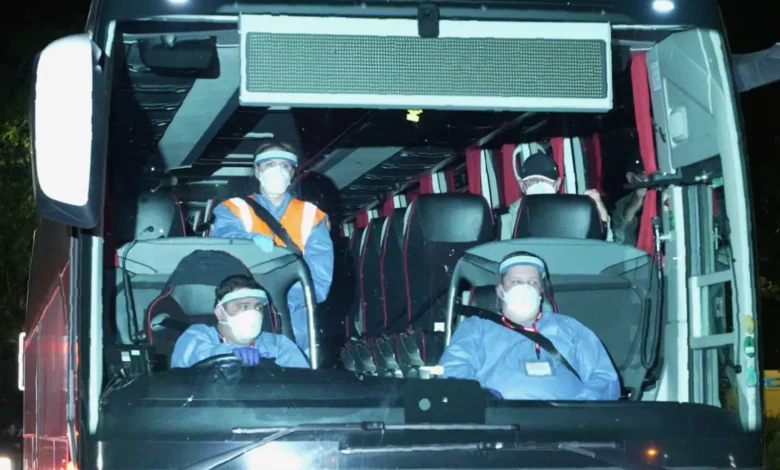
Ten Britons from the South Atlantic islands of St Helena and Ascension, who were on the ship, are being “brought to the UK to complete their self-isolation as a precautionary measure”, the UK Health Security Agency said. Some passengers evacuated to the UK were housed at Arrowe Park Hospital in Merseyside, a facility previously used for Covid-19 quarantine, where they underwent clinical assessments and testing. Six individuals who tested negative for the Andes strain and remained asymptomatic have since returned home or to suitable accommodation to complete a 45-day isolation period.
Public Health Scotland has warned that a “small number” of individuals in Scotland may have had potential contact with the virus. The agency is actively tracing and monitoring these contacts for up to 45 days from their last potential exposure, with precautionary testing and ongoing care. Currently, there are no known cases of hantavirus in Scotland, and the risk to the general public is considered very low. The UK Health Security Agency is leading the monitoring and public health advice, working with international partners including the World Health Organization, and has published guidance for healthcare providers on the isolation and management of suspected cases.

Research efforts and treatment gaps
Professor Thomson noted that the Andes virus has existed in Argentina for many years, with previous outbreaks. “Often in the outbreaks in Argentina they are very, very limited, so just small numbers of people affected,” she said. “Obviously the virus, if you get it, it is concerning but it is not something we would expect to cause problems on a very large scale.”
Argentina is currently experiencing a significant increase in hantavirus cases and mortality. Since June 2025, the country has reported 101 confirmed infections and 32 deaths, a substantial rise compared to previous years. This surge has been partly attributed to climate change, which may be expanding rodent habitats and increasing human exposure. Person-to-person transmission of the virus was first documented in Argentina in 1996. The Andes strain can cause severe disease, with a mortality rate that can approach 60% in hospitalised patients in some parts of southern Chile — higher than Covid-19, but its transmissibility is considered far lower.
There is currently no vaccine or specific treatment for hantavirus. The MRC Centre for Virus Research is working to see if existing antiviral treatments could be used against the Andes virus. Professor Thomson’s group, which has previously investigated Seoul hantavirus in Scotland, is also using methods to think about new treatments. Twenty passengers from the MV Hondius have volunteered for research to help find new solutions. “There are many gaps, as you know there is no vaccine and there is no treatments,” Professor Thomson said.