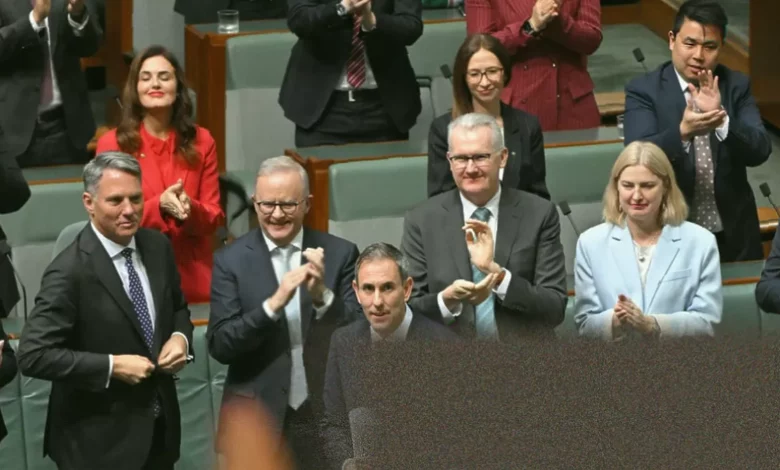
Treasurer Jim Chalmers has delivered what he called the “most important and ambitious budget in decades” — one that think tank the Centre for Policy Development said marks a “clear shift” by Labor toward addressing intergenerational and wealth inequality, as well as prioritising a more resilient economy. The assessment from research director Warwick Smith came as the government unveiled sweeping tax reforms that will limit negative gearing on residential property to new builds from July 2027 and replace the 50% capital gains tax discount for assets held over 12 months with a cost-base indexation model, under which tax is paid only on the profit above inflation. A minimum 30% CGT rate will apply from the same date.
The changes, which the government says aim to rebalance the system for workers and first-home buyers, are projected to raise approximately $3.6 billion over five years. Treasury modelling estimates they will help an additional 75,000 Australians into home ownership over the next decade, while limiting the impact on property prices to a 2% slower growth rate — equivalent to around $19,000 less on a median-priced home over a couple of years. The effect on median rents is expected to be minimal, at roughly $2 a week. Existing investment properties purchased before the budget announcement cut-off of 7:30pm AEST on May 12, 2026, will be grandfathered until sold. New residential properties will be exempt from the CGT changes, allowing investors to choose between the existing 50% discount or the new indexation model.
Small business and worker support
Alongside the property tax overhaul, the budget makes the $20,000 instant asset write-off for small businesses permanent and introduces a two-year loss carry-back measure for companies with a turnover of up to $1 billion. A loss refundability scheme for start-ups will begin in 2028-29. Small business software provider MYOB welcomed the changes; chief executive Paul Robson called the permanent write-off a “practical reform” that gives businesses greater certainty to invest, while noting the loss carry-back would help firms manage uncertainty and retain staff. For workers, a new $250 Working Australians Tax Offset (WATO) will be introduced from the 2027-28 income year, alongside an instant tax deduction of $1,000 for work-related expenses from 2026-27. The government says these measures will benefit more than 13 million working Australians, although some social services groups have pointed out that the WATO will not assist those unable to work or generate income.
Other measures include a minimum 30% tax rate on discretionary trusts from July 2028 (with certain exclusions), a $10 billion fund to increase the national fuel stockpile, an additional $53 billion in defence spending over the next decade, and a permanent 25% discount on fringe benefits tax for eligible electric cars above $75,000 from April 2027.
Reactions to the reforms
The negative gearing and CGT changes have drawn sharp criticism from industry groups and the opposition. Master Builders Australia chief executive Denita Wawn said the government’s “broken promises” on the tax incentives dilute positive features of the budget, warning the opportunity to “turbocharge housing supply has been lost”. Treasury itself has speculated the changes could lead to 35,000 fewer homes being built over a decade. Master Builders Australia welcomed the $2 billion fund for enabling infrastructure to support 65,000 additional homes, but warned that overall supply forecasts still fall short of the National Housing Accord target, amid declining construction productivity and workforce shortages. The group also praised measures to speed up skills assessments for migrant trades workers.
The Business Council of Australia gave a thumbs-up to productivity and resilience measures and said reducing regulatory costs by more than $10 billion a year was a “most welcome step”. However, chief executive Bran Black expressed concern about the “complexity and net impact” of the CGT and negative gearing changes, saying they risk making Australia “a less desirable place for investment”. Shadow Treasurer Tim Wilson confirmed the opposition would repeal the measures if elected, telling Sky News the prime minister was “red hot with rage” in the lead-up to the election, having promised not to touch the incentives. Wilson also argued the $250 tax offset would be consumed by inflation within six months. Barnaby Joyce, speaking to the ABC, described the changes as “destroying the inspiration” for Australians who work from nothing, and dismissed the government’s estimate of 75,000 new homeowners as a “fallacy”.
Greens leader Larissa Waters accused the government of favouring wealthy people and corporations, saying the decision to grandfather existing settings “bakes that inequality in”. She lamented that the budget did not go further on taxing the gas and resources sector, and said it does nothing for renters. Independent MP Allegra Spender, a longtime advocate for tax reform, said she supported the changes to negative gearing and discretionary trusts but raised legitimate concerns about the impact on people investing in start-ups. Budget analyst Chris Richardson echoed that view, noting the CGT change is “rough if you made big bucks with your start-up” and warning “you don’t want to discourage people from taking risk”.
Fiscal outlook questioned
Ratings agency S&P Global Ratings said the budget’s “ambitious” tax and spending changes do little to improve the bottom line, despite a $34.5 billion boost to tax revenue over five years driven largely by higher commodity prices. As the Commonwealth approaches the politically sensitive $1 trillion debt threshold, S&P questioned whether the government could deliver on its plan to cut nearly $38 billion from NDIS spending over four years. Achieving the target of limiting overall spending growth to 2% a year, S&P analysts noted, “would mark a dramatic turnaround” from the average 24% growth rate between 2020 and 2024. The projected deficit for 2026-27 stands at $28.3 billion, with spending increasing by $47.5 billion. S&P also pointed to big-spending state governments that could make it harder for the Reserve Bank to bring inflation under control, and warned that extra billions channelled into off-budget vehicles such as the Clean Energy Finance and National Reconstruction Fund — averaging about $24 billion per year — were rising as industrial policy comes back into vogue.