Poland has announced plans to build a “drone armada” in partnership with Ukraine, a move Prime Minister Donald Tusk said would allow both countries – and Europe – to “leapfrog an entire technological epoch” and secure the continent from air attacks. Speaking at a conference on Ukraine’s postwar recovery in the city of Rzeszów, Tusk declared that Warsaw intends to combine Polish resources with Ukrainian technical and practical battlefield experience, warning that the threat environment demands a rapid response capability. The initiative comes as the European Union separately explores its own “drone wall” following a series of disruptions across the continent last year attributed to suspected Russian drones.
Poland’s drone strategy: a leap in European defence
“We know how unstable the situation is not only in the region, but in the whole world,” Tusk told the conference. “We also know how important the ability to react quickly is in the event of some provocation or aggression.” He added that it was “very important that these tragic and at the same time impressive experiences of Ukraine in the confrontation with Russia also become part of our knowhow on how to defend the Polish skies.” The Polish prime minister framed the drone armada as a direct strategic response to the war in Ukraine, arguing that the conflict had unexpectedly accelerated technological development in a way that could now benefit the entire continent. “As a consequence of this war, somewhat unexpected for the Russians, we will leapfrog an entire technological epoch so that in the near future, Ukraine, Poland, and Europe will be safe from air attacks,” he said.
The announcement was made during a conference focused on the “security and defence dimension” of Ukraine’s recovery, attended by Ukrainian Prime Minister Yulia Svyrydenko, who is expected to meet Tusk later on Monday. The initiative is seen as a deepening of bilateral defence cooperation, building on Ukraine’s extensive combat experience with drones – both offensive and defensive – since Russia’s full-scale invasion began. Poland’s proximity to Ukraine and its own concerns about Russian military activity on NATO’s eastern flank give the project particular urgency. Tusk’s remarks came on the same morning that Ukraine reported another night of heavy Russian drone attacks, which injured more than 10 people in the Odesa region.
Zaporizhzhia nuclear plant: fatal strike and new blackout
Meanwhile, the Russian-occupied Zaporizhzhia nuclear power plant – Europe’s largest – was again at the centre of cross-accusations of risking a nuclear catastrophe. A Ukrainian drone strike on the plant complex killed a transport worker, according to the site’s Moscow-installed authorities. “Today, a driver was killed in a strike by a Ukrainian armed forces drone on the transport shop floor of the Zaporizhzhia nuclear power plant,” the plant’s press service said in a statement on Telegram, reported by AFP. The plant, which is in cold shutdown and sits close to the frontline in southern Ukraine, has been a major sticking point in stalled talks on ending the war. Moscow and Kyiv have repeatedly accused each other of attacks that risk a nuclear disaster since Russian forces seized the facility in March 2022.
Hours earlier, Ukraine’s state nuclear company Energoatom reported that the plant had suffered its 15th blackout since the occupation. A power transmission line – the 330 kV “Ferosplavna-1” line – was disconnected, forcing the plant to switch to blackout mode for an hour and a half. During that period, 19 backup diesel generators were running to maintain safety functions. “This is already the 15th blackout at the Zaporizhzhia NPP since its occupation,” Energoatom said. “Each such incident significantly increases nuclear and radiation safety risks not only for Ukraine, but for Europe in general.” The main 750 kV “Dniprovska” line has been disconnected since 24 March, leaving the plant reliant on a single backup line. The International Atomic Energy Agency has repeatedly urged Russia to allow repairs and return the plant to Ukrainian control.
The nuclear concerns were heightened by the 40th anniversary of the Chernobyl disaster, marked by Ukraine on Sunday. President Volodymyr Zelenskyy accused Russia of “nuclear terrorism”, pointing to regular drone flights over the Chernobyl exclusion zone and an incident last year in which a drone hit the protective “sarcophagus” covering the destroyed reactor. The IAEA has said repairs to the damaged shell should begin as soon as possible, while Greenpeace has warned of a heightened risk of a radioactive leak. Zelenskyy stated that Russia’s invasion is “again bringing the world to the brink of a man-made disaster.”
Odesa under fire: civilian infrastructure hit
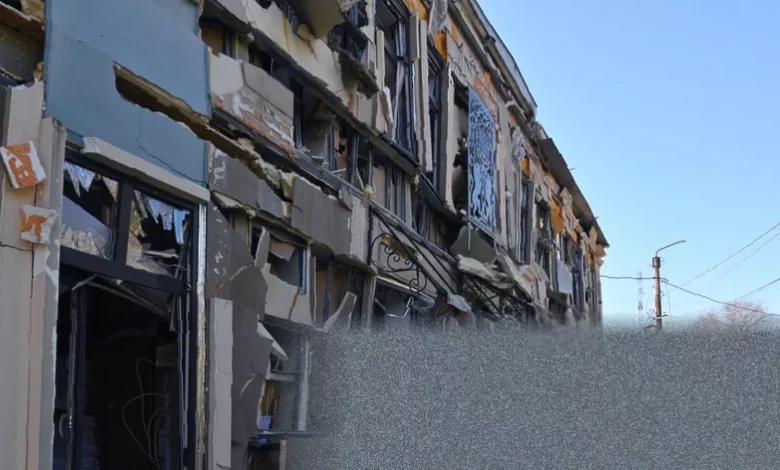
Overnight Russian drone strikes on Odesa left more than 10 people injured, with the heaviest damage concentrated in the central Prymorskyi district. Serhiy Lysak, head of the local military administration, described it as “an extremely difficult night”, reporting that high-rise residential buildings, private homes, and vehicles were attacked across three districts – Prymorskyi, Khadzhibeyskyi, and Kyivskyi. A hotel and facilities in the city centre were also damaged, along with port infrastructure including an energy facility within a cargo terminal, leading to localised fires that were quickly extinguished. A Nauru-flagged vessel sustained minor damage. Over 250 service and utility workers were deployed overnight to address the aftermath, and authorities are providing compensation consultations to residents of damaged buildings. The attack followed a drone strike on Odesa just three days earlier, on 24 April, which killed a married couple and injured 15 others.
Other European leaders on the move
Elsewhere on Monday, French President Emmanuel Macron is set to visit Andorra, of which he serves as co-prince – a historical title shared with the Bishop of Urgell. Germany’s Friedrich Merz is expected to speak to pupils about Europe, while European Commission President Ursula von der Leyen is in Berlin for a politically awkward meeting with her former party, the CDU/CSU. The activities of European leaders come as the continent continues to grapple with the wider security implications of the war in Ukraine, from drone threats to nuclear safety and the future of European air defence.