Iran may close the Strait of Hormuz for good, threatening global shipping and pushing the world economy towards a recession of a scale unseen since the oil shocks of the 1970s. The waterway has been effectively shut since February 28, 2026, following US and Israeli air strikes on Iran and the subsequent Iranian retaliation, but Tehran has now escalated the crisis by threatening to impose permanent tolls on all vessels and to sink any ship that refuses to pay.
The threat and the weapon
On March 4, 2026, Iran declared the Strait “closed,” bringing more than 1,000 commercial vessels to a standstill. Since then, the Islamic Revolutionary Guard Corps (IRGC) has broadcast VHF warnings, seeded the waterway with naval mines, and conducted drone and missile attacks on merchant ships. The IRGC has boarded and attacked vessels, and the US military reported the elimination of 16 Iranian mine-laying vessels on March 10–11, 2026, though both sides continue to accuse each other of further strikes despite a ceasefire. On May 20, 2026, a tanker was seized off the UAE coast by “unauthorized personnel” and taken toward Iranian waters, while the UK Maritime Trade Operations (UKMTO) agency reported on May 21 that threats in the Strait and the wider Persian Gulf remained at a “critical” level.
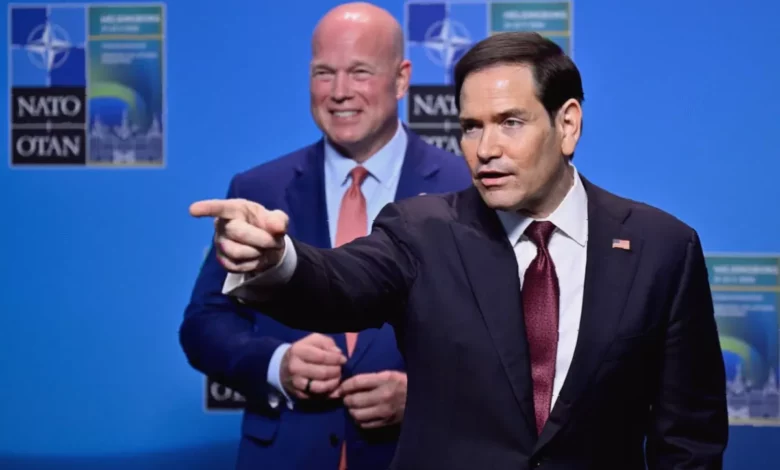
Iran has established a Persian Gulf Strait Authority (PGSA) to manage passage, potentially directing traffic through its territorial waters for monetary gain — a system the United States and other nations deem unacceptable and illegal. Tehran’s demands indicate a belief that it has “won the war,” analysts note, as formalising control over the Strait is seen as a territorial claim. US Secretary of State Marco Rubio has warned NATO allies to prepare for the worst, saying that if Iran refuses to open the Strait, “someone’s going to have to go in and do something about it.” He added: “So, all I’m saying, and have said, and I think this has been reiterated by others, there are other countries that agree with me on this, is that we have to start thinking about what do we do if a few weeks from now Iran decides we don’t care, we’re going to keep the straits closed, we’re going to sink any ship that doesn’t listen to us or doesn’t pay us.”
Economic shockwaves across the globe
The prolonged closure of the Strait of Hormuz poses the “single greatest threat to global energy markets in decades.” The disruption has already been described as the largest to world energy supply since the 1970s energy crisis and the biggest in the history of the world oil market. Tanker traffic through the Strait has dropped to near zero, with over 150 ships anchoring outside the waterway to avoid risks.
Oil prices have surged dramatically. Brent crude surpassed $100 per barrel on March 8, 2026, and reached a peak of $126. In a worst-case scenario, prices could approach $200 per barrel by the end of 2026. Diesel and jet fuel prices could rise towards $300 per barrel in major refining centres by the close of the year. The impact extends well beyond crude: over 80 million tonnes per annum of liquefied natural gas (LNG) supply — roughly 20% of global supply — remains inaccessible. Other commodity markets, including aluminium, fertiliser, and helium, are also suffering severe supply disruptions and price increases. Approximately one-third of global seaborne fertiliser trade passes through the Strait.
The global economy is under direct threat. Analysts project that a prolonged closure could trigger a global recession, with the world economy contracting by as much as 0.4% in 2026.
Diplomatic and military calculus
Rubio has outlined a “Plan B” if Iran refuses to reopen the Strait. At a NATO-affiliated meeting in Sweden, he suggested that NATO countries “willing” to help could be involved, though he clarified it would not necessarily be a formal NATO mission. European officials acknowledged the problem but did not commit to specific actions, with private discussions focusing on contingency planning.
The United Kingdom has deployed the Royal Navy destroyer HMS Dragon toward the Middle East, signalling London’s commitment to maintaining freedom of navigation. Prime Minister Keir Starmer has cautioned that reopening the Strait is “not a simple task” and would require broad coalition support, likely not being enacted until a cessation in hostilities. The UK, alongside France, is co-hosting an international summit of over 40 nations to discuss safeguarding shipping once the conflict ends. The UK plans to contribute autonomous mine-hunting systems, counter-drone technology, Typhoon jets, and HMS Dragon to a future multinational mission. The Royal Navy’s role in mine-clearing operations is expected to rely heavily on autonomous and remote mine-hunter drones, as traditional mine-hunting vessels are stretched thin and prioritised for UK waters. The UK previously joined a US-led maritime security mission in 2019 after Iran seized merchant vessels. Operation Sentinel, a Royal Navy-led task force, has been operating in the region since 2019 to deter threats to seafarers.
On May 4, 2026, the US launched Operation Project Freedom to escort merchant ships, which reportedly faced deadly confrontations. Meanwhile, diplomatic efforts are intensifying. Pakistan’s Army Chief, Field Marshal Asim Munir, is playing a key role in coordinating efforts and mediating between Iran and the US, with reports of him travelling to Tehran. Qatar has also sent mediators to Tehran, indicating that talks to reopen the Strait are reaching a climax. The US and Iran have identified nuclear weapons and the Strait of Hormuz as the two main “sticking points” in negotiations. A senior UAE official has estimated a “50-50” chance of a US-Iran agreement, warning Iran against “overestimating their cards.” China has stated its opposition to the militarisation of the Strait and to Iran charging tolls.
Legal and historical context
The Strait of Hormuz is a vital chokepoint through which approximately 20% of global seaborne oil trade and 20% of global LNG supply typically passes. While Iran has not ratified the UN Convention on the Law of the Sea (UNCLOS), most countries, including the US, claim the right of passage as codified in the convention. In 1959, Iran expanded its territorial sea to 12 nautical miles, declaring it would only recognise transit by innocent passage. Oman also expanded its territorial sea to 12 nautical miles in 1972, effectively closing the Strait to non-innocent passage under the combined territorial waters of both nations. Tensions have flared before — in 1988, 2011–2012, and 2019 — but the current closure is unprecedented in duration and impact, stemming from the collapse of the Joint Comprehensive Plan of Action (JCPOA) and rising tensions over Iran’s nuclear programme, ballistic missiles, and regional influence. Analysts describe the Strait as a “perfect bottleneck for Iran” and a “perfect weapon.”