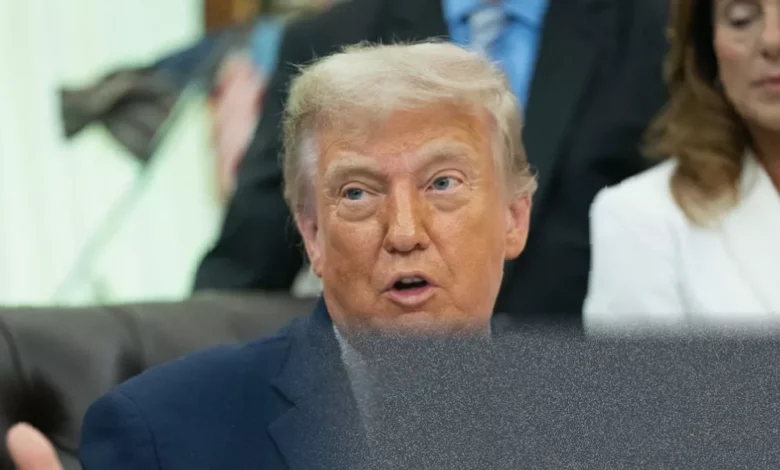
US stock markets surged on Thursday after Donald Trump announced he had cancelled planned airstrikes on Iran, a move that sent the S&P 500 jumping 1.3 per cent as investors welcomed the prospect of de-escalation. The Dow Jones Industrial Average climbed 802 points, or 1.6 per cent, by 2 pm ET, while the Nasdaq composite rose 1.8 per cent. Stocks leaped immediately after the president posted on his Truth Social network that “discussions with the Islamic Republic of Iran have been brought to the highest level of Iranian leadership and approved”.
Oil prices also fell sharply on the news. Brent crude futures dropped $3.37, or 3.6 per cent, to $89.73 a barrel, while US West Texas Intermediate crude fell $3.20, or 3.6 per cent, to $86.83 a barrel, according to the Associated Press. The decline reflected the reduced risk of supply disruption in the Gulf region.
Trump’s announcement and conflicting accounts
In a series of posts on Truth Social, Trump wrote that he had “cancelled the scheduled strikes and bombings against Iran this evening” because “discussions with the Islamic Republic of Iran have been brought to the highest level of Iranian leadership and approved”. He added that “discussions and final points have been, in both concept and great detail, approved by all parties involved”, listing the United States, Israel, Saudi Arabia, the United Arab Emirates, Qatar, Turkey, Pakistan, Bahrain, Kuwait, Jordan, Egypt and others. The president stated that a naval blockade “will remain in full force and effect until this Transaction is finalized”, with the time and place of a signing to be “announced shortly”.
However, Iran’s Fars news agency reported, citing an informed source close to Iran’s negotiating team, that Tehran had not agreed to any document or memorandum of understanding with the United States. The report directly contradicts Trump’s assertion that final points had been approved by all parties. It is the latest in a pattern of claims by the president that a peace deal was close; he has previously said Iranian leadership had agreed terms that in fact they had not.
The announcement came after talks to end hostilities carried on late into Wednesday night, according to reports. Key issues under discussion included the release of frozen Iranian assets, the reopening of the Strait of Hormuz and the future of Iran’s nuclear programme. It remains unclear whether Trump’s reference to “discussions” alludes to a formal peace deal, something he has repeatedly said must include preventing Iran from developing a nuclear weapon.
Political opposition and Iranian warnings
US Senate minority leader Chuck Schumer took to the floor on Thursday to accuse the Trump administration of lying to the public about the war with Iran. Urging Senate Republicans to support a war powers resolution and “end this war for real”, Schumer said: “It doesn’t take a military genius to see that Trump’s fiasco of a war with Iran never ended – not with American helicopters being shot down, not when American bases are being attacked, and American troops are coming under fire.” He described the president as “incapable, given his way, his lack of concern for facts, his only concern being his own ego”.
Schumer’s remarks followed Trump’s earlier threat on Thursday to attack Iran “very hard tonight” and to seize the country’s Kharg Island and “other infrastructure”. In a Truth Social post, the president wrote: “The United States will be hitting Iran (Whose Navy, Air Force, Radar, Anti Aircraft, and all other forms of Defense, together with most of its offensive capability, are GONE!), VERY HARD TONIGHT.” Trump later told Fox News that he would “rather not” attack civilian infrastructure, such as power plants and bridges, despite previous threats to do so, because “once you do that, the people suffer”.
One of Iran’s top negotiators, parliament speaker Mohammad Bagher Ghalibaf, warned of an “endless quagmire” if the US made “impulsive” decisions. In a post on X, he said: “Wrong strategies and impulsive decisions will reset the entire board for the worse, explode energy infrastructure and markets and create an endless quagmire that you will be stuck in for years. You will see a different Iran.”
Iranian foreign minister Abbas Araghchi stated that renewed US strikes against Iran “have rendered the ceasefire ineffective”, according to a statement on his Telegram channel. He discussed the latest developments with EU foreign policy chief Kaja Kallas, condemning the US attacks.
Regional escalation and international reaction
The US Central Command confirmed that it had carried out a strike on the Guinea-Bissau-flagged vessel M/T Jalveer, alleging the ship was violating the blockade and attempting to transport Iranian oil through the Gulf of Oman. Separately, Kuwaiti armed forces said they had responded to 24 Iranian drones in their airspace over the past two days, with the army reporting “limited material damage without any human casualties”.
Explosions were heard at sea in the Sirik area near the Strait of Hormuz, according to Iran’s semi-official Mehr news agency, citing a state television reporter who said: “A few minutes ago, an explosion was heard in the Sirik area at sea.”
Three Indian seafarers were killed in a US attack on an oil tanker earlier this week, confirmed India’s shipping minister, Sarbananda Sonowal, in a post on X. “Sadly, three Indian seafarers initially reported missing are now confirmed dead after bodies have been located and identified,” he wrote, referring to the Palau-flagged MT Settebello.
UN secretary-general Antonio Guterres called on all parties to work towards a diplomatic settlement that fully respects the territorial integrity, sovereignty and political independence of Lebanon. In a post on X, he advocated for a comprehensive ceasefire and said he fully supports a monopoly on weapons by the Lebanese government.
A strike near Hiram hospital in the Lebanese city of Tyre wounded 10 members of medical and administrative staff, the facility’s director, Dr Salman Aydibi, told AFP. He said the strike shattered windows and damaged cars, adding that this was the sixth time the hospital area had been targeted by Israeli raids since the start of the war between Iran-backed Hezbollah and Israel in early March.
Saudi Arabia lifted its five-year import ban from Lebanon, a significant step in improving relations. The ban, introduced in 2021, initially targeted Lebanese fruits and vegetables over drug smuggling concerns.
Pakistan’s foreign ministry said the country would continue its mediation efforts despite the escalation. “Pakistan remains deeply concerned at the situation in the region marked by recent escalation. We appeal to the parties to adhere to the understanding reached on the ceasefire,” spokesperson Tahir Andrabi told reporters.
Bahrain’s interior ministry reported that an 11-year-old girl was injured by falling debris after Iranian drones were intercepted by air defences in the capital Manama and Hamad Town. The ministry posted images of scorched cars and damaged buildings.
In a separate development, Israeli authorities deported French journalist Alice Froussard after she was refused entry at Ben Gurion Airport. Her employer, Radio France Internationale, stated she had the required travel authorisation and had applied for a press visa to work in the occupied West Bank, but received no explanation for the decision.
Footage has also emerged that appears to contradict the Israeli military’s account of the killing of seven-month-old Sam Abu Haikal in the occupied West Bank. The Israel Defense Forces said a soldier fired at a vehicle that was “accelerating toward them”, but video obtained by the Israeli Information Center for Human Rights shows the family’s car slowing down and stopping. The clip has no sound, but appears to corroborate the account of the child’s father, Fahed Abu Haikal.