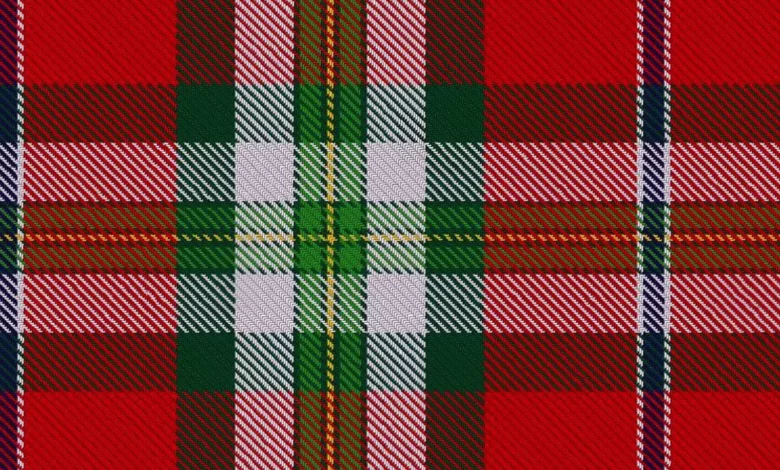
A new tartan inspired by the Bayeux Tapestry has been created, designed by Professor Michael Lewis – the lead curator of the British Museum’s forthcoming Bayeux Tapestry exhibition – and officially registered with the Scottish Register of Tartans. Permission to use the name “Bayeux Tapestry” for the tartan was granted by the Mayor of Bayeux on behalf of the city, giving it both Scottish and French approval.
A Tartan for the Tapestry
The tartan’s colours are drawn directly from the famous 11th-century embroidery, specifically a scene depicting the dying King Edward the Confessor apparently promising the English throne to Earl Harold in January 1066. The shades have been matched as closely as possible to the original unfaded colours used in the tapestry itself. Professor Lewis, who holds a PhD on “The Archaeological Authority of the Bayeux Tapestry” from the University of Kent and has written extensively on the subject, selected the palette to reflect the tapestry’s distinctive tones: the muted greens, ochres, blues and reds that once brightened the linen before centuries of ageing. The tartan carries the reference number 15335 in the Scottish Register of Tartans, categorised as “Fashion” and dated 1 January 2026, with registration confirmed on 24 March 2026.
The design was created to honour the return of the Bayeux Tapestry to the United Kingdom for the first time in nearly a thousand years. The tapestry, an 11th-century embroidery on linen telling the story of the events leading up to the Norman Conquest of 1066 and the Battle of Hastings, is usually housed at the Musée de la Tapisserie de Bayeux in Normandy. It is considered a masterpiece of Romanesque art, likely commissioned by Bishop Odo of Bayeux, William the Conqueror’s half-brother, and made in England in the 1070s.
An Irony of History
There is a modest irony in a Scottish tartan honouring the conquest of England, because in 1072 William the Conqueror also invaded Scotland. That campaign was partly a response to King Malcolm III of Scotland harbouring English nobles who had fled William’s rule, including Edgar Ætheling, a claimant to the English throne, and to Malcolm’s own raids into northern England. William led a large army and fleet into Scotland, and the conflict was settled quickly by the Treaty of Abernethy. Under its terms, Malcolm submitted to William as his liege man, exchanged hostages – including his son Duncan – and expelled Edgar Ætheling from the Scottish court. In return, Malcolm was granted estates in Cumbria. The exact details of the treaty are not fully preserved, and despite the agreement Malcolm later resumed raids into Northumbria.
The tartan thus carries a historical echo: an emblem of a Scottish heritage used to celebrate an event that ultimately led to Norman dominance over Scotland as well as England. Professor Lewis, who is also a member of the Comité scientifique Tapisserie de Bayeux advising the Bayeux Museum, has said the design is intended to add a playful dimension to visitors’ experience of the exhibition.
Exhibition and Ticketing Details
The Bayeux Tapestry will be displayed at the British Museum’s Sainsbury Exhibitions Gallery (Room 30) in London from 10 September 2026 to 11 July 2027. It will be the first time the tapestry has been shown in England in nearly a thousand years, and for this exhibition it will be displayed flat and in one continuous length within a specially constructed showcase – a departure from the vertical displays often used in the past – allowing visitors to appreciate its full scale and detail. The loan has been a significant logistical undertaking: concerns about the tapestry’s fragility were raised in 2018, but a custodianship agreement between the French state and the city of Bayeux (valid until 2066) and advances in conservation understanding facilitated the move. A faithful facsimile was used to test transport protocols, and the British Museum’s conservation team is overseeing the installation. The tapestry is insured by the British Government for £800 million while in the UK.
The exhibition will contextualise the tapestry within 11th-century England and Normandy, featuring other objects from the British Museum’s collection and loans from other institutions. Among the highlights will be the Junius 11 manuscript, which influenced the tapestry’s design. Visits are timed for 40-minute slots, and tickets will be released in phases: general sale begins on 1 July 2026 via the British Museum website, with the first phase covering visits from September to December 2026. Later releases in October 2026 and January 2027 will cover dates between January and March, and April to July 2027, respectively.
Ticket prices are as follows: peak adult tickets cost £33; off-peak adult, £27; “Super Off Peak” (the last slot of each weekday during term time), £25. Students, 16- to 18-year-olds, jobseekers and disabled visitors pay £25, while under-16s go free when accompanied by an adult. Art Fund National Art Pass holders receive a discounted rate of £16.50. A maximum of 12 tickets can be booked per transaction, and multiple bookings from the same email address may be cancelled.
British Museum membership, available from £82, includes two free visits to the Bayeux Tapestry during its run, with discounts for further visits, as well as free entry to all other special exhibitions. Members’ priority booking opens at 12:30 on Tuesday 16 June 2026, allowing each member to book two separate free timed tickets. The Bayeux Museum in Normandy, meanwhile, remains closed for renovations, with a new museum dedicated to the tapestry scheduled to open in Bayeux in late 2027.