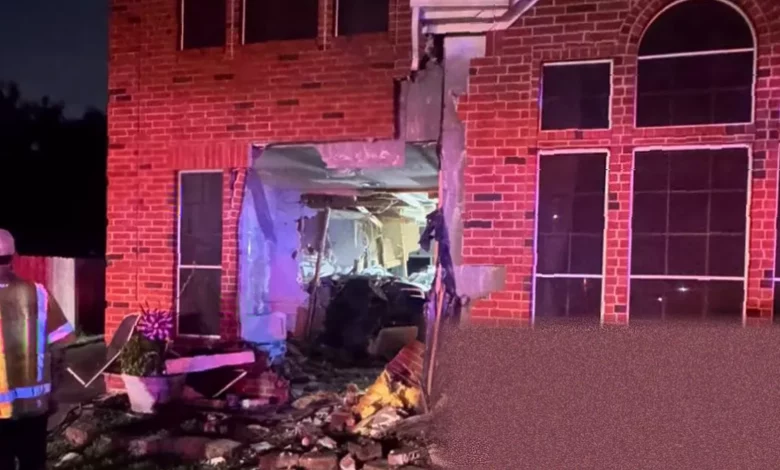
Two federal agencies are investigating a fatal Tesla crash in Texas, after a 76-year-old woman was killed when a Model 3 ploughed into her home in the Houston suburb of Katy.
The National Transportation Safety Board said on Wednesday it had opened a safety investigation into the 19 June crash, working in coordination with the Harris County sheriff’s department. The announcement came two days after the National Highway Traffic Safety Administration confirmed it was also launching a special probe into the incident.
The crash happened at around 8pm on Rose Hollow Lane in Katy, a residential area. Surveillance video captured the Tesla speeding down the street before smashing into the front wall of Martha Avila’s home, fatally pinning her. She died later at a nearby hospital. Her son-in-law, Justin Barbour, was also injured.
Data from the vehicle, obtained by Tesla, indicates the Model 3 reached approximately 73mph and that the accelerator remained fully depressed even after the collision. The driver, 44-year-old Michael Butler, told law enforcement he had engaged an automated driving assistance system before the crash. Butler has been cooperative with investigators and showed no signs of intoxication, according to the sheriff’s department. No criminal charges have been filed against him as of 24 June.
The NTSB did not elaborate on which aspects of the crash its investigation would focus on, only saying it was working with local authorities. The Harris County sheriff’s office has stated that, so far, no mechanical malfunction has been found in the vehicle.
Family files wrongful death lawsuit alleging defective systems
On Tuesday, attorneys for Avila’s family filed a civil complaint in Texas state court against Tesla and Butler, seeking more than $1m in damages plus punitive damages. The plaintiffs — Avila’s daughter Jennifer Barbour and her husband Justin Barbour — allege gross negligence and a failure to warn that Tesla’s “Autopilot” and “Full Self-Driving” (FSD) systems were defective.
The lawsuit claims the driver-assistance systems suffered from design flaws including an inability to adequately monitor driver engagement, a failure to detect the end of the street and the home in its path, and a lack of proper warnings to consumers about their limitations. The family also alleges the vehicle may have experienced sudden unintended acceleration.
The plaintiffs argue that Tesla showed a “reckless disregard for a substantial risk of severe bodily injury” and should be held liable for the wrongful death of Martha Avila. The suit also names Butler as a defendant; it is unclear whether he has obtained legal representation.
The crash has placed renewed scrutiny on Tesla’s driver-assistance technology, which has been the subject of multiple federal investigations, recalls and court rulings. Since 2016, the NHTSA has opened nearly 50 special investigations into crashes involving Teslas where advanced driver-assistance systems were believed to have been active, resulting in about two dozen reported deaths.
In March, the NHTSA escalated its investigation into 3.2m Teslas equipped with FSD, citing concerns that the system may fail to detect or warn drivers in conditions of poor visibility. That followed an earlier probe opened in October 2025 into nearly 2.9m Tesla vehicles after reports of traffic safety violations linked to FSD, including running red lights and unsafe lane changes.
In December 2023, Tesla recalled approximately 2m cars — nearly all of its electric vehicles on US roads — to better ensure drivers pay attention when using Autopilot. The recall followed a two-year NHTSA investigation that found the driver monitoring system to be defective.
Legal precedents are mounting against the company. A Miami federal jury in August 2025 found Tesla 33% liable for a fatal 2019 crash involving Autopilot, awarding $243m in damages — a judgment that was upheld in February 2026. A California federal court has also ruled that Tesla’s marketing of FSD was “actually, unambiguously false.” European traffic safety authorities have accused Tesla of exaggerating the safety record of its FSD vehicles in documents presented to regulators in Switzerland and the Netherlands. In March 2026, a separate lawsuit was filed involving FSD on Cybertrucks, alleging the system is not ready for real-world operation.
Tesla’s defence: driver override and high-speed claim
Tesla has pushed back against the allegations. On Monday, hours before the lawsuit was filed, Elon Musk wrote on X, the social media platform he owns: “FSD drives slowly through neighborhood streets and this was a high speed crash!”
Ashok Elluswamy, Tesla’s vice-president of artificial intelligence software, posted separately on X that “the driver manually overrode self-driving by pressing the accelerator all the way to 100% of the accel pedal in this residential area.” According to Tesla, the Model 3’s accelerator remained pressed even after the collision. The company has previously said that both Autopilot and FSD require “fully attentive” drivers whose hands are on the wheel. Autopilot enables vehicles to steer, accelerate and brake within their lanes, while FSD allows vehicles to obey traffic signals and change lanes.
Neither Musk nor Tesla responded to requests for comment on the lawsuit or the federal investigations. Tesla’s stock fell sharply early in 2025 as car sales plunged amid a boycott of Musk after he became heavily involved in US federal politics, leading the Trump administration’s budget-cutting “department of government efficiency” (Doge) initiative and embracing extremist political candidates in Europe. The Barbours’ lawyers also did not respond to requests for additional comment.