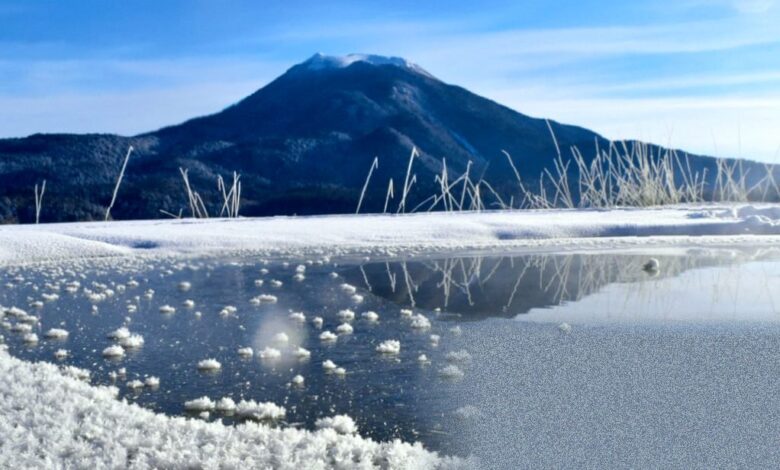
A rare and fragile natural spectacle, known as “frost flowers,” has been observed forming intricate three-dimensional gardens on the frozen lakes and seas of the Arctic, as stated by The Guardian.
These delicate structures, typically measuring 3-4 centimetres across, are a more elaborate version of the familiar fern-like patterns painted on windows and windscreens during British winters. They emerge from ice crystals growing in a slow, orderly fashion on the frozen surface.
Arctic frost flowers develop under specific conditions, when relatively warm ice is exposed to still air that is at least 15 degrees Celsius colder. This temperature difference causes the ice to sublime directly into water vapour, creating a low-lying cloud of humid air. As the temperature drops further, this moisture crystallises into hoar frost, which sprouts from tiny protrusions on the ice and grows into complex shapes.
The appearance of these frost flowers varies with humidity levels. In more humid conditions, they form side branches and can resemble miniature trees, while at lower moisture levels they take on a star-like crystal form without branches. Initially composed of pure water, they quickly draw up salt from the ice beneath, becoming saltier than seawater.
Their existence is highly precarious, as they can only form in completely still air and are extremely fragile. Even a strong wind will destroy them, which is why they typically survive for no more than a few days and are seldom witnessed or captured in photographs.