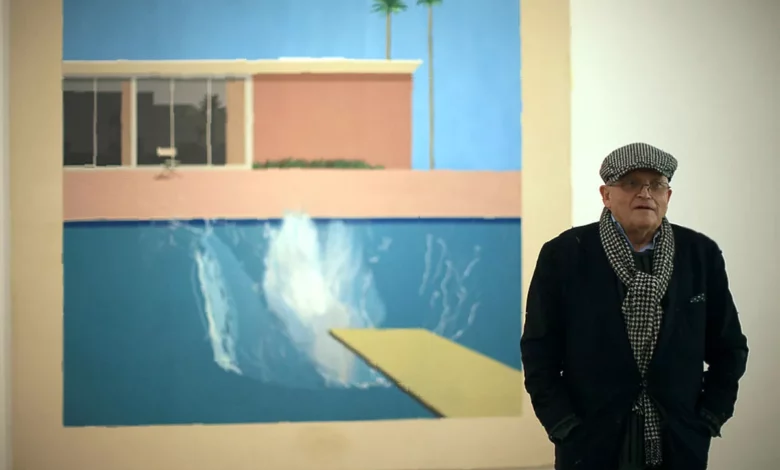
David Hockney, the artist who redefined the boundaries of his craft by embracing everything from fax machines to iPads, has died aged 88. He passed away peacefully at his home in London on 11 June 2026, his publicist, Erica Bolton, confirmed. Hockney was a pivotal figure in the pop art movement of the 1960s and is considered one of the most influential British artists of the 20th and 21st centuries.
The Technological Artist
Hockney’s career was marked by a relentless drive to experiment with new tools. In April 2020, interviewed by The Spectator’s art critic Martin Gayford, he remarked of his iPad: “I was just drawing on this thing I’m talking to you on.” He had begun drawing on an iPhone as early as 2009, later moving to the iPad and the Brushes app, producing works such as “The Arrival of Spring, Normandy, 2020,” which documented the changing seasons. Beyond digital devices, Hockney embraced fax machines, Polaroids, photocopiers, high-resolution cameras, Photoshop and the Quantel Paintbox. Art critic Michael Prodger noted that Hockney saw no reason why he should not use such tools to create his art.
No aspect of his technological curiosity was more controversial than the theory he advanced in his 2006 book Secret Knowledge: Rediscovering the Lost Techniques of the Old Masters. Hockney argued that many Old Masters, including Vermeer, had used optical aids such as lenses and mirrors to achieve the remarkable naturalism and accuracy in their paintings. He contended that the rapid advancements in Western art from the 15th century onward were driven by these aids rather than by direct observation alone. To support his thesis, Hockney created a large collage timeline of art history, identifying periods of significant change in technique. The theory became known as the “Hockney-Falco thesis” and sparked fierce debate among art historians. For Hockney, the logic was simple: if the Old Masters had used such aids, then he, too, was free to deploy whatever technology was at hand — from a fax machine to a camera to an iPad.
From Swimming Pools to Normandy Landscapes
Hockney’s most famous paintings emerged from his move from his native Yorkshire and “gloomy” London to sun-drenched California in the 1960s. That relocation drew comparisons with the painters of the late 19th and early 20th centuries, such as Van Gogh and Gauguin, and later Matisse and Dufy — artists who also sought new light and colour in foreign landscapes. In 1967, working from a photograph taken by someone else, Hockney created A Bigger Splash, now arguably his most iconic work. The painting shows a pink modernist building as the backdrop to a Californian swimming pool. While the building came together quickly, Hockney laboured for two weeks on the split-second splash in the water, an irony he well understood — capturing a moment that lasted just two seconds consumed weeks of painstaking effort.
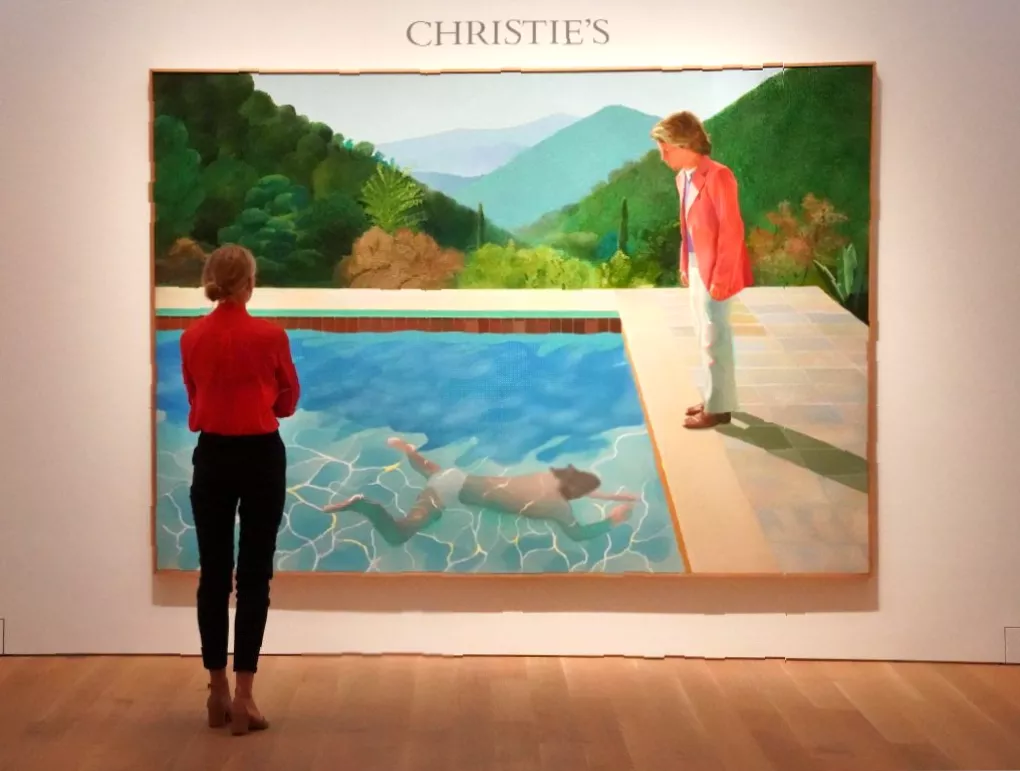
In 1972 he painted Portrait of an Artist (Pool with Two Figures), inspired by two unrelated photographs that had fallen together in his studio. The work depicts one figure swimming underwater while another, clothed, looks down from the pool’s edge. In November 2018, it sold at Christie’s in New York for $90.3 million, setting a record at the time for the most expensive painting by a living artist sold at auction. These works belong to what are known as Hockney’s “swimming pool period” (beginning in the 1960s) and his “double portraits” of the 1970s, but as critics have noted, these represent only a small fraction of his overall output.
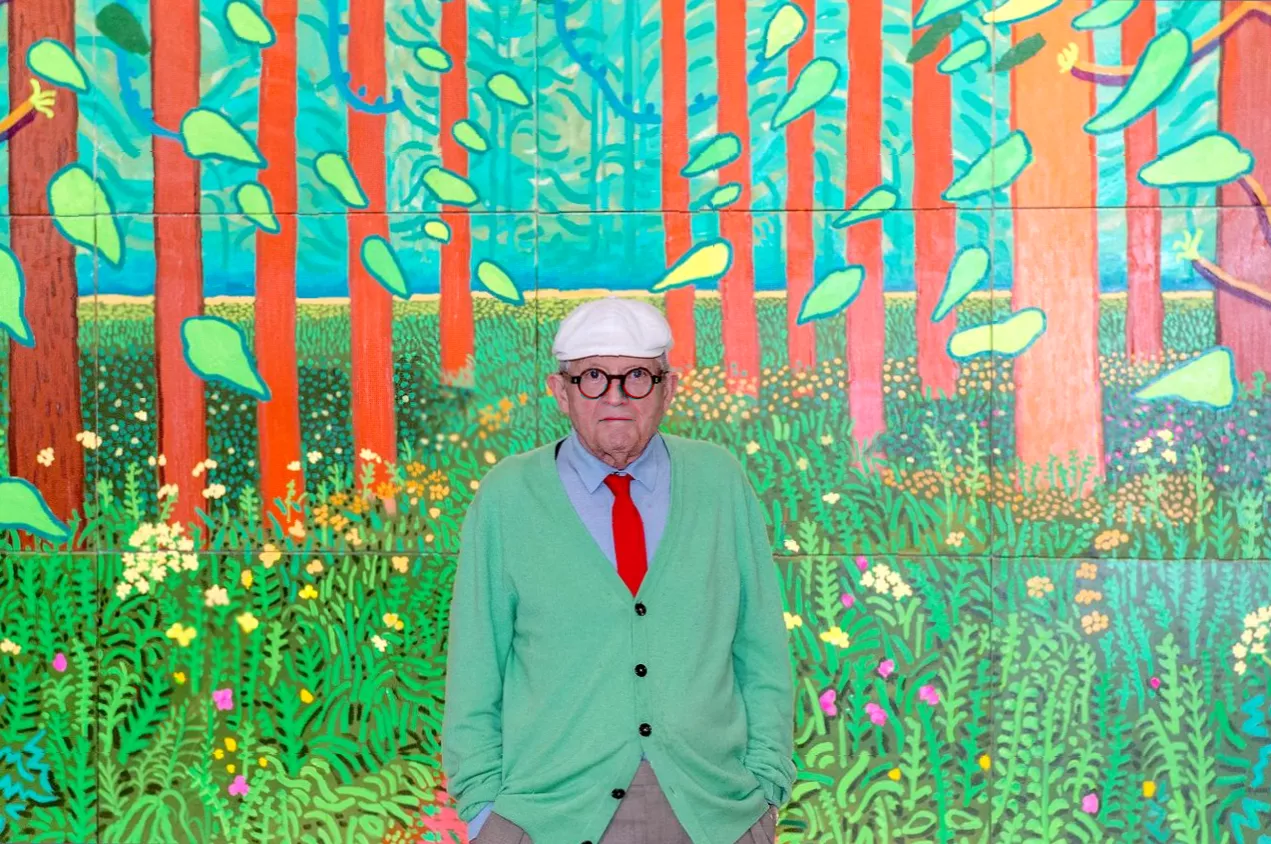
In later years Hockney returned to landscapes, first of Yorkshire and then of northern France. His 90-metre frieze A Year in Normandie (2020–2021), inspired by the Bayeux Tapestry, captures the changing seasons at his Normandy studio. The work was exhibited at the Serpentine Galleries in London from 12 March to 23 August 2026. Hockney’s approach to landscape and colour drew clear inspiration from Van Gogh; a 2019 exhibition at the Van Gogh Museum in Amsterdam explored the shared themes between the two artists.
Legacy and Tributes
Hockney’s death prompted an outpouring of tributes. King Charles III described him as “a giant of the world of art and painting, a Yorkshireman through and through, and a dear friend and inspiration to so many.” The artist Tracey Emin called him “a great artist and a wonderful man, who with the power of art changed the perception of Britishness.” The UK prime minister paid tribute, saying Hockney’s “vivid, instantly recognisable work influenced generations of artists.” Andrew Marr, writing in an appreciation, remarked: “I can’t think of an artist so loved by millions today. The man is gone, but the pictures live on. ‘Spring cannot be cancelled’ was one of his more recent slogans. Nor can David Hockney.”
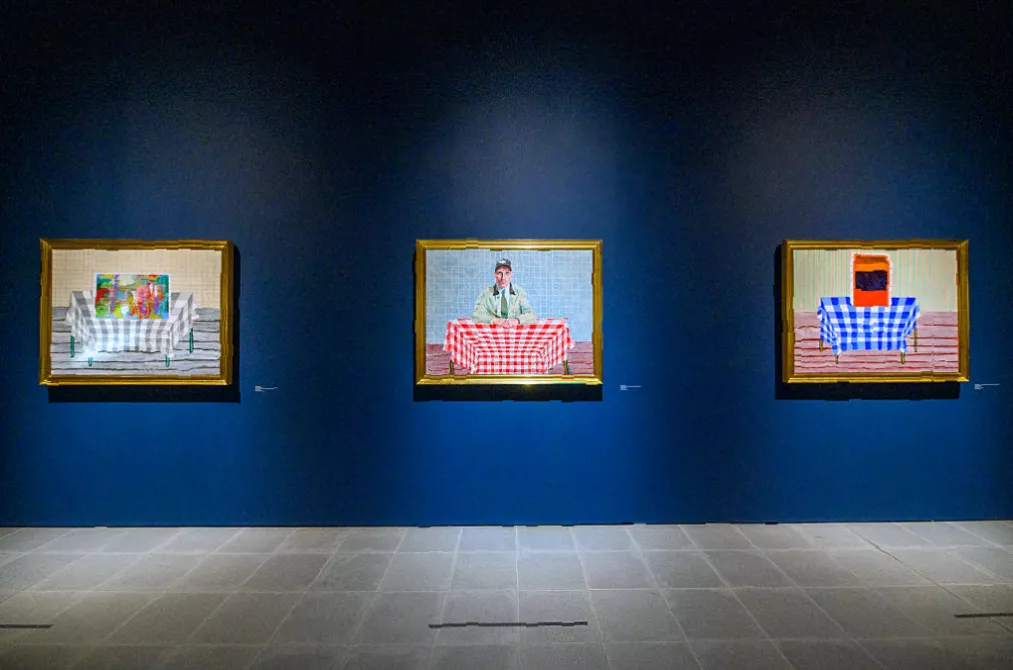
In accordance with his wishes, Hockney’s funeral was a private affair attended only by his partner, Jean-Pierre Gonçalves de Lima, and his great-nephew, Richard. Memorial services are planned for London in spring 2027, with further services in Yorkshire, Paris and Los Angeles. Hockney’s publicist confirmed that he did not keep a collection of artworks by other painters, nor were any of his own works stored at his properties in the UK, France or the US. A significant portion of his works will be donated to foundations and public institutions worldwide to further his legacy.
Beyond the Serpentine exhibition, Tate Britain had planned two major projects for 2027: an exhibition spanning seven decades of Hockney’s career and a multimedia installation showcasing his opera set designs. Hockney was appointed to the Order of the Companions of Honour in 1997, received the Order of Merit in 2012, and was made an Officer of France’s Légion d’Honneur in 2026.