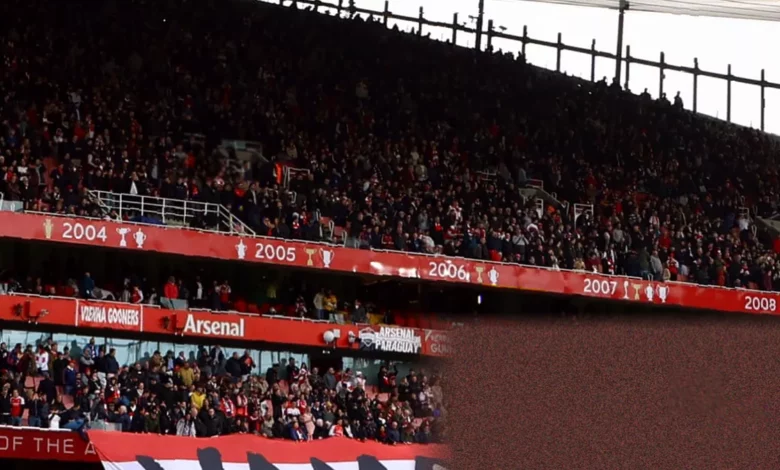
Arsenal supporters have been urged to arrive at the Emirates Stadium two hours before kick-off on Monday night to greet the team bus, as the club attempts to recreate the electrifying atmosphere that fuelled its Champions League semi-final victory over Atlético Madrid. Tickets for the Premier League meeting with Burnley — who have already been relegated and returned 1,500 of their allocation — were being sold for upwards of £650 last week, reflecting the stakes in a title race that has galvanised the fanbase. The call to action is a deliberate echo of the night Arteta says left his players and staff exchanging looks of astonishment, marvelling at the “engagement, the passion, the enthusiasm of our fans in their eyes”.
The transformation of the atmosphere at the ground Arsenal moved into five years before Arteta signed as a player in 2011 ranks among his proudest achievements. It stands in stark contrast to the later Arsène Wenger era, when frustration at the club’s inability to compete for the biggest prizes frequently boiled over in the stands, and to the Unai Emery period that followed. The change did not happen by accident: Arteta has implemented a series of deliberate, finely calibrated initiatives designed to turn the Emirates into a fortress. The tunnel cover was removed at the start of this season so that both sets of players hear the full force of the crowd before kick-off. Second-half match replays are no longer shown on concourse screens, encouraging fans to return to their seats. The stadium announcer now pauses after a goalscorer’s first name is read out, allowing the crowd to roar the surname in response. “We need to ignite the atmosphere so they can play every single ball with us because it makes such a difference,” Arteta has said. “We want to play and win things. That’s a non-negotiable. You need to have a stadium that is able to create those moments, for sure.”
Arteta’s drive to overhaul the matchday environment was forged in a moment of stark realisation five days before he was unveiled as Emery’s successor in December 2019. In his final match as Pep Guardiola’s assistant at Manchester City, he sat in the visitors’ dugout and watched Arsenal trail 3-0 at half-time after a Kevin De Bruyne masterclass. “It was the first thing because a few days before I was appointed here, I was on the other bench with Man City and that image, that feeling of the stadium, the crowd … 50% of the stadium was empty,” he recalled. “It really got into me. I said: ‘With this, there is no project. This is not going to work.'” The situation worsened when Covid struck, forcing a complete rebuild of the relationship between team and supporters. “But when it’s harder at the beginning, then it’s better,” Arteta added. “So to see that transformation and that joy in the people, it’s something that is beautiful to watch.”
The manager describes the fans as the team’s “12th man, and a magic player”, and his ambition is to create “the best atmosphere in the world at Emirates Stadium”. He acknowledges that the process has not been seamless: his battle cry for supporters to “bring your lunch” before the early kick-off against Bournemouth last month did not pay off, as Arsenal slumped to a defeat that opened the door for Manchester City in the title race. Since then, however, a noticeable shift has occurred. Despite some nervous moments during the narrow win over Newcastle, the crowd more than played its part against Fulham and Atlético. Against Burnley, who only lost 1-0 to City at Turf Moor last month, Arteta has urged patience. “It’s supposed to be like this and especially when you haven’t won for that long, it’s going to be edgy,” he said. “And I’m very glad that now we’ve turned that point and we are very optimistic, but being very, very present as well.” He added: “When the stadium provides that level of energy, passion and optimism, they play every single action with the team. When we have the ball, when the opponent has the ball, in every element, they live the game like that. The value of that is just infinite. I think you cannot measure it and the team becomes different.”
While many supporters have embraced these changes, some have reacted with scepticism about the impact of minor adjustments, and rival fans have used the club’s focus on atmosphere as a source of mockery, citing a lack of recent trophies. The club, however, views these “marginal gains” as essential to building a winning culture. Arteta’s own experience — having been at the club during the tail end of the Wenger era, when frustrations were rife — has made him attuned to the emotional temperature inside the stadium. He has described the Atlético semi-final as a benchmark: “The players were in the other bus, but I could see straight away all the staff and everybody was there just looking at each other and saying: ‘Wow, we’ve taken this to a different level.'”
Stadium expansion plans
Off the pitch, Arsenal are understood to be exploring ambitious plans that could push the Emirates Stadium’s capacity beyond 70,000, up from its current 60,704. The club is reportedly in discussions with Populous, the architectural firm that originally designed the venue and which also worked on Wembley Stadium and the Tottenham Hotspur Stadium. The move is driven by extraordinary demand: the season ticket waiting list is estimated to exceed 100,000, with a renewal rate of 98 per cent. Any significant redevelopment, however, presents formidable logistical challenges given the stadium’s location in the densely populated borough of Islington, where transport infrastructure is already under strain. The cost of such a project is estimated to exceed £500 million, though the long-term boost to matchday revenue — potentially reaching between £200m and £250m annually — is seen as crucial for Arsenal to remain financially competitive with Europe’s elite clubs.
A major rebuild might require a temporary move away from the Emirates, with Wembley Stadium — capacity 90,000 — a potential option, as it was for Tottenham Hotspur during their own stadium construction. Arteta will be desperate to avoid such disruption after the progress he has made in forging a connection between team and supporters. Beyond expansion, Arsenal has already undertaken other renovations, including upgrades to the PA system, improvements to mobile connectivity inside the ground, and the installation of new exterior artwork. The club is also considering the introduction of safe-standing areas.
The move from Highbury — a 38,500-capacity venue renowned for its Art Deco architecture — to the Emirates in 2006 was driven by the need for a larger capacity to accommodate a growing fanbase and enhance financial competitiveness. That project cost £390 million. Now, with the title race intensifying and the atmosphere at the Emirates transformed, the club is weighing the next step. Arteta, for his part, maintains that the driving force must come from the stands. “Everybody at the club is trying to give his vision, his input, his support, to try to encourage that,” he said. “But especially the fans or the supporters need to provide that. I think it has to come from them, naturally. And we have to provide that as well, it goes both ways. We are constantly connected with them to try to be the best stadium in the world.”