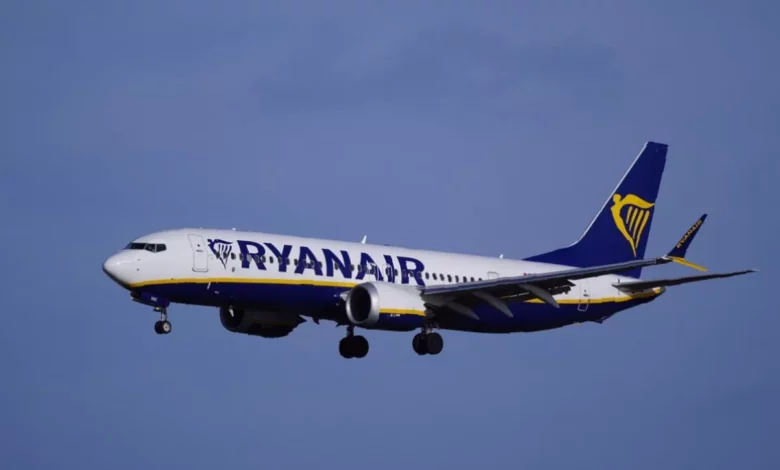
Ryanair’s pre-tax profit surged 35 per cent to €2.4bn (£2.1bn) in the year to March, the Dublin-based carrier announced, as it insisted its fuel‑hedging strategy and debt‑free balance sheet leave it better placed than European rivals to weather the crisis triggered by the closure of the Strait of Hormuz.
Profit growth amid uncertainty
Revenue climbed 11 per cent to €14.5bn (£12.6bn) and passenger numbers rose four per cent to 208 million. The airline, listed on Euronext Dublin, forecasts a further four‑per‑cent increase in travellers to 216 million in the current financial year, although it noted that holidaymakers are booking closer to departure because of the disruption caused by the Iran conflict. Ryanair’s full‑year pre‑exceptional profit after tax reached €2.26bn, a 40‑per‑cent improvement on the previous year.
The Middle East conflict and the blockade of the Strait of Hormuz – through which about 20 per cent of the world’s oil supply passes – have pushed global jet‑fuel shipments to record lows, forcing some European airports to introduce rationing and airlines such as Lufthansa to reduce short‑haul schedules. Chief executive Michael O’Leary acknowledged the uncertainty: “The conflict in the Middle East has created economic uncertainty and we still don’t know when the Strait of Hormuz will reopen.” Nonetheless, Ryanair maintains that Europe “remains well supplied” via alternative routes through West Africa, the Americas and Norway.
Fuel contracts shield Ryanair
The airline’s resilience rests primarily on a longstanding fuel‑hedging strategy that has been in place since the post‑9/11 era. Ryanair has locked in approximately 80 per cent of its jet‑fuel requirements for the year ahead at a fixed price of $67 per barrel, while current market prices have rocketed beyond $150 per barrel – an increase of more than 120 per cent since hostilities began. Although fuel‑hedge gains are fading, the locked‑in prices mean Ryanair’s effective fuel costs remain broadly in line with pre‑conflict levels, sparing it the worst of the volatility that has prompted other airline chiefs to describe the surge as more damaging than the Covid‑19 pandemic.
This cost advantage is reinforced by the company’s strong financial position. Ryanair anticipates becoming effectively debt‑free by May 2026 after repaying a €1.2bn bond, leaving it with a BBB+ credit rating from both Fitch and S&P. In its accounts, the airline stated: “This financial strength further widens the cost gap between Ryanair and our competitors, many of whom are exposed to expensive (long‑term) finance, rising aircraft lease costs and unhedged jet‑fuel.” The carrier’s robust gross cash position provides substantial flexibility to absorb external shocks, while competitors grappling with higher financing costs and unhedged fuel are being forced to cancel flights and raise fares.
Italy fine and legal challenges
Ryanair is also fighting a €256 m fine imposed in December by Italy’s competition watchdog, which alleged the airline made “abusive” use of its dominant market position to restrict sales through online travel agents. The company described the charge as “baseless” and said its lawyers are “confident” of overturning it on appeal. Nevertheless, it has set aside an €85 m provision on its balance sheet – roughly a third of the fine’s value – as a contingency. In a separate development, Italy’s highest administrative court annulled a €4.2 m fine issued in 2021 over Covid‑19 flight cancellations, ruling that Ryanair had faced discriminatory treatment by the Italian Competition Authority (AGCM).
Beyond the legal disputes, the airline warned that EU environmental taxes are set to surge by €300 m this year to a total of €1.4bn, part of the bloc’s Emissions Trading System. Ryanair argued that the levies render air travel within the European Union “even less competitive”.
On a separate front, O’Leary has renewed his criticism of airport bars serving alcohol before early‑morning flights, accusing airports of “profiteering” from enabling drunken behaviour that leads to nearly one flight diversion per day. He has called for a ban on alcohol sales before standard licensing hours and a two‑drink limit. The comments put him at odds with Tim Martin, the boss of JD Wetherspoon, who defended the pub chain’s large airport presence and the right of passengers to enjoy a pre‑flight pint.