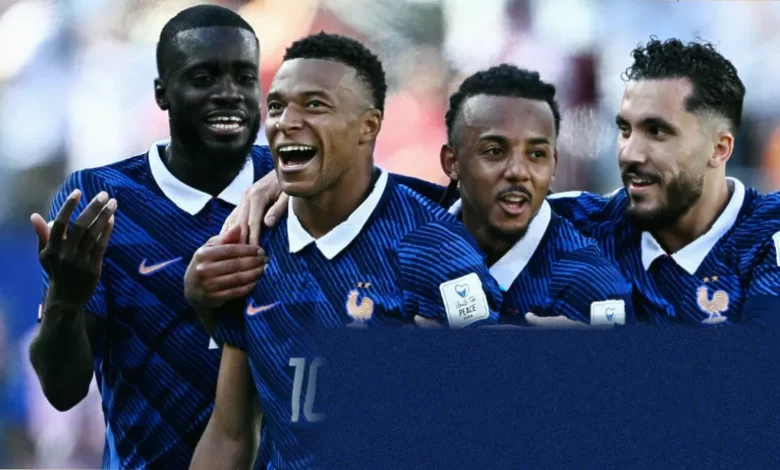
Michael Olise delivered a performance that transformed France’s World Cup opener, turning a stuttering first half into a statement victory over Senegal. While Kylian Mbappé’s double rightly seizes the headlines, it was Olise’s second-half involvement that broke the game open, a shift so emphatic that even those watching from the stands might argue he deserved the Player of the Match award over his more celebrated teammate.
For 45 minutes, Senegal had been the superior side. They pressed France in a compact 4-4-2 shape, created big chances, and should have been ahead. Nicolas Jackson hit the post; Ismaila Sarr missed a glorious close-range opportunity, shooting over the bar when it seemed simpler to score. Senegal’s expected goals (xG) in the first half stood at 0.47, with more shots on target, more touches in the opposition box, and a clear edge in territory. France, by contrast, managed an xG of just 0.02 and not a single shot on target. The ghosts of 2002 – when Senegal shocked the defending champions in the opening game of the World Cup – began to stir.
Didier Deschamps made no changes at the break, but his half-time talk clearly altered France’s approach. The rhythm quickened. Passes began to find their intended targets. Most critically, France found a way to get Michael Olise on the ball in space and in dangerous areas – and from that moment, the game was effectively over.
Olise’s shift in momentum
Olise’s impact was not merely statistical; it was structural. In the first half, France’s midfield pairing of Aurélien Tchouaméni and Adrien Rabiot had been criticised for lacking imagination and dexterity – neither an aggressive passer nor carrier – and Senegal’s compact unit had closed down the channels through which France usually attacks. By moving Olise into a freer role, Deschamps unlocked a player whose combination of grace, wit and power proved impossible for Senegal to contain.
Just after the hour mark, Olise began to reappear in central areas, turning his marker and driving at the defence. In the 64th minute, he slipped a luscious pass into the box at precisely the pace Mbappé wanted – though the forward miscontrolled. Minutes later, Olise power-slid an oblique pass from the right into the near side of the box, meeting Mbappé’s run; this time the finish was first-time across Senegal goalkeeper Édouard Mendy and into the far corner. The move was exquisite, a moment of pure attacking intelligence that broke Senegal’s resistance.
Olise’s ability to change pace – on the ball or with a pass – and to do it with consummate style drew comparisons to the best attacking performances of the tournament so far. His second-half display was described as the most impressive of the competition, a rare demonstration of grace, wit and power that left Senegal defenders unable to get close. The commentator’s verdict was blunt: “Once he got on the ball in space and in dangerous areas, it was over for Senegal.”
Even a controversial VAR moment could not derail France’s momentum. In the 59th minute, Mbappé raced into the box and went down under a challenge from Sadio Mané. The referee initially signalled a corner, but on review – and after consulting the pitchside monitor – he decided against a penalty, suggesting Mbappé had initiated contact. The decision drew angry responses; former linesman Darren Can was shown on television, extremely displeased, saying his phone had been “blowing up with messages from top refs”. Deschamps, too, was unamused. But France did not let the setback stall them.
France’s second-half resurgence
The half-time transformation was comprehensive. France emerged with a tempo and purpose that had been entirely absent. In the 53rd minute, Jules Koundé pounced on a lax touch from Senegal’s Idrissa Gueye and punched the ball into Olise, who slowed up Kalidou Koulibaly, then accelerated past him. Mendy spread himself well and blocked the shot with his thigh – excellent goalkeeping – but the message was sent: France were now the aggressors.
Mbappé equalised in the 66th minute with a first-time finish across Mendy, but his second goal was of a different order. In the 86th minute, Olise fed him the ball 30 yards out, almost dead centre. Mbappé spun and unleashed a rising right-footer that soared past Mendy – not quite in the roof, not quite in the corner, but a brute regardless. The strike was emblematic of a player who, despite a ragged first half, can never be written off. It was his 58th goal for France, making him the nation’s all-time leading scorer, and his 14th in World Cups, also a French record.
Substitute Bradley Barcola added France’s third in the 82nd minute. Adrien Rabiot barrelled through midfield and played a perfectly timed pass through the middle to meet Barcola’s run. Mendy came out to narrow the angle, but Barcola, a notoriously panicky finisher according to some observers, produced a delightful dink to beat him. The goal was described as “seriously impressive behaviour from France, suffused with le groove”.
Senegal’s missed chances and late consolation
Senegal’s regret will be the first half. Sarr’s miss just before half-time – a golden chance from close range – loomed ever larger as France seized control. “When Ismaila Sarr missed that chance, you feared he’d regret it,” one commentator noted. “One of the most crucial traits any elite sportsperson can have is the memory of a goldfish.” Senegal did not fold, though. They continued to create opportunities, and their commitment to attack remained admirable.
In the 68th minute, Camara released Jackson behind the defence. The ball bounced and he absolutely pasted a shot that shrieked above Mike Maignan into the roof – although the flag went up for offside; replays confirmed he was just off. Minutes later, Diouf delivered a delectable cross that Jackson allowed to run across his body, stabbing home another fine finish – only for the offside flag to rule it out again.
Senegal’s persistence finally paid in stoppage time. Rabiot gave the ball away and Ndiaye oozed through midfield, finding Ibrahim Mbaye at inside-right. The 18-year-old attacking midfielder – on loan from Paris Saint-Germain and described as special by his manager – threw lollipops left and right until Lucas Hernández fell, his legs twisted, exposing the space behind. Mbaye crashed a shot that beat Maignan at the near post; the keeper got a touch but could only help it in. The goal was a livener, and it set up a frantic finale.
Senegal pushed for an equaliser. In the 100th minute, Ndiaye raced to the line and stood up a cross that tempted Tchouaméni into a clumsy intervention – the ball looped over Maignan, who clawed it away. Goal-line technology confirmed it had not crossed the line. That was the final meaningful action.
France had escaped a first-half ambush and emerged with a 3-1 victory, but Senegal’s performance – particularly in the opening 45 minutes – suggested they will cause problems for the rest of Group I, which also features Norway and Iraq. As one observer put it, “Senegal will play worse than this and win comfortably.” Whether Mbappé’s brilliance and Olise’s intervention prove the difference in this tournament remains to be seen.