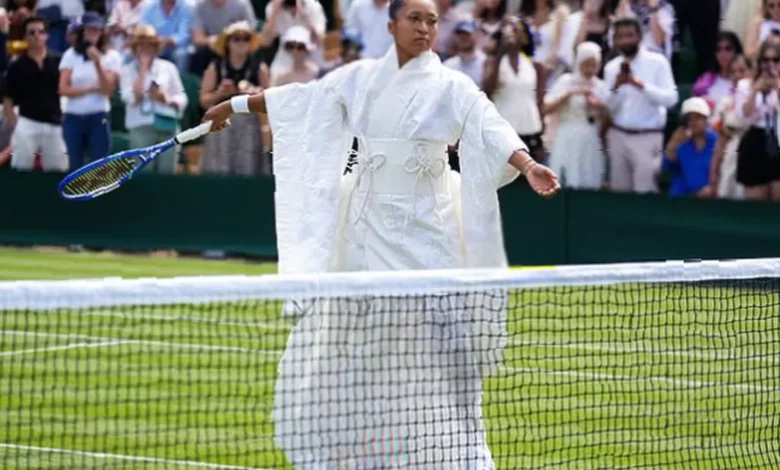
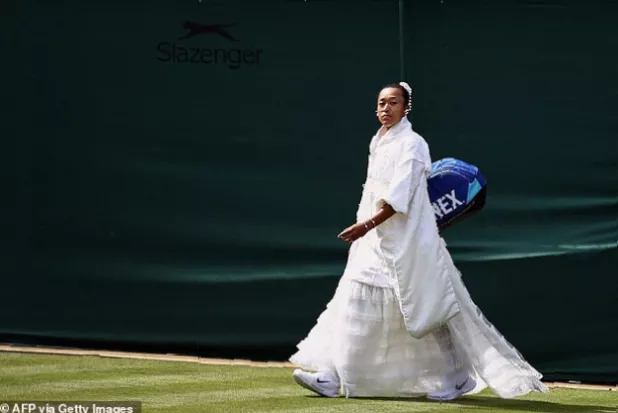
Naomi Osaka turned Wimbledon into her personal catwalk on Monday, arriving for her first-round match against Elsa Jacquemot on Court 3 in a custom kimono-inspired outfit that honoured Japanese tradition while staying within the tournament’s famously strict all-white dress code.
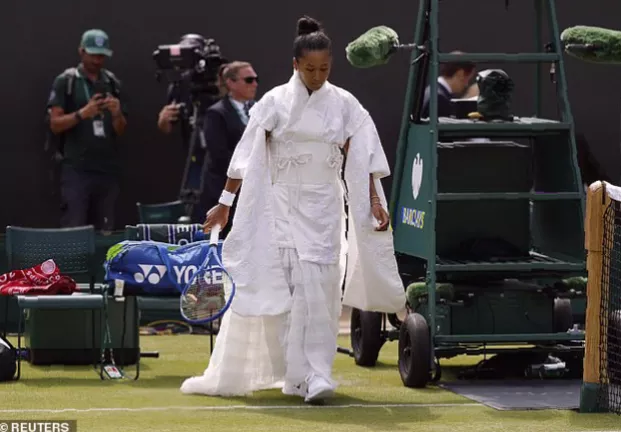
The Japanese star, 28, drew cheers from the crowd as she emerged in a layered ensemble that blended ceremonial bridal wear with the geometric precision of kirigami, the Japanese art of paper cutting. Designed by Tokyo-based Hana Yagi, the white garment was embroidered with cranes and cherry blossoms — enduring symbols of Japanese culture — and featured bell-shaped sleeves, an obi belt and a trailing tulle bow.
Yagi told Vogue that the outfit began with the concept of “Evolving Ceremony”. “The garment is constructed from vintage shiromuku (traditional Japanese bridal garments), kimono and wedding dresses – ceremonial garments originally created to mark important moments in people’s lives,” she said.
Osaka accessorised with a kanzashi hair ornament, historically worn by geisha and with origins dating back to Japan’s Jomon period, and jewellery from Mikimoto, the luxury pearl brand founded in 1893 by Kōkichi Mikimoto, who pioneered the cultured pearl industry. The entire ensemble was built in detachable layers; after shaking hands with Jacquemot, Osaka removed the outer kimono to reveal a white Nike match dress that carried matching embroidery.
An All-White Stage
Wimbledon’s all-white dress code dates back to the 1880s, when the tradition began partly to mask perspiration, considered unsightly especially for women during the Victorian era. The rule was codified in 1963 and tightened in 1993 to require “suitable tennis attire” that is almost entirely white, with trimmings no wider than one centimetre. The All England Lawn Tennis and Croquet Club’s 2014 competitor’s guide made clear that “white does not include off-white or cream” and ordered that undergarments must also be white.
Despite the restrictions, Osaka said she felt no constraint. “I actually didn’t feel limited at all,” she told Vogue. “Obviously, the outfit has to be white, but aside from that, you can play with a lot of different design elements. In some ways, not having to think about the colour allows you to highlight other cool features like fabrics and textures.”
Wimbledon’s departing chief executive Sally Bolton, who has been in the role since August 2020 and is set to step down after the 2026 Championships, said just hours before Osaka took to Court 3 that there were no concerns about the player pushing boundaries. “We’re very relaxed, so long as it meets the all-white dress code,” she said. “I haven’t been in any conversations with her about what she wears, but as any of our athletes coming onto court, they just simply need to follow the all-white dress codes. I don’t think we’ve got any concerns that that will be an issue.”
From Paris Couture to Centre Court Criticism
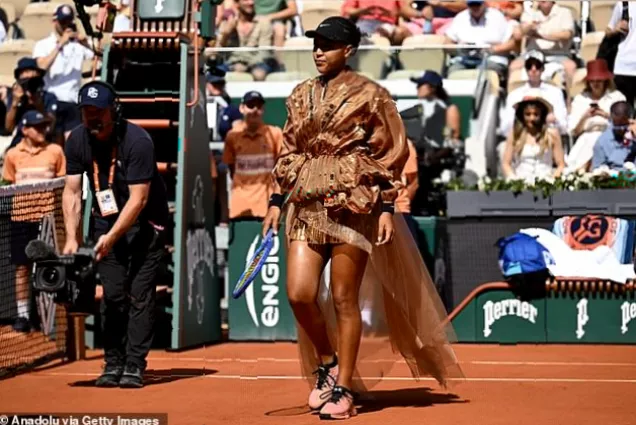
Osaka’s Wimbledon entrance came just weeks after her outfits at the French Open sparked accusations from a rival that she was prioritising fashion over tennis. At Roland Garros, Osaka wore a sparkling gold dress designed by couturier Kevin Germanier, which she said made her feel like she looked like “the Eiffel Tower at night-time when it’s sparkling”. She admitted she was so worried the dress might blind spectators that she brought back-up outfits to Paris. “When the sun hits the dress, it reflects a lot,” she said. “I was a little scared that the umpire was going to kick me off the court.”
Her first-round opponent in Paris, Laura Siegemund, was unimpressed. “I came here to play tennis, not to put on a fashion show,” Siegemund told TNT Sports. “And if others want to put on a fashion show, then they should go ahead and do it. That’s totally fine with me.”
Osaka refused to back down. She arrived for each match in upcycled jackets and skirts made from her old match outfits, worn over the gold dress. For her fourth-round defeat to Aryna Sabalenka — the first women’s match in three years scheduled for the prestigious evening slot on Court Philippe-Chatrier — she wore a matching sequinned jacket and skirt. In the earlier rounds, she had entered with ivory and coffee trains attached to the back of her outfit. The black corset and skirt she wore for her opening match, designed by Germanier using upcycled materials, was made from the inner layers of one of her jackets, with old tennis skirts and dresses cut up and reused, then covered in hundreds of hand-applied crystals.
Her opponents at Wimbledon and in Paris took a different view from Siegemund. Jacquemot, who lost 6-1 7-5, said: “I think it shows her personality. Honestly, it doesn’t bother me at all. Her outfits are beautiful, so it’s great. It’s all about the details and the little touches.” Donna Vekic, Osaka’s second-round opponent in Paris, added: “Some people take tennis way too seriously. Relax, it’s just an outfit. I think it’s good that she’s doing different things, expressing herself through fashion.”
Fashion as a Second Court
Osaka is renowned for treating Grand Slam walk-ons as a stage for self-expression. At the Australian Open in January, she arrived at Rod Laver Arena in a jellyfish-inspired outfit designed by Robert Wun in collaboration with Nike, wearing a wide-brimmed hat with a white veil and carrying a parasol, before warming up in a frilled jacket and dress that resembled tentacles. Wun’s design was partly inspired by a storybook she read to her daughter and incorporated butterfly details that referenced a viral moment from her 2021 Australian Open win.
At Indian Wells, she appeared on court with tribal-inspired jewellery over her lips, nose and ears, paired with a black mesh and cheetah-print Nike dress, trainers and jacket. The look was inspired by an iconic photo of Naomi Campbell with a cheetah, and Osaka’s creative director, Marty Harper, described the concept as “Mad Max return to the desert” with tribal undertones.
Off the court, Osaka turned heads at this year’s Met Gala — which she called “the Grand Slam for all fashion” — with a dramatic performance on the entrance steps. She wore a white coat covered in red feathers to resemble blood, then removed it to reveal a blood-red, crystal-embellished Robert Wun gown designed to look like exposed muscle, tendon and sinew. The outfit was described as representing “the shedding of the skin and human anatomy”. A subsequent after-party look featured a white lace ensemble that obscured her face.
Osaka, who earns £7.5 million a year from her Nike deal, often collaborates with Harper, Wun and Germanier. “I don’t talk a lot, so I can talk through my clothes,” she has said, embracing the philosophy that “look good, feel good”. Reflecting on her approach, she told Vogue: “Sometimes people say athletes in show business or entertainers or whatever. I feel like, for me, Grand Slam walk-ons are the only time that I possibly feel like I’m an entertainer.”