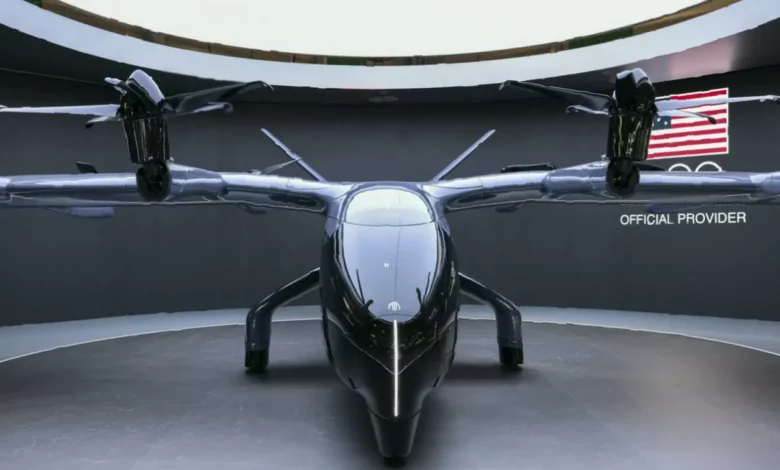
Archer Aviation is burning through cash at a rate that shows no sign of slowing, and despite bold promises about the future of urban air travel, the company has yet to produce anything approaching a profit. The electric vertical take-off and landing (eVTOL) specialist lost $618 million last year, and its board has admitted it expects to lose up to $200 million in the next quarter alone. For the first three months of 2026, the net loss came in at $217.7 million, according to the company’s latest financial report. Archer maintains that it has enough liquidity — around $1.8 billion as of early 2026 — to keep operating for now, but analysts expect steep losses to continue for several more years with no clear route to profitability in sight.
Financial losses mount with no end in sight
The scale of Archer’s cash burn is the most compelling argument against its current valuation. The company has raised more than $1.1 billion through equity investments and strategic partnerships since it was founded in 2018 by Adam Goldstein and Brett Adcock, but those funds are being consumed rapidly. Even if Archer’s revenue were to take off, the stock is still valued at roughly 30 times expected sales for 2027 — a multiple that assumes extraordinary future growth from a business that has yet to generate meaningful revenue. The company’s own guidance, disclosed by its board, points to continued heavy spending: the expected $200 million quarterly loss for the coming period is in line with the pattern of deep deficits that has characterised Archer’s trajectory since its inception.
Archer’s business model depends on manufacturing eVTOL aircraft at scale and selling them to airlines, governments and corporate clients. It has secured conditional orders from United Airlines, which is both an investor and a launch customer, and has contracts with the U.S. Air Force for logistics, pilot training and medical evacuation. A partnership with defence technology firm Anduril Industries has brought in $430 million in funding to develop a hybrid gas-and-electric VTOL aircraft for military use. These deals provide some revenue visibility, but the company is still years away from the kind of commercial operations that would turn the financial picture around. The core problem, as analysts see it, is that Archer is spending heavily on research, certification and manufacturing infrastructure while generating almost no income from its core product — the piloted eVTOL aircraft known as the “Midnight”, designed to carry a pilot and four passengers up to 100 miles at 150 miles per hour.
The company’s manufacturing facility in Covington, Georgia, is designed to produce up to 650 aircraft per year, with the potential to scale to more than 2,000 annually. That operation is backed by a manufacturing partnership with Stellantis, the automotive giant, which has contributed funding and expertise. But building the factory and developing the supply chain requires capital, and Archer’s quarterly losses reflect the upfront cost of creating an industrial base for an entirely new category of aircraft. The company has a long runway of cash, but the path from spending to profitability remains vague.
Technological and regulatory hurdles remain
Even if Archer can solve its financial equation, it must still navigate a thicket of technological and regulatory challenges. The U.S. government has tried to accelerate the regulatory process for eVTOLs, but getting the Midnight aircraft approved for use in American airspace will still take several years. Archer is working through the Federal Aviation Administration’s four-phase type certification process. It has completed Phase 3, which involved agreeing on the certification basis, means of compliance and test plans. Phase 4 — physical testing and FAA-witnessed validation — is still ahead, and some industry analysts do not expect final type certification until 2028.
Archer plans to launch its first limited commercial air taxi network in late 2025 in the United Arab Emirates, with Abu Dhabi as the primary focus. In the U.S., initial operations are expected in 2026, with the company participating in the White House’s eVTOL Integration Pilot Program across states including Florida, New York and Texas. It has also been named the designated air taxi provider for the 2028 Los Angeles Olympics. These milestones are ambitious, and they depend on the aircraft being certified and manufactured on time. The company has conducted some limited successful test flights, but rival firms such as Beta Technologies — which is focusing more on cargo and logistics — are further along in certain areas. Joby Aviation, another well-funded competitor, is also advancing rapidly in the passenger air taxi sector. Archer faces a crowded field that includes EHang, Eve Air Mobility, Lilium, Supernal, Volocopter and Wisk Aero.
Beyond certification and competition, there are broader questions about how eVTOLs will fit safely into airspace already used by planes, helicopters and drones. Archer has partnered with Starlink to integrate satellite internet for communication, and with NVIDIA to develop aviation artificial intelligence technology, but the challenge of airspace integration remains a critical concern. Public acceptance is another hurdle: passengers need to trust that these battery-powered aircraft are safe, quiet and affordable enough to replace a taxi or a short flight. The company’s target market is high-income urban commuters and travellers aged 30 to 60, particularly in congested corridors in New York, Los Angeles and Miami, but convincing a sceptical public will take time and money.
Stock performance reflects investor uncertainty
Investors have already started to sour on Archer’s story. The stock, listed on Nasdaq under the ticker ACHR, has lost almost two-thirds of its value from its 52-week peak and now trades well below its 50-day and 200-day moving averages. At the current price of $5.73, the shares are a long way from the highs reached earlier in 2026. A brief resurgence in the spring proved short-lived. Wall Street analysts remain largely positive — the consensus rating is “Moderate Buy” — and average price targets suggest significant upside potential, though some analysts have trimmed their targets recently. An insider sale of shares by an officer was reported, though the company attributed the transaction to tax obligations.
For those looking to bet against the stock, the continued cash burn and lack of a near-term profit horizon make a short position tempting. One suggested trade is to short Archer at $5.73 with £300 per $1 of exposure, covering the position if the shares rise to $8.73, which would give a total downside of £900. The valuation remains stubbornly high relative to the company’s financial reality, and while Archer has deep-pocketed partners and a plausible long-term vision, the gulf between hype and commercial reality has not narrowed as quickly as the company once hoped.