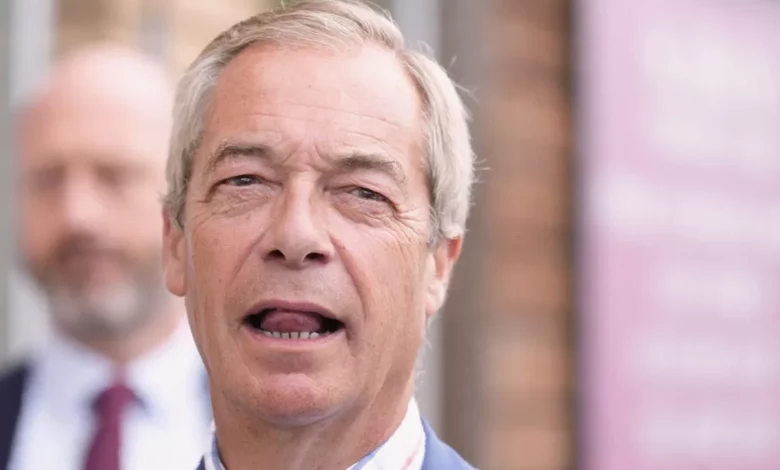
Nigel Farage has admitted he is “disappointed” after Reform UK fell well short of his own target in a key by-election, securing just under 16,000 votes against his forecast of 18,000. The party leader’s frank admission came as he directly appealed to supporters of the rival right-wing party Restore Britain to switch their allegiance, acknowledging the result was not what he had hoped for.
Disappointment in Makerfield
Speaking after the Makerfield by-election on June 18, 2026, Farage said: “As for the Reform vote share, well, I thought we would get 18,000 votes, we got just shy of 16,000 so I’m disappointed by that, no question about it.” The party’s candidate, Robert Kenyon, finished second with 15,696 votes – a 34.5 per cent share of the vote. That was more than 2,300 votes short of the leader’s personal benchmark, representing a shortfall of nearly 13 per cent on his stated expectation.
The result in the north-west constituency – historically a Labour stronghold – was a clear victory for Labour’s Andy Burnham, who secured a comfortable majority. Reform UK had hoped to build on recent momentum, including a narrow by-election win in Runcorn and Helsby in May 2025, where they prevailed by just six votes. But Makerfield proved a sterner test, and analysts have suggested that the party’s message of “pure cold rage” is being rejected in recent by-elections.
Vote count and the rise of Restore Britain
Full figures from the Makerfield contest show Labour first, Reform UK second with 15,696, and Restore Britain third with 3,111 votes (6.8 per cent). The presence of Restore Britain – a party founded by former Reform UK MP Rupert Lowe after a split with Farage – has complicated the right-wing vote. Restore Britain fielded Rebecca Shepherd as its candidate. If all 3,111 votes cast for Restore Britain had gone to Reform, Farage would have surpassed his 18,000 target, reaching 18,807. The result underscores how the fragmentation of the right can hurt Reform UK even as it continues to poll strongly nationally.
Reform UK, described as a right-wing populist and far-right party positioned to the right of the Conservatives, has seen dramatic growth since the 2024 general election, when it won five seats with a 14.3 per cent vote share – a major leap from its 2 per cent as the Brexit Party in 2019. It has since led in seat counts in the 2025 and 2026 local elections, and polling through 2025 and 2026 has placed the party neck‑and‑neck with the Conservatives, occasionally ahead. Farage, who took over as leader in June 2024, secured his first Westminster seat in Clacton at the 2024 election after eight previous attempts. The party’s support is strongest among middle‑aged and older voters, with a slight male bias, and draws heavily from those who previously voted Conservative, live outside London, and believe life in the UK is worse than it used to be. Key concerns for Reform supporters include immigration, globalisation, and Net Zero policies.
Financially, Reform UK has been buoyed by substantial donations, particularly from cryptocurrency investors. Party records show Christopher Harborne, a British‑Thai dual citizen based in Thailand, contributed over £3 million in the first quarter of 2026 alone. Ben Delo, co‑founder of the BitMEX exchange, donated £4 million in early 2026. In total, Reform UK raised £9.3 million in the first quarter, far exceeding Labour (£4 million) and the Conservatives (£4.2 million).
Farage’s plea to Restore Britain voters
Farage’s disappointment was coupled with a direct appeal to those who backed Restore Britain, the party founded by Rupert Lowe after he left Reform UK following disputes with the leadership. Lowe established Restore Britain first as a pressure group in June 2025 and then as a political party in February 2026. The party is considered to be further to the right than Reform UK, advocating mass deportations of irregular migrants and foreign nationals who cannot speak English, a referendum on reinstating the death penalty, defunding the BBC, and banning the burqa and niqab. It has been described as holding a “fairly openly ethno‑nationalist position on issues of immigration, race, and identity”. Restore Britain has also attracted attention from figures such as Elon Musk.
In his plea, Farage did not name Restore Britain directly but made clear he was speaking to those who had voted for the rival outfit. The implication was that he sees the 3,111 votes cast for Restore Britain’s candidate as a pool that Reform UK must reclaim if it is to grow beyond its current plateau. Some Reform‑minded voters in Makerfield reportedly voted tactically for Labour to prevent a Conservative win, further complicating the picture.
Farage’s admission of disappointment and his appeal to Restore Britain voters mark a notable shift in tone for a politician accustomed to defying expectations. With a general election expected within the next two years, the battle for the right‑wing vote – and the question of whether Reform UK can absorb its harder‑line rival – is set to define the party’s trajectory.