Poorna Bell has become the germaphobe she once mocked in her uncle. Thirty-five years after watching him recoil from a soda can touched by a cousin’s saliva, the award-winning journalist and author finds herself living the same script – and she is unapologetic about it.
The childhood imprint
Bell recalls the grimace on her uncle’s face when a sticky young relative drank from his can of soda in the early 1990s. “He announced that he could no longer drink it because another person’s saliva had touched it,” she writes. The family did not say the words “germaphobe weirdo” out loud, but they were all thinking it. Their shock deepened when he abandoned the old can for a fresh one, because in that era of serious wastage fizzy drinks were a treat. The prevailing parenting style was emphatically not the “don’t worry if you can’t finish that, darling” school.
The rules of engagement
Fast forward three and a half decades and Bell, now 45, realises she has become that uncle – and the aversion extends beyond drinks to food. This may surprise some people, she acknowledges, given that she is Indian and sharing food is a fundamental pillar of that culture. At home, her family serves food in giant pots, family-style, with a spoon for every dish. That kind of sharing is perfectly fine because “unspoken rules of engagement” prevent double-dipping. What is not fine, however, is when different cultures come together and someone puts a spoon that was in their mouth into the main pot, or uses it to scoop something from another person’s plate. Bell’s work as a journalist – she has been UK executive editor and global lifestyle head at HuffPost, and has written for The Times, The Guardian, Red and Stylist – has given her a platform to explore these tensions. Her recent book, She Wanted More, published in February 2026, draws on interviews with more than 1,000 women and her own experiences, including navigating grief after her husband’s death, to examine how women redefine success and power in midlife. That journey has clearly reshaped her boundaries around food.
A crème brûlée stand-off
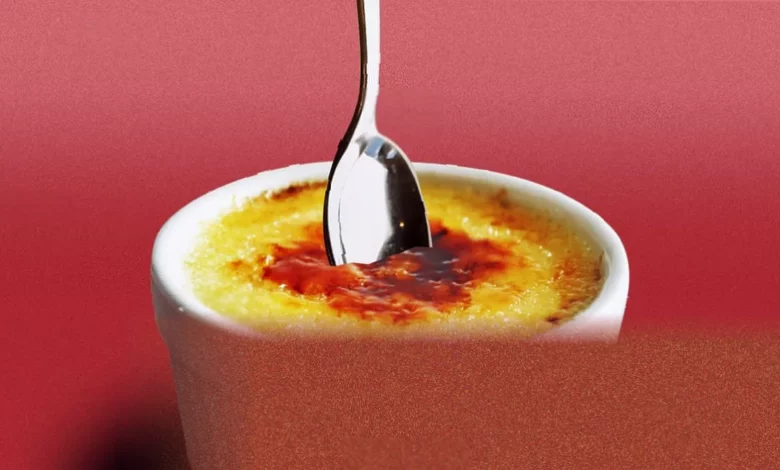
The restaurant incident that crystallises Bell’s stance took place at a chic establishment with only five items on the menu and dainty glassware. Having quit alcohol a year earlier, she had upped her desserts game, and in what she calls the “wonderfully belligerent” stage of perimenopause, ordered a crème brûlée as a starter. The waitress, in what Bell perceives as “an act of violence”, asked: “Two spoons?” despite Bell giving no indication she intended to share. She was with new friends, and so she did “the British thing” and said yes, even though she wanted to say no. When the two spoons arrived, she could not continue the farce. As her new friend held a spoon aloft, Bell told her she would have to take the first bite. “Oh, but then you won’t get to crack the top of the brûlée!” the friend said. Bell explained patiently that as a 45-year-old she would be fine not doing that. When the friend seemed about to protest again, Bell was direct: “I really don’t want to double-dip because I’m conscious about catching germs.”
The awkward silence that followed did not trouble her. “I regret nothing,” she writes. This refusal to share food or drink is a conscious choice driven by a desire to avoid illness, even if it clashes with social politeness. Research suggests that while 81 per cent of Britons share meals, comfort levels vary dramatically, with a significant portion feeling uneasy sharing with strangers or even neighbours. Historically, communal eating was widespread in Britain – in Tudor England, food was shared in “messes” with strict etiquette to prevent contamination – but industrialisation and the rise of convenience culture have eroded that tradition. The contrast with cultures such as those in Asia, where family-style meals are the norm and sharing signals community, is stark. In India, eating with the hand is common, but only the right hand is used; the left is considered unclean. Serving spoons or the back of utensils are used for communal dishes, not personal ones. In China, sharing is normal and leaving a small amount of food can signal satisfaction. In Thailand, a fork pushes food onto a spoon for eating. Bell’s own family traditions – designated spoons, unspoken rules – align with these protocols, but she argues that cross-cultural dining often breaks down those safeguards.
Pandemic radicalisation
The COVID-19 pandemic “undoubtedly radicalised” Bell’s views, she says. She noticed how many people she knew seemed to have caught the virus after sharing food off each other’s plates. She also tracked her own pattern of falling ill after sharing drinks with friends who would insist she take a sip and then ask to try hers. “These viruses often knocked me out for two weeks, and now I refuse point-blank,” she writes. “I don’t care if it has been made with the cordial of a flower that only blooms every 20 years. If it’s touched your mouth and you aren’t my lover or partner, it isn’t touching mine.”
Research confirms a measurable shift in British behaviour: before the pandemic, 50 per cent of Britons were likely to share food with a close friend when eating out; after the pandemic, that figure dropped to 41 per cent. Bell sees herself as part of that trend, but she also links her current assertiveness to perimenopause, the transitional period before menopause that typically begins in the 40s and is marked by hormonal fluctuations. Common symptoms include hot flushes, night sweats, mood swings, brain fog and weight gain, but Bell emphasises a psychological effect: a heightened willingness to say no without guilt and to honour personal boundaries without shame. Her refusal to try a friend’s braised cauliflower – met with a muttered accusation of being “precious” – was vindicated two days later when the friend messaged to say she had come down with a cold. Bell replied: “Vindication!” The friend did not respond.