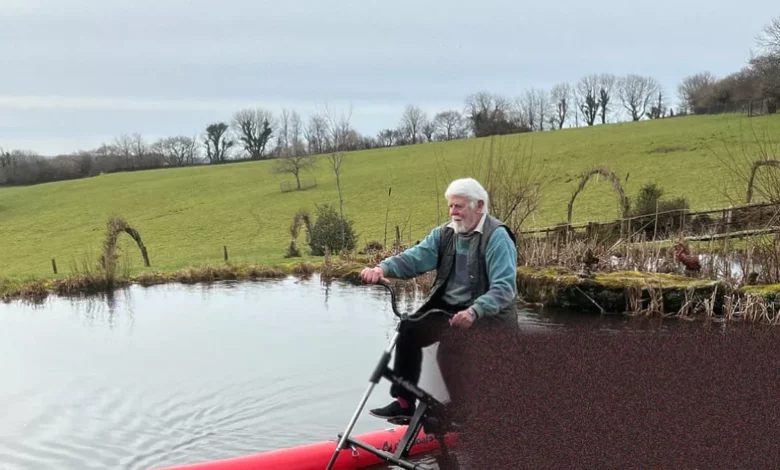
A 90-year-old rainforest campaigner with a bad knee, failing balance and malfunctioning arms and shoulders is pedalling a water-bike 104 miles down the River Thames to raise money for a research station dedicated to Britain’s critically endangered temperate rainforests.
Robin Hanbury-Tenison, who co-founded Survival International and spent decades advocating for tropical rainforests from the Amazon to Borneo, began his journey on Friday from Magdalen Bridge in Oxford. He aims to reach Teddington Lock in Richmond on Monday — International Rainforest Day — having navigated 31 locks, battled east winds and endured a heatwave.
The challenge
The four-day trip is a physical ordeal by any measure. Hanbury-Tenison, 90, has said he has “only got one working leg” and admits “things begin to hurt” but insists he will “pedal through the pain threshold”. He has been training on an exercise bike and on a pond near his home in Cornwall.
His son, Merlin Hanbury-Tenison, is riding alongside him. “As a 90-year-old he finds he has been slightly falling apart,” Merlin said. “He’s got a bad knee so he’s trying to rest that to get ready. He did a rowing challenge but found his arms and shoulders stopped working. He climbed to Cornwall’s highest point but his balance and his legs have gone, so he’s worked out he can sit on a bike and pedal. It’s like a rickety old car going down a mountain with bits falling off it.”
Merlin added: “I’m going to take a stick so I can beat him when he slows down. It’s going to be a tough one. I just hope it doesn’t finish him off.”
Several people living along the Thames have offered to let him stop for tea. “As if I have time for a cup of tea,” Hanbury-Tenison said.
He expects to cover about 25-26 miles each day. A film crew is documenting the journey, and the route requires careful timing with tides downstream of Teddington.
The man and his mission
Hanbury-Tenison is a veteran explorer and conservationist. He co-founded Survival International in 1969, which campaigns for the rights of indigenous and tribal peoples. His past expeditions include the first overland crossing of South America at its widest point and leading a major scientific expedition to Borneo.
In 2020 he spent seven weeks in hospital with COVID-19 and was given a low chance of survival. More recently, at the age of 89, he completed a rowing challenge along Cornwall’s River Tamar that raised £64,030 for the Thousand Year Trust, the charity run by his son that is now building the research station.
His focus shifted to temperate rainforest after he discovered a fragment of the habitat on his own modest hill farm on Bodmin Moor. “I’ve seen what we’ve lost,” he said. “At my age, if I’m going to do something about it, I’d better get on with it.”
The importance of Britain’s temperate rainforests
Temperate rainforests — also known as Atlantic woodlands or Celtic rainforests — once covered up to a fifth of the British Isles. Today they survive in fragmented patches that amount to less than 1% of the land area. They are a globally rare habitat, found along the UK’s western seaboard in Scotland, Wales, Devon and Cornwall, where high humidity, regular rainfall and mild temperatures allow a rich tapestry of mosses, lichens and liverworts to flourish. These forests also store significant amounts of carbon and help regulate local climates.
Yet they face severe threats from deforestation, logging, overgrazing and climate change. Some conservationists consider them more endangered than tropical rainforests. Hanbury-Tenison put the scale of loss starkly: “We’ve lost half of the Amazon in my lifetime, which is disastrous, but temperate rainforest that used to cover a fifth of Britain is now down to less than 1%.”
The Thousand Year Trust aims to triple the amount of temperate rainforest in the UK over the next 30 years. The Wildlife Trusts and the Woodland Trust are also running long-term restoration programmes. The research station now under construction is intended to become a “blueprint site” for that work.
The research station
Europe’s first dedicated temperate rainforest research station is being built on Hanbury-Tenison’s farm on Bodmin Moor. The project is led by the Thousand Year Trust and has already received backing from more than 20 university research partnerships, including the Universities of Exeter and Plymouth.
The first phase is under construction using locally sourced timber provided by the Woodland Trust. When complete, the facility will include fieldwork lodging, a laboratory and a community hub. The charity describes it as “a once-in-a-generation effort to save Britain’s rainforest”.
Hanbury-Tenison hopes to raise £100,000 from the water-bike challenge towards the cost of the station. The charity still needs several hundred thousand more to finish the work. Actor Russell Crowe has pledged to match the first £25,000 raised, taking that portion to £50,000. “What a champion Robin is,” Crowe said.
Hanbury-Tenison said: “I’m proud of being part of the movement that showed the world that tropical rainforests matter, are endangered and need to be saved. To find that the scruffy piece of land on this small farm is a last vestige of the equally rich but even more endangered temperate rainforest is extraordinary. If you want to study a rainforest, you can study at tropical rainforest research stations all over the world but there is nowhere you can study the temperate rainforest at home.”
As for the heatwave expected over the weekend, Hanbury-Tenison was unperturbed. “I prefer heat to cold and I’ll wear a good floppy hat,” he said.