Burnham sets sights on Labour leadership as pound slides towards worst week in 18 months

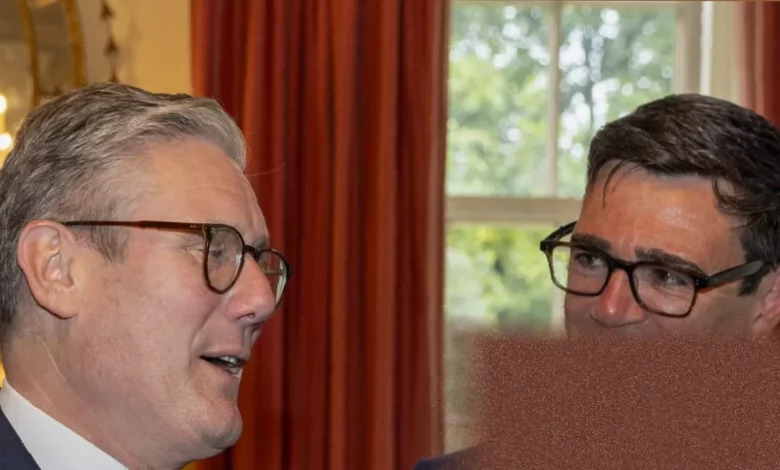
The pound is heading for its worst weekly drop in 18 months, with traders in the City betting that Keir Starmer could face a leadership challenge from the Manchester mayor, Andy Burnham, before the year is out. Sterling has fallen against the dollar every day this week, shedding about three cents — or 2.2% — to trade at $1.332 on Friday, a five-week low. That marks the largest weekly depreciation since Donald Trump’s election victory in early November 2024, according to market data.
The sell-off gathered pace on Thursday after Burnham announced he would seek to return to Westminster by contesting the north-west constituency of Makerfield in a forthcoming by-election — a move widely interpreted as the first step in a bid to unseat Starmer. “The pound is weakening this morning after a sharp drop on Thursday, when Andy Burnham threw his hat into the ring,” said Kathleen Brooks, research director at XTB. “This is a sign that Burnham is the least market-friendly of all the candidates, as Wes Streeting’s resignation did not have the same negative effect.”
The health secretary, Wes Streeting, resigned from cabinet earlier this week, citing a loss of confidence in Starmer’s leadership. Streeting is considered a more centrist figure and more closely aligned with fiscal discipline than Burnham. By contrast, Burnham is viewed with deep unease by investors, who fear his premiership could loosen the UK’s fiscal rules and unlock higher borrowing to fund greater public spending.
Why the City sees Burnham as a risk
Investors’ wariness of Burnham is rooted in his track record of scepticism toward bond markets. Traders recall that in January, Burnham said the UK was “in hock to the bond markets” and trapped in “a low-growth doom-loop”. Although he has since softened his language in interviews, analysts say the comment crystallised a perception that he is less committed to the kind of fiscal orthodoxy markets demand. Neil Wilson, an investment strategist at Saxo UK, said: “Markets would not like the idea of the Labour party anointing a left-leaning PM whose fiscal views — and his views of the bond market — were well known.” Wilson added: “Ultimately the bond market is likely to impose fiscal discipline, but it can get messy before that happens.”
The unease is compounded by Burnham’s popularity. Bill Diviney, head of macro research at ABN Amro, noted that Burnham is “by far the most popular among the general public, and in YouGov polling he is actually the only major politician in the UK with a net positive approval rating”. That public support, analysts argue, could embolden a Burnham-led government to pursue a more expansive fiscal agenda, increasing the risk of a confrontation with bondholders. Diviney predicted that uncertainty and speculation about any changes in fiscal policy are likely to fuel volatility in gilt markets, though he added that a factor that would “significantly help is if Rachel Reeves keeps her role as chancellor. This would signal continuity and a commitment to her fiscal rules that have kept markets relatively stable.” Reeves, who has served as chancellor since July 2024, is the first woman to hold the office and has pursued a “modern supply-side” approach focused on infrastructure and labour supply, drawing inspiration from Joe Biden’s economic policies.
Bond markets flash warning
The anxiety has already pushed UK government borrowing costs sharply higher. The yield on 10-year bonds jumped to 5.18% — their highest level since 2008 and above the 18-year high set on Tuesday, when pressure on Starmer was mounting after last week’s local elections. Thirty-year bond yields also rose sharply, hitting 5.85%, surpassing a 28-year high reached earlier in the week. That amounts to a rise of 20 basis points — 0.20 of a percentage point — in a single move. The sell-off in UK bonds reflected fears in the City that a Burnham premiership might tear up the fiscal guardrails that have kept borrowing costs in check, though the rise in yields was not unique to Britain: US and German government debt also sold off after a rise in the oil price fuelled inflation worries. Brent crude is trading around $100 a barrel, driven by the closure of the Strait of Hormuz amid Middle Eastern tensions — a development that Neil Wilson described as a “stagflationary” shock for the UK, a net oil importer.
The broader global backdrop is adding to the strain. Mark Dowding of RBC BlueBay Asset Management told clients that Starmer’s days in Downing Street were “numbered … and against this backdrop UK financial assets and sterling seem likely to be subjected to an elevated political risk premium for an extended period”.
Burnham’s path to a challenge remains uncertain
It would take weeks before Burnham is in a position to challenge Starmer, as he must first win the by-election in Makerfield. The sitting Labour MP, Josh Simons, is standing down to give Burnham a route back to Westminster, saying he is stepping aside to “drive the change our country is crying out for”. Burnham requires approval from Labour’s National Executive Committee (NEC) to stand as the candidate, and the NEC has granted him permission to be part of the selection process — a change from an earlier instance when it blocked his candidacy for the Gorton and Denton by-election. Makerfield is a Labour-held seat with a majority of just over 5,000 votes from the 2024 general election, but the contest is far from guaranteed. Reform UK performed strongly in the constituency’s wards during the recent local elections, and the Green Party has also stated its intention to stand, potentially splitting the anti-Conservative vote. Burnham’s appeal cuts across age and class demographics — YouGov polling puts him as the only major UK politician with a net positive approval rating — but the by-election will test whether that popularity translates into votes in a seat where Reform is on the rise.
Angela Rayner, meanwhile, has been cleared by HMRC over her tax affairs, removing a potential obstacle to her involvement in any leadership contest, and she is seen as another possible contender should Starmer fall. The Labour leader faces mounting pressure from multiple directions: poor local election results, internal party divisions, and the resignation of a senior cabinet minister. Against this backdrop the pound has fallen daily, yields have surged, and analysts say the uncertainty is unlikely to subside quickly. “The only major politician with a net positive approval rating” may be a boon to Labour at the ballot box, but for the City, his path to power is the source of the sharpest currency drop in 18 months.