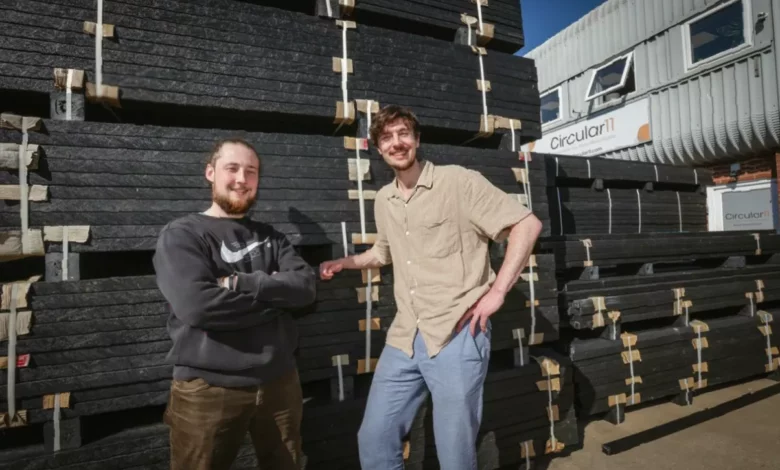
A Dorset company that has developed a technology capable of recycling low-quality plastics into durable building materials has secured £2.4m in equity funding to scale its operations.
Funding round details
The round was led by European early-stage tech investor Vectr7 Investment Partners, with The FSE Group acting as co-lead and investing £630,000 from the British Business Bank’s South West Investment Fund. Additional backing came from The FSE Investor Network, Oxford Innovation Network, and other private investors, alongside an InnovateUK grant. Circular11, based in Christchurch, will use the funding to bring its manufacturing technology to market and ramp up production, aiming to recycle an estimated 10,000 tonnes of low-quality plastic over the next two years.
Benjamin Gibbons, the company’s chief executive, said: “We believe that every tonne of plastic that gets incinerated is a missed opportunity to deliver low-carbon materials to a construction sector that desperately needs affordable and long-lasting assets. The backing of Vectr7, the South West Investment Fund, FSE and other investors is an important step; it gives us the resources to scale manufacturing, whilst continuing to develop the systems behind our materials and respond to growing pressure on industry to find better uses for plastic waste.”
Dominic Wilson, founder and managing partner at Vectr7, said Circular11 was addressing a “critical need head on” with its technology. “We are excited about the next stage of their growth,” he added. “The supply side constraints within the timber markets means the construction and manufacturing industries need sustainable alternatives.”
Matt Browning, investment manager at The FSE Group, said: “Circular11 is addressing a clear challenge in the construction and materials market. The team has developed a compelling approach to turning difficult-to-recycle plastic into useful, long-life products, and this investment will help the business scale its operations and build on early commercial traction.”
From Nepal to Christchurch
Circular11 was founded in 2020 by friends Benjamin Gibbons and Connor Winter after they took part in a waste management project in Nepal. The experience exposed them directly to the damage that burning plastic waste inflicts on communities, and they wanted to turn plastic into a “force for good”. Gibbons, an Oxford University anthropology graduate with a background in international development, and Winter launched the company with a mission to transform low-grade, difficult-to-recycle plastic waste into low-carbon building materials that could replace traditional timber.
The company began operations inside an old bread delivery van nicknamed “Hovis” before moving to larger facilities. It later received support from the British Business Bank’s Start Up Loans programme in 2024. Prior to the latest round, Circular11 had secured approximately £1.1m in public and private funding, including €578k (£500k) in 2023 to establish a full-scale recycling and manufacturing facility in Dorset and develop its machine-learning approach. In November 2022, it raised £80,000 through an advance subscription note and around £120,000 in grants. The company also received accelerator support from Connected Places Catapult, including participation in the National Highways Accelerating Low Carbon Innovation programme, which helped build team capabilities and secure early customers.
How the technology works
Circular11’s proprietary technology is designed to handle the very plastics that conventional recycling cannot process because of purity issues. The process begins by shredding mixed plastic waste and subjecting it to chemical analysis to create a detailed data profile. That profile feeds into machine-learning models that optimise the formulation of the waste into usable materials, adapting in real time to variations in the feedstock. After strength testing, the material is processed through extrusion to produce recycled plastic lumber.
The resulting lumber is used to manufacture products for fencing, furniture, landscaping and infrastructure. Applications range from planters, planter beds and picnic benches to decking sub-frame systems, scaffolding formwork and materials for national infrastructure providers such as National Highways. The company also operates an accompanying digital system that tracks the origin of each plastic stream, its carbon impact, and the volume diverted from landfill or incineration.
Circular11’s products are designed to last 30 to 50 years and can themselves be recycled multiple times. The company views incinerated plastic as “wasted feedstock” and says its materials provide a low-carbon alternative for a construction sector that accounts for nearly 40% of global emissions. Timber supply constraints, bans on traditional preservatives that shorten timber lifespans, and growing demand for sustainable alternatives have created a clear market opportunity. Gibbons does not consider the process “downcycling”, arguing that it creates valuable, long-lasting assets from what would otherwise be burned.
The company also collaborates with Brunel University London’s RIEm programme, which led to a joint research bid of £450,000 as part of a wider £2.5m multinational R&D project. That project aims to combine waste plastic with food and agriculture byproducts for advanced composite applications. Circular11’s technology is designed to be scalable and deployable globally, particularly in communities that lack adequate waste management infrastructure – a direct extension of the founders’ original experience in Nepal.