
UK inflation defied expectations in May, holding steady at 2.8% as lower food prices offset rising transport costs, the Office for National Statistics (ONS) has confirmed. The figure was unchanged from April and below the consensus forecast of economists who had predicted a rise closer to 3%, offering a modest surprise to markets and policymakers alike.
The headline Consumer Prices Index (CPI) increased by 0.2% on a monthly basis, matching the same rate recorded in May last year. The broader measure of CPI including owner occupiers’ housing costs (CPIH) also remained flat at 3.0% in the 12 months to May, while core CPI — which strips out volatile items such as energy, food, alcohol and tobacco — ticked up to 2.6% from 2.5% in April. Services inflation, a closely watched gauge of domestic price pressures, rose from an annual rate of 3.2% to 3.7%.
Transport costs drive inflation higher…
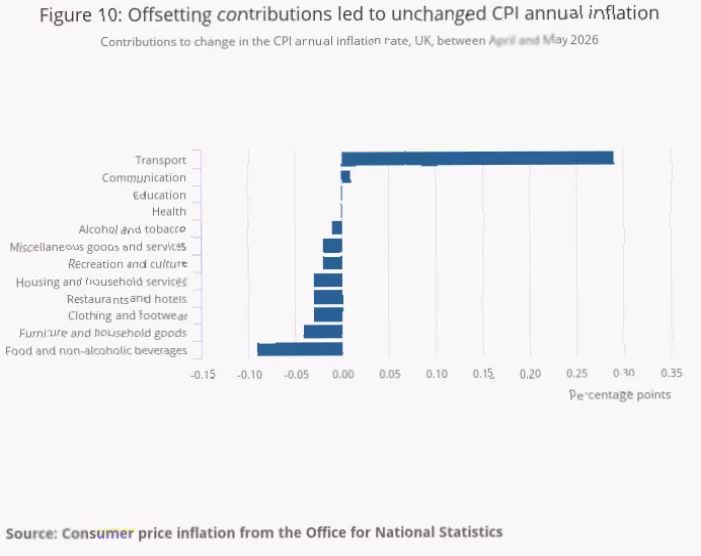
Transport had the largest upward impact on annual inflation, with prices in the category rising 6.8% over the 12 months to May and contributing 0.29 percentage points to the headline CPI figure. On a monthly basis, transport costs increased by 0.4% — a sharp reversal from the 1.8% fall recorded in April. The ONS attributed the upward pressure to higher airfares, increases in vehicle excise duty and more expensive petrol prices.
Grant Fitzner, chief economist at the ONS, said: “The main upward movement came from transport with airfares, vehicle taxes and petrol prices all pushing up inflation.” The data reflects the lingering impact of the conflict in the Middle East, which had pushed oil prices higher in the months before a framework peace deal was announced between the US and Iran earlier this week.

…while falling food prices provide relief
Offsetting the transport-driven rise was a drop in the cost of food and non-alcoholic beverages, which fell by 0.1% month-on-month. This decline lowered annualised CPI inflation by 0.09 percentage points. The ONS noted decreases in the price of a range of meat, dairy and vegetable items compared with the previous month. Falls in domestic heating oil — which had climbed in recent months — also helped to temper the headline figure.
Fitzner added: “These [increases] were offset by lower food prices, with decreases in inflation seen across a range of meat, dairy and vegetable items compared to last month, as well as the cost of domestic heating oil, which fell back after climbing in recent months.” The combination meant that, despite higher energy costs, retailers appeared hesitant to pass on the full impact to consumers. “Outside of services CPI, headline, core, and food prices all undershot our expectations,” said Sanjay Raja, chief UK economist at Deutsche Bank. “Driving some of the downside in price momentum was a combination of weaker core goods prices and food prices. Indeed, despite rising energy costs, retailers remain hesitant to price in any cost pass-through.”
Expert views on the outlook
The flat reading prompted a range of reactions from economists, with several pointing to signs that the worst of the inflationary shock from the Iran conflict may have passed. Raja noted that the peace deal had already pushed oil prices around 10% below last month’s market assumptions, adding that “this will slowly flow through the inflation data over the summer and winter”. He also highlighted a concurrent fall in gas prices, saying: “It’s looking increasingly likely that the Ofgem Price Cap could be lower as opposed to higher come October 2026, bringing some much-needed relief for UK households and businesses. Altogether, the sting from the Iran conflict looks less than markets initially assumed. The peak in CPI could end up well below what we saw last year.”
Richard Flax, chief investment officer at wealth manager Moneyfarm, described the unchanged inflation rate as “a modest positive surprise” given consensus expectations of a move towards 3%. He said the data “suggests underlying price pressures remain more finely balanced than anticipated”, adding that the easing of food price pressures points to a longer-term disinflationary trend beneath the headline impacts of higher energy prices.
Other experts struck a more cautious note. Rob Morgan, chief investment analyst at wealth manager Charles Stanley, warned that, despite the peace deal, “disruption to global energy markets and related supply chains is yet to work its way through the system”. He said households still need to “brace themselves for pricier shopping baskets and energy bills in the coming months”. However, he acknowledged that the reopening of the Strait of Hormuz “is undoubtedly good news for consumers, business owners and central banks alike” and means that “the price jolt won’t be as ferocious as it might have been”.
Scott Gardner, investment strategist at J.P. Morgan Personal Investing, saw the flat reading as providing “some hope that any rebound in UK inflation could be short-lived” following the Iran framework deal. But Luke Bartholomew, deputy chief economist at asset manager Aberdeen, warned that “despite energy prices having fallen recently, there is more inflationary pressure to come for the UK, when the Ofgem price cap moves higher next month”.
The Bank of England’s Monetary Policy Committee (MPC) is meeting this week, with its interest rate decision due on Thursday. The May inflation data will be a key input. Analysts at Pantheon Macroeconomics said they expect the MPC to keep rates on hold for now, factoring in the latest figures alongside labour market data. Chris Beauchamp, chief market analyst at IG, said falling oil prices had “arrived at a convenient moment”, allowing both the Bank of England and the Federal Reserve to “strike a more measured tone”.
Chancellor Rachel Reeves responded to the data by saying the government’s economic plan is controlling inflation. “While the war in the Middle East pushes prices up globally, we have got the right economic plan and inflation has held steady,” she said. She highlighted measures including cuts in energy bills, freezes in fuel duty and rail fares, targeted support on heating oil, reduced tariffs and an extension of the fuel duty cut to December 2026.
What does this mean for your money?
Beyond the headline figure, inflation has direct and indirect consequences for household finances. State pensioners stand to benefit from the triple lock, which increases payments by whichever is highest out of CPI inflation, average wage growth or 2.5%. Utility bills linked to the Retail Prices Index (RPI) — which is often used in contracts — also rise with inflation. The MPC’s interest rate decisions, shaped in part by inflation data, affect mortgage costs and savings returns. Higher inflation erodes the purchasing power of money over time. As MoneyWeek editor Andrew VanSickle noted, the “rule of 72” illustrates how small differences compound: at 4% inflation, money halves in value in 18 years; at 3%, it takes 24 years; at 2% — the Bank of England’s target — 36 years.
Individual inflation rates can vary depending on spending patterns. The ONS offers a personal inflation calculator for readers to work out their own rate. The broader historical context shows that UK CPI peaked at 11.1% in October 2022, fell below the Bank of England’s 2% target in September 2024, then rose steadily until the war in Iran pushed it to 3.3% in March this year — followed by the dip in April and the flat reading in May.
“After last month’s slowdown, inflation held steady in May as various price movements offset each other,” said Grant Fitzner of the ONS.