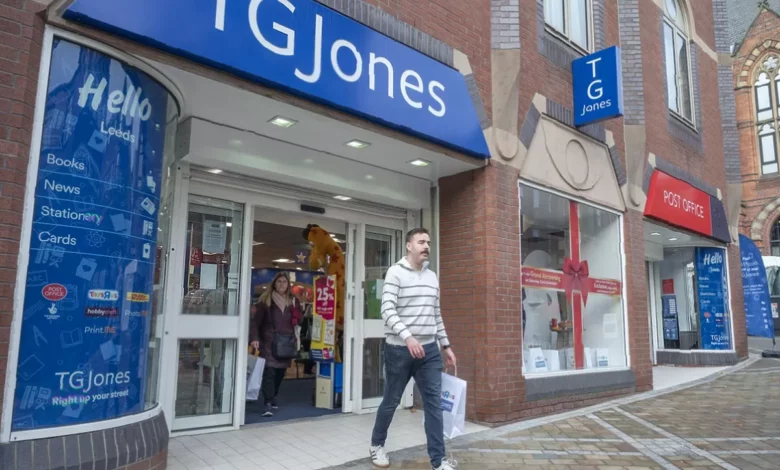
Around 150 branches of TG Jones are set to shut after a High Court judge approved a restructuring plan for the high street chain, in a move that will put hundreds of jobs at risk. The approval, granted by Mr Justice Hildyard on Wednesday, spares the business from insolvency but will reduce its store estate by roughly a quarter.
The retailer, which operates about 450 outlets and employs 4,700 people, mostly in the UK, has not disclosed exactly how many workers will be affected by the closures. Tom Smith KC, counsel for the company, told the court that the “working assumption” is about 150 stores will close, after landlords who refuse to accept lower rents choose to terminate their leases.
Alex Willson, chief executive of TG Jones, welcomed the decision, saying it “allows us to move ahead with our turnaround strategy” and “protects the substantial core of the store estate”. He added that the plan makes TG Jones “a stronger, more sustainable business”.
Financial rescue and court battle
The restructuring plan, approved under a “Part 26A” mechanism that allows courts to impose terms on dissenting creditors, injects an additional £15 million loan from owner Modella Capital, on top of £10 million loaned in April. The total financial commitment from Modella now exceeds £35 million. Without court approval, lawyers warned the company was facing an £8 million shortfall by the end of the week, with urgent payments due for tax, payroll and rent. The judge was told TG Jones was “highly distressed” and “running on fumes”.
Mr Justice Hildyard acknowledged the case was “not an easy matter”. In a written summary he described the plans as “complex” and “far-reaching in their effect”. He noted that Modella’s post-restructure valuation of TG Jones at £3 million was “difficult to swallow” compared with the £40 million reportedly paid for the business when it was acquired from WH Smith last year. Nevertheless, he said: “I propose to sanction the plans.”
The restructuring reduces rent for landlords, but not all were happy. Major landlord British Land initially opposed the plan, calling it “fundamentally unfair” and a “wholly unfair allocation of the burdens and benefits”. It withdrew its opposition after Modella made concessions, including offering landlords a larger share of future profits and deferring some rent arrears. Many landlords of less desirable stores voted against the deal, while a majority controlling the chain’s top properties supported it.
Small and “non-core” suppliers are expected to lose at least half of the money owed to them. “Exit contract” suppliers may see their debts wiped out entirely. Among those facing significant losses is the charity Help for Heroes.
From WH Smith to TG Jones: a troubled rebrand
TG Jones is the new name for the high street business that was once the backbone of WH Smith. Henry Walton Smith and his wife Anna first established WH Smith in 1792 in Mayfair as a news vendor. After their deaths, the business was taken over by their youngest son William Henry Smith in 1812 and expanded throughout the 19th century. The last member of the Smith family left the board in 1996.
Last year, WH Smith decided to split its travel stores (which operate in airports and train stations) from its high street operations, selling the latter to Modella Capital for £76 million. The acquired stores were rebranded as TG Jones, a name invented by Modella to sound similar to “WHSmith” and imply family business continuity. The colour scheme was also kept similar. But the rebranding has backfired. Tom Smith KC told the court that sales had been damaged by the name change. Modella executives have since conceded they underestimated the loss of the established WH Smith brand.
Why TG Jones was on the brink
The chain’s decline is not simply a branding problem. Lawyers for the retailer laid out a litany of pressures: “long-term sales decline” worsened by high inflation, the surge in online shopping, reduced consumer spending, and higher labour costs and taxes. But the deeper picture, disclosed in court and in subsequent remarks by CEO Alex Willson, reveals a business neglected for years.
Willson said his first impression on joining the company was the “huge scale of under-investment over many years” by the previous owner. He described stores with “missing lightbulbs, threadbare carpets with holes in, you’ve got missing ceiling tiles, you’ve got lifts and escalators that don’t work”. The chain owed £4 million to suppliers, £3.4 million in business rates, and £8.4 million to HMRC. Without the rescue deal, the company warned it could face administration by the end of July.
The financial strain reflects broader high street challenges, but TG Jones’s troubles are compounded by the ownership structure. Modella Capital is a private equity firm founded in August 2022, part of the Hay Wain Group, specialising in retail and consumer investments in the UK and Western Europe. Its portfolio includes Hobbycraft (acquired August 2024), The Original Factory Shop (acquired February 2025), Flying Tiger Copenhagen (acquired May 2026), and Dealz (acquired June 2026). It has also had interests in Paperchase, Tie Rack, Claire’s (UK and Irish business), and Ted Baker. Notably, both The Original Factory Shop and Claire’s UK and Irish businesses collapsed into administration in January 2026, resulting in significant job losses. The TG Jones rescue follows a similar pattern of aggressive restructuring under court supervision.
Sean Toal, the initial CEO of TG Jones after the sale, stepped down in March 2026. He has been succeeded by Alex Willson, formerly CEO of Hobbycraft, who has held roles at Woolworths, World Duty Free, Tie Rack, Rolling Luggage and Samsonite.
Mr Justice Hildyard, reflecting on the broader implications, said he had to “stand back, and ultimately subjectively assess, whether the plans have a realistic prospect of achieving their purpose, or whether in reality they are flawed, or more generally, whether the writing was on the wall for retail operations of this kind”. He concluded that the plans should be sanctioned, allowing TG Jones to continue trading, albeit with a much smaller store footprint and a deeply uncertain future for those landlords, suppliers and employees left to bear the cost of the rescue.